Food for thought: the contribution of refugees
Fatma Al-Baiti answers our question: How do refugees contribute to London’s food culture?
“THESE FAMILIAR FOODS ARRIVED IN THE LUGGAGE AND MEMORIES OF MIGRANTS AND REFUGEES”
Words: Fatma-Al Baiti
Borough Market, which is run by a charitable trust, exists “for community, the love of food and a better tomorrow”. This statement informs everything from our Food Policy to our work with local schools; it also sparks lots of questions about what we do and why we do it. This spring, we’re throwing some of those same questions out to experts beyond the Borough Market community.
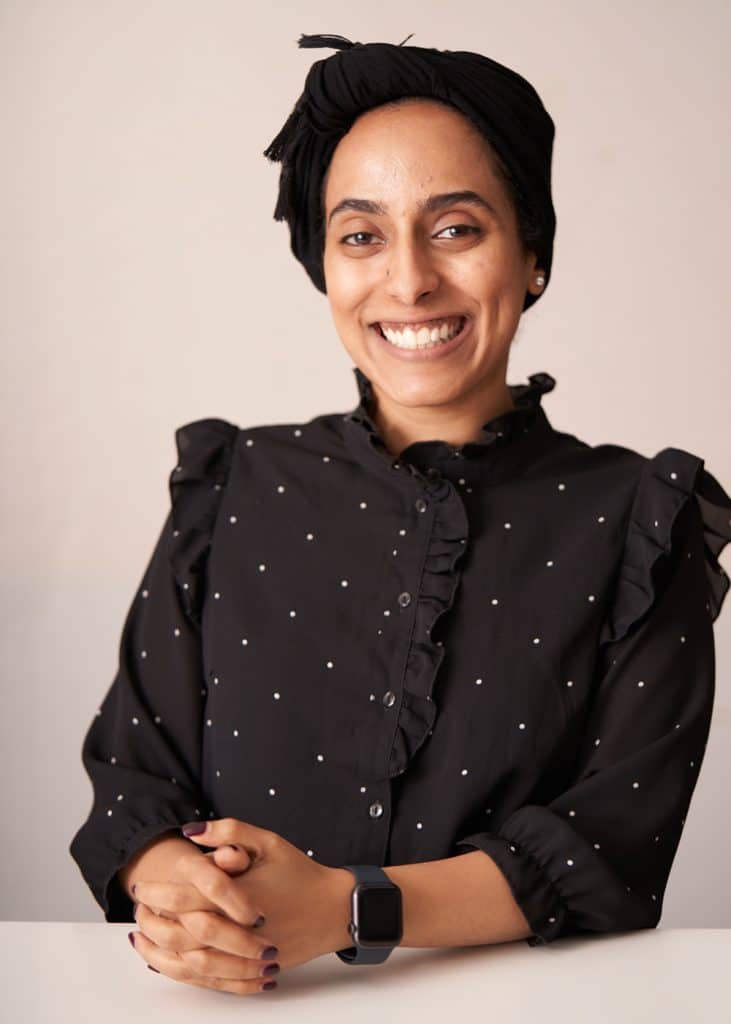
This week’s answer comes from Fatma Al-Baiti. Fatma came to London to study for a master’s degree in social entrepreneurship, before the war in Yemen made it impossible for her to return home. Alongside her job as a civil servant, she is a champion for the Entrepreneurial Refugee Network (TERN), a social enterprise that helps refugees launch their own businesses.
Question: How do refugees contribute to London’s food culture?
Fried eggs with lebneh and zhug. Cheese and kimchi sourdough toasties. Dark chocolate and sea salt tahini brownies…
I work in the city, and when I decide to treat myself to lunch, I walk down to Strutton Ground – the closest market to the office. Almost every time, I’m forced to make a series of brilliant but impossible choices. Do I queue to get one of the best Palestinian falafel wraps in London? Or do I grab a Greek gyros? I recently returned from a trip to China, and while I absolutely loved eating noodles and dumplings every day, about week in I found myself missing the sheer variety that London has to offer. It made me realise that we take this dizzying variety for granted.
When I first arrived here from Yemen in 2014, I remember being stunned at the fact that I could find packaged hummus everywhere. Today, we treat menus featuring Yemeni zhug, Korean kimchi or Levantine tahini as the default setting for a city lunch. But London didn’t become one of the world’s greatest food capitals by accident.
These foods travelled here in the suitcases and memories of migrant and refugee communities who arrived from Yemen, Korea, the Levant and every other corner of the globe. Long before fiery green chilli pastes and fermented cabbage established themselves as exciting additions to a British brunch, they offered a vital lifeline for people navigating displacement. They were introduced to the London food scene by people who used cooking as a way of preserving their identity and building a new life from scratch – and they completely reshaped our palates in the process.
This is nothing new. If you look closely at the foods we consider fundamentally ‘London’, you realise that our culinary scene has always been influenced by people who arrived on our shores in search of sanctuary or a new start. What we think of as traditional British fried fish was introduced by Spanish and Portuguese Sephardic Jewish refugees in the 17th century. South Asian immigrants adapted their spices to the British palate, and curry houses started serving chicken tikka masala – a dish so wildly successful it was officially declared a “true British national dish” by the government in 2001. Some of the country’s most familiar comforts are, at their core, the inventions of immigrants and refugees.
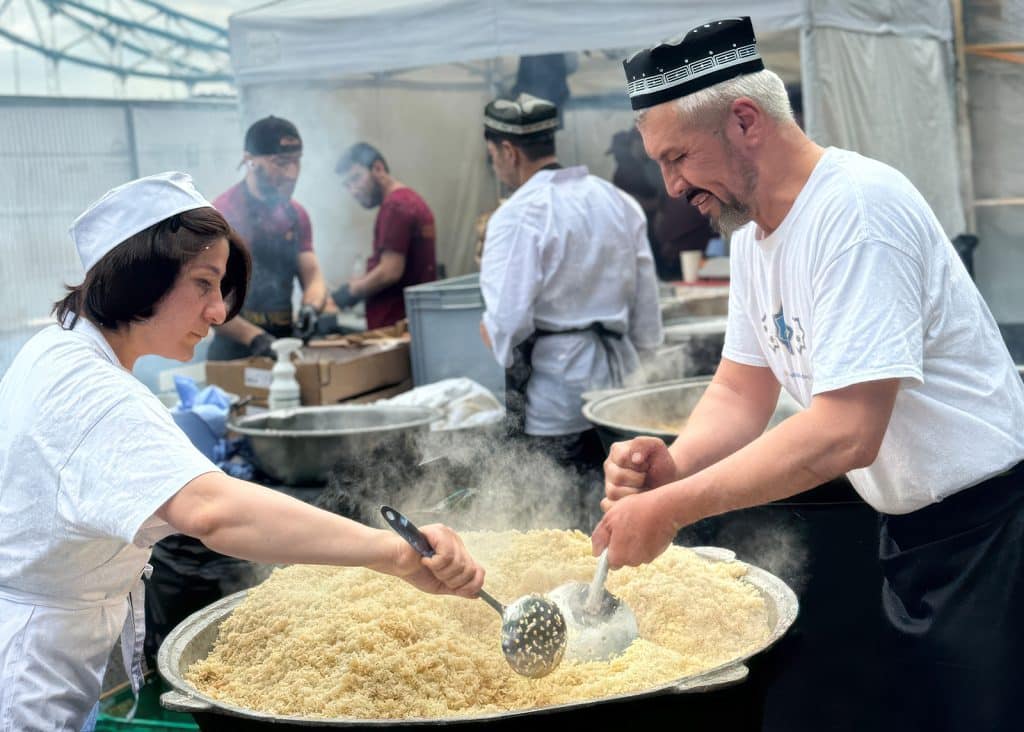
For refugees, cooking the dishes of home isn’t just about making a living, it’s about keeping an identity alive. When you leave a familiar world behind, food is often one of the few things you’re able to cling to. This rings entirely true for Sanobar and Akbar Majidova (pictured top), the couple behind Samarkand Palav. After arriving in London from Uzbekistan, they began cooking their traditional Tajik recipes for friends, whose overwhelming praise made them understand the uniqueness of their culinary heritage. Today, Sanobar and Akbar use their food to tell stories about that heritage through food markets, cooking classes and event catering.
For them, serving one of their dishes is more than a sale; it’s an opportunity to share their personal journey and educate Londoners on the rich history of Samarkand and Silk Road cuisine. “Back home, we have a deep culture and history,” says Sanobar. “We always share the food with family, friends and neighbours. We just wanted to bring that here. We’re happy to bring Samarkand to London, because Samarkand is a very ancient city like Rome, and not many people know that.”
With its relatively low barriers to entry, making and selling food offers one of the most accessible bridges to a new life for many refugees and migrants. But for Mouna Elkekhia, who arrived here in 2009, food wasn’t a default option – it was a very deliberate choice. Mouna, a Syrian, had spent years working in human rights. When I asked her about what seemed like a massive shift from secure employment in a reputable international organisation to running a food business, she told me that introducing her cuisine to Londoners was much more fulfilling and impactful. “People look at refugees as one block – that they all arrive on a dinghy, have no qualifications, no backgrounds, they just need pity and charity. But that is definitely not the case. Every single refugee is a person,” she says. “Food is something that everyone to a certain extent can get their head around – it becomes the way we retell our stories, show our skills, and prove who we really are.”
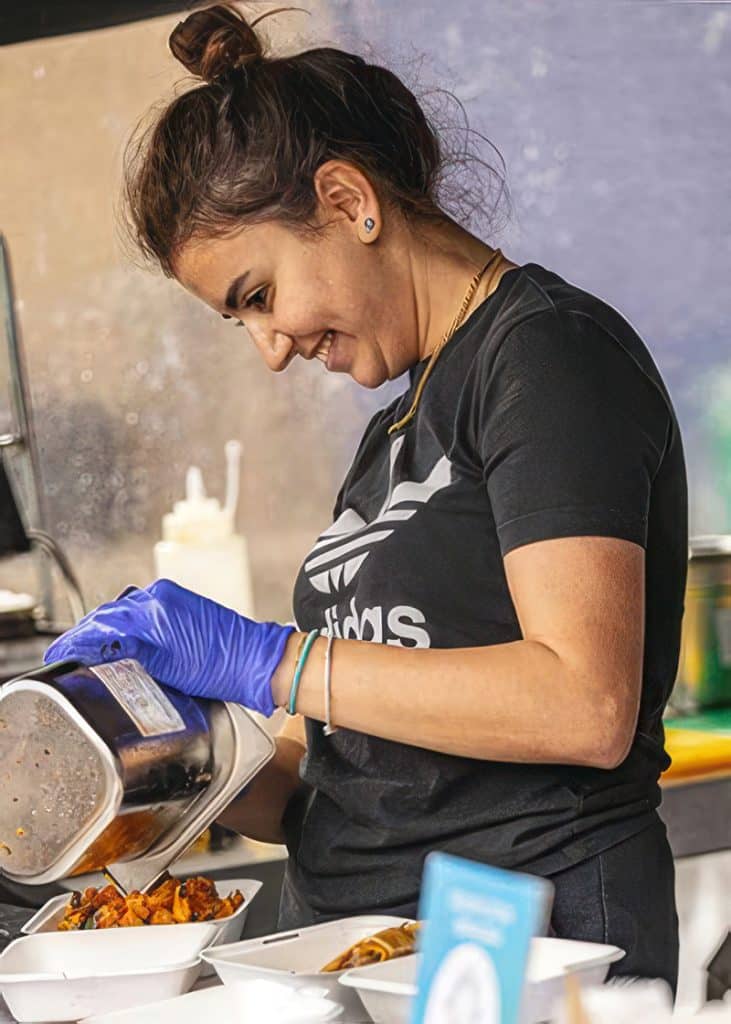
In 2018, Mouna quit her job in human rights and became a full-time food entrepreneur. Within months, she had launched Mouna’s Kitchen, an event catering service, and a thriving street-food business, Arnabeet, named after the Arabic word for cauliflower. While many aspects of Levantine cuisine have become familiar to Londoners, Mouna made a bold move with her business: she deliberately bypassed familiar dishes and instead introduced the more unusual anddistinctive flavours of her home city of Aleppo. She finds comfort in serving recipes she learned from her mother, including traditional fatteh and her signature dish, arnabeet – crispy seasoned cauliflower.
What I find particularly inspiring is Mouna’s determination to use her commercial platform to help others learn from her and build their own businesses. Among others, she mentored Hind Danoun, a fellow Syrian, spending two years sharing her hard-earned business insights. Armed with that blueprint, Hind stepped out into the London market scene herself. With the support of TERN, she was able to make a success of her street food business, Utopia, and is now proving exactly what a refugee entrepreneur is capable of achieving. “In the beginning, the language barrier felt completely overwhelming,” says Hind. “But over time, I’ve managed to turn that vulnerability into my greatest strength. Yes, I am a refugee and I’m not from this country, but I look at what I’ve built and I am proud of it.”
It is difficult to talk about these businesses without acknowledging the noisy, often hostile headlines surrounding migration today. The current climate can feel incredibly daunting for those who are trying to rebuild their lives from scratch. Yet, walking through a crowded London market offers a completely different story – one where migration isn’t an abstract debate, but a tangible, enriching reality that brings flavour and economic energy to our communities.
This is precisely why Borough Market and other food markets matter so deeply; they are the physical crossroads where traditions from across the world meet Londoners’ appetites. Every time we buy a falafel wrap or a bowl of palov from a refugee-led business, we aren’t just eating well, we are participating in the ongoing story of London’s resilience and adaptability. The city’s food scene is a book of human journeys, and it is infinitely richer for it.