Territorial army
Bronwen Percival of Neal’s Yard Dairy on why British territorial cheeses warrant a prominent place on your Christmas cheeseboard
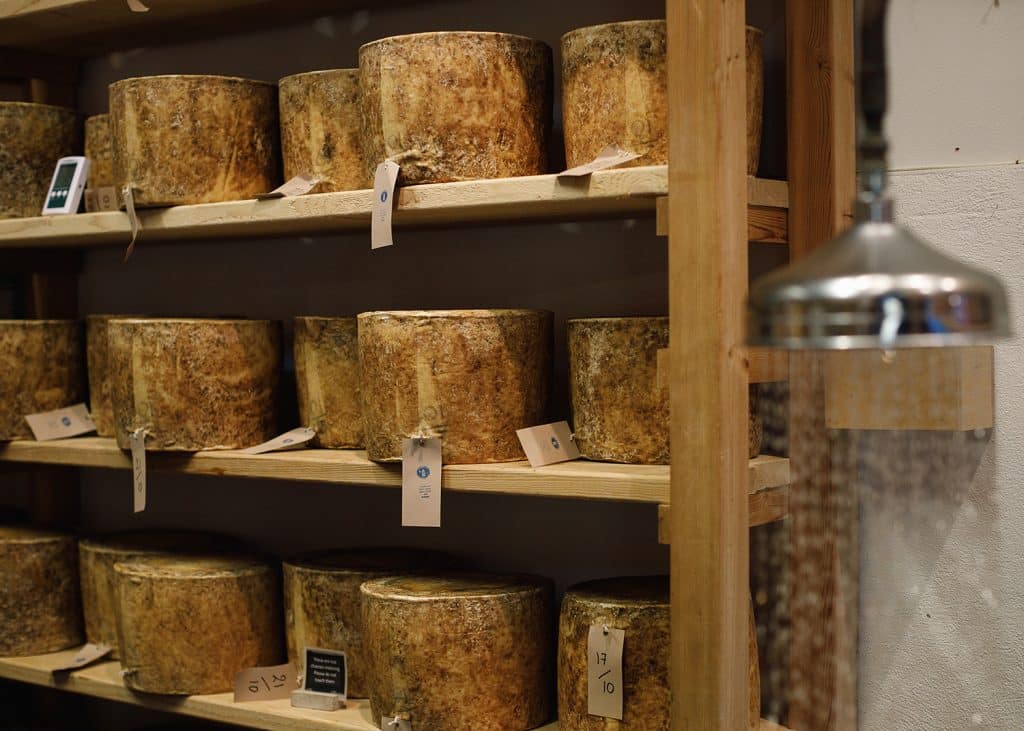
“THESE CHEESE ARE A UNIQUE SET OF ANSWERS TO THE CHALLENGES POSED BY OUR CLIMATE AND SOCIAL STRUCTURES”
Interview: Mark Riddaway
Eat them or lose them. That’s the stark message of a campaign by Neal’s Yard Dairy to raise awareness of ‘British territorials’, a loose family of cow’s milk cheeses that tend to take their name from a specific county or locality: Cheshire, Lancashire, Wensleydale, Caerphilly and many more.
These cheeses share more than just a naming convention. “You might look at stilton and Lancashire and think they have absolutely nothing to do with one another, but if you really dial into how they’re made, you’ll see there are so many similarities,” says Bronwen Percival, technical director of Neal’s Yard Dairy. Their form, she explains, is fundamentally British, “a unique set of answers to the challenges posed by our climate and social structures”.
They share history. They share form. They also share a worrying vulnerability. Many of these territorial cheeses, which have been a cornerstone of our culinary culture for centuries on end, are either extinct or on the verge of extinction. A quick glance into the fridges of a supermarket might lead you to infer that some are thriving, but they live on in name only – an industrially produced Cheshire cheese, for example, has almost nothing in common with the traditional farmhouse version, of which only a single producer has survived.
With the dairy industry’s most important month of the year upon us, Bronwen sat down to explain what makes these cheeses unique and why they warrant a prominent place on our Christmas cheeseboards.
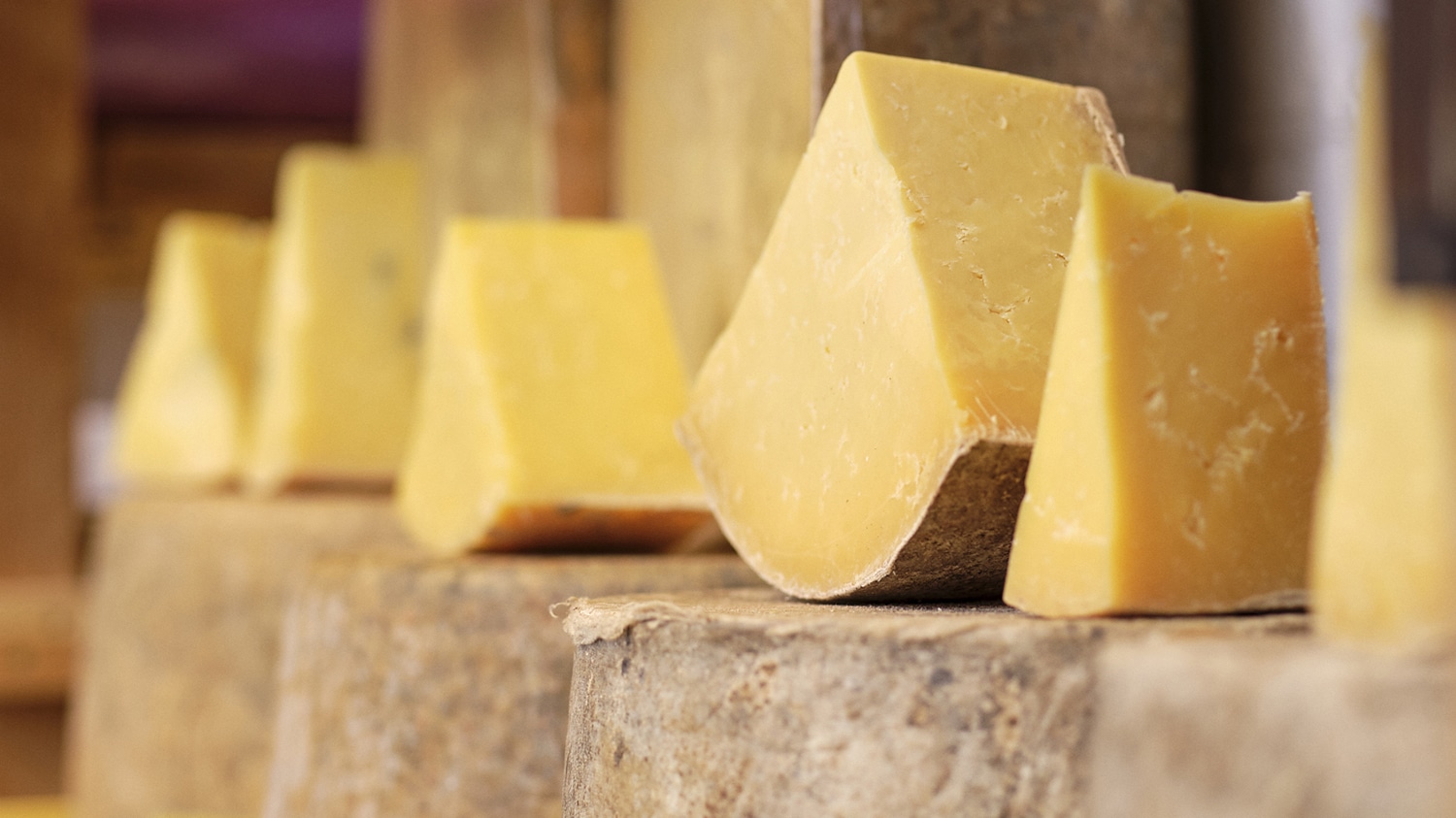
What is it these cheeses have in common, and what makes them uniquely British?
One of the key things about Britain is that it’s cold and grey and it rains a lot. Historically, that made it really difficult for farmers to make excellent hay. There are these spores called Clostridium tyrobutyricum that thrive in damp hay. When that gets into cheese, particularly the kind of low acid, cooked, pressed cheeses we associate with alpine production, it starts to develop this putrid gas. It’s basically the taste of vomit. In some old books, they call these “heaving cheeses”. Over the course of hundreds of years, British cheesemakers realised that the slower the make, the more acidity developed, the lower the chances that their cheeses would go bad as they matured. All of these cheeses are made with a long, slow acidification, a method which is almost completely unique to Britain.
So, if they’re all made in a broadly similar way, what is it that creates such clear regional differences?
A lot of it’s to do with how the drainage of the curd and the acidity development align with one another, and the timings involved. But those differences weren’t always so clearly defined. When you look back far enough, the way cheese was made in Cheshire, from farm to farm, would have seen lots of very different permutations. The sense that we know what Cheshire looks like and what Lancashire looks like is the culmination of a Victorian impulse to standardise things. There’s also a bottlenecking effect that happens when you go from having thousands of small farmhouse cheesemakers to just a handful. Appleby’s is the only raw-milk farmhouse Cheshire left, so that is now the absolute definition of traditional Cheshire, but the sheer variety of Cheshire cheese 150 years ago would have blown our minds.
Wasn’t Cheshire once Britain’s most widely eaten cheese?
It was – even more so than cheddar. Cheshire was the cheese that first escaped its county, shipped around on canal boats. Everyone ate Cheshire, and cheddar barely registered by comparison. Now the tables have turned. Cheshire is like the panda, an endangered species.
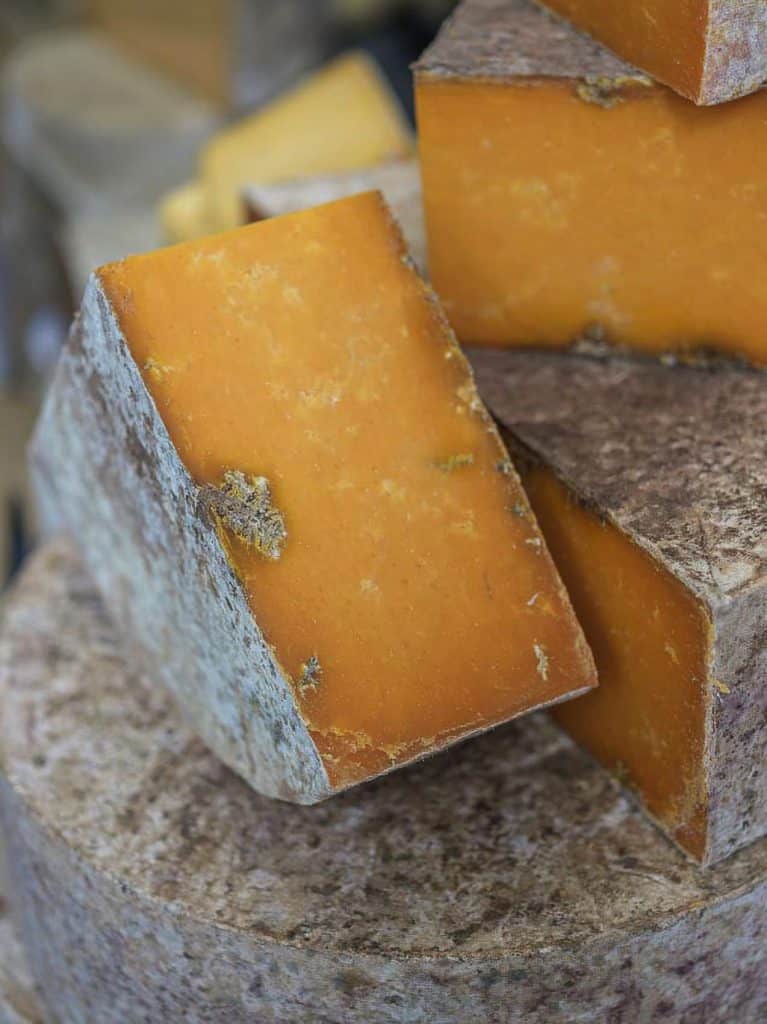
So why is it that these cheeses at risk?
The problem is that many of the best British cheesemakers want to make European-style cheeses. We’ve got Baron Bigod, we’ve got St Jude, we’ve got all these beautiful, wrinkly-rind cheeses, but the old territorials simply don’t have the same cachet anymore. When a cheesemaker comes to us and asks, “What should I be making?” I want to say, “You should be making a Dales-style cheese, because you’re in the Yorkshire Dales; you should be making something that’s rooted in the place where your farm is located.” But it’s very hard to say that when you look over our sales sheets year on year and see that territorials are holding flat at best while all these other continental styles have tremendous energy behind them.
How much does that loss of cachet come from the fact that I can walk into any supermarket and pick up something cheap and plasticky that bears the name Lancashire or Red Leicester?
One hundred per cent. About five years ago, when the Hattan family started making Stonebeck Wensleydale on their remote farm in the Yorkshire Dales, they initially didn’t want to call it Wensleydale, because they felt the name had been so devalued by the factory version. Industrialisation has completely changed the face of these cheeses. Instead of maintaining the traditions of cloth binding and a slow make, the emphasis is on speed and consistency – adding more starter cultures, flattening out the flavour, removing the rinds. Who wants to deal with a rind when you could have a completely perfect vac-packed cube that won’t lose weight and can be matured in a fridge for six months? As a result, when people go into a shop and buy a packet of something called Wensleydale or Lancashire the experience they’re having is a far cry from what those cheeses traditionally tasted like.
It’s not all doom and gloom, though, is it? Red Leicester in its traditional form was essentially extinct, but then two young cheesemakers, David and Jo Clarke, saw an opportunity to rescue it from the dustbin of history by creating Sparkenhoe, which is amazing.
Yes, that provides some hope. I think their success has been a testament to the fact that the world is interested in these kinds of cheeses, as long as you make them with integrity and communicate clearly. Our challenge is to create the demand so that more cheesemakers are inspired to do something similar – our dream is to have 10 Red Leicesters to choose from. We also need to help keep the existing cheeses going. The moments of extreme peril are those intergenerational transfers, when older cheesemakers retire. The business needs to be secure enough to attract the kids that could otherwise do something different with their lives and enjoy weekends and holidays where they’re not milking cows and making cheese.
Is there something about the winter months – and the Christmas period in particular – that makes these territorials particularly appealing at this time of year?
Yes! These are cosy, warm, snacking-by-the-fire cheeses. There’s something very wholesome and comforting about them that fits perfectly. They also make sense in terms of the entire farming system. Lots of people want their Christmas cheeseboard to have one of everything, but having a soft, young goat’s cheese is as unseasonal as it gets. The animals’ natural cycles are about producing milk in the summertime, and it’s hard work to get them to milk in winter. A lot of these territorial cheeses are made in the summer when milk is plentiful, then they’re perfectly ready to eat at Christmas.
Also, at a time of year when fridge space is at a premium, is there something to be said for the fact that these cheeses can live quite happily without refrigeration?
They’re so much better when you don’t put them in the fridge! If they’re served cold it kills the entire experience – all that subtlety and complexity disappears. If you have to choose one item to leave out that’s going to be perfectly safe at a cool room temperature and will actually improve as a result, this is it.