Crunch time
Angela Clutton on how the arrival each spring of sharp, crunchy radishes coincides perfectly with her sun-induced desire for laid-back cooking and eating
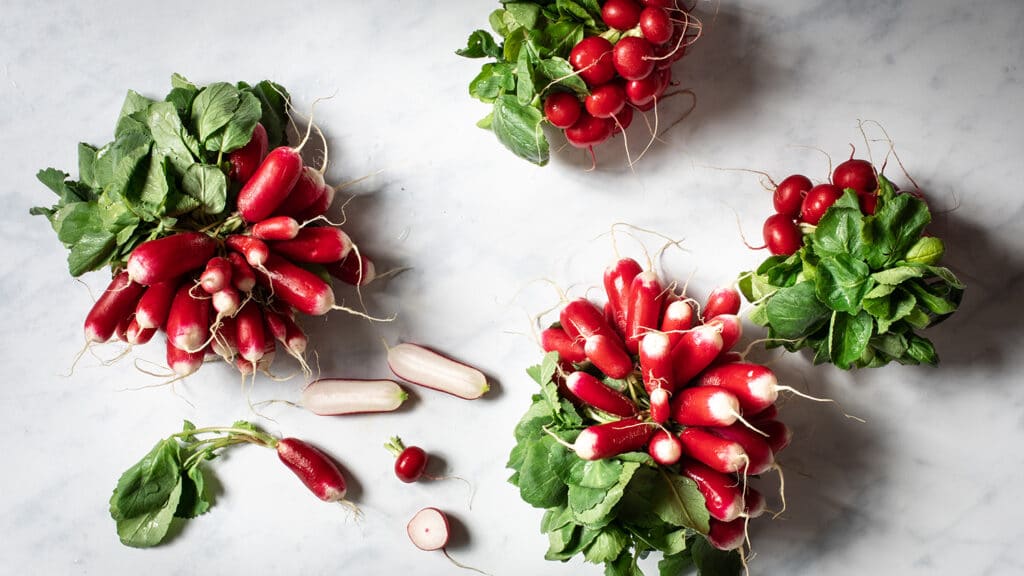
“FRESHNESS IS KEY. RADISHES NEED TO BE BOUGHT – AND EATEN – WHEN SMOOTH AND FIRM, WITH UNBLEMISHED, BRIGHT SKIN”
Image: Regula Ysewijn
Picture the scene, if you will, of an early Saturday evening in April or May. My husband is fixing us a cocktail and I’m preparing a little bit of something to go with it. I’m happy because it’s spring, meaning that all I need do is put out a plate of bright radishes and some salt flakes to dip them into. Simple as that: we will have crunchy, refreshingly sharp bites of deliciousness to accompany our drinks.
Those radishes – the small, peppy little buttons of heat in gemstone colourways that appear in April and last right through the summer months – may include the scarlet globe or cherry belle (both of which look rather like little cherry tomatoes), or the longer french breakfast radish, which runs from white to blushing pink along its length and is my go-to as a cocktail partner.
The perfection of the radish season is in its timing: radishes abound exactly when the warmer, longer days demand laid-back cooking and eating. In her 1960s opus Summer Cooking, Elizabeth David extols the simple pleasures of a dish of long red radishes served with olives, tomatoes, hard-boiled eggs, salt and pepper, olive oil, bread and butter. “Not very original, perhaps,” she writes, “but how often does one meet with a really fresh and unmessed with hors d’oeuvre?” It’s a good question – and I am happy to say the answer is, round at mine, most Saturday nights.
Freshness is key. Radishes need to be bought – and eaten – when smooth and firm, with unblemished, bright skin. That’s when they’ll be at their crunchiest and tastiest. It’s worth remembering, though, that radishes are still revivable if you’ve kept them in a fridge a little too long and they’ve begun to resemble your wrinkled fingers after a lengthy soak in the bath. Older radishes can be crisped-up by sitting them in a bowl of iced water for a few hours. The water seeps into their flesh, rehydrating it. Similarly, you can make retro radish water-lilies by scoring four slits down the length of the radish without cutting through the base; after a few hours in iced water they will have opened up into kitschy-cool flowers.
If vegetable art somehow isn’t your thing, instead slice the radishes thinly into salads with a simple dressing of olive oil, lemon juice and mint or dill to bring out the flavours. There’s an Alice Waters recipe for a radish, fennel and dandelion salad, which couldn’t be any more seasonal if it tried, and I have fond memories of making Claudia Roden’s vibrant radish and orange salad from her iconic A Book of Middle Eastern Food for a summer party for the Borough Market Cookbook Club.
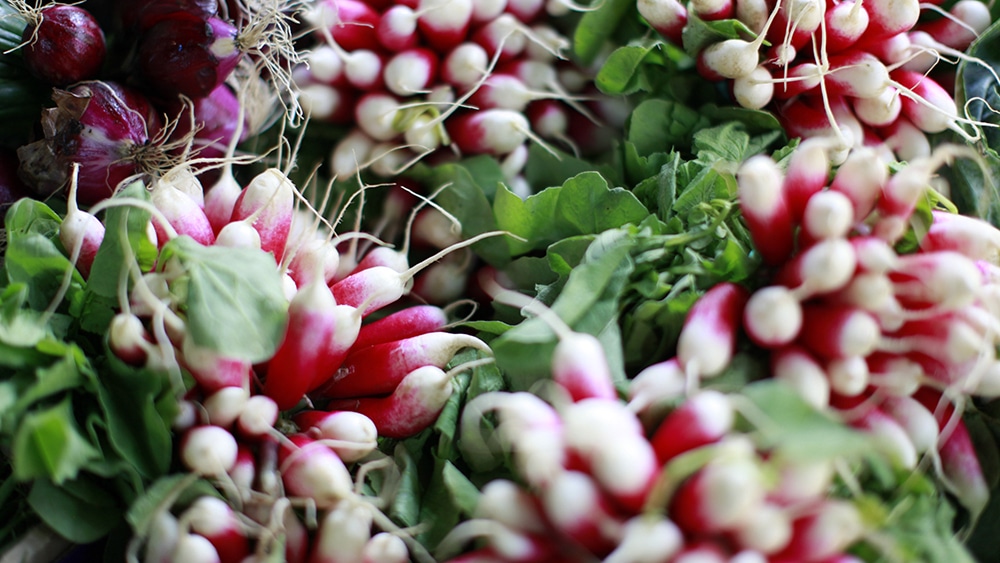
Spring and summer radishes also work marvellously as a quick pickle. The same principal by which water is easily absorbed into the flesh is just as true if the steeping liquid is a mild vinegar. Slice the radishes thinly, sit them in the vinegar with some herbs and spices and a little sugar and in barely an hour you’ll have punchily pickled radish, fabulous on a Scandi-style open sandwich, layered up on rye bread with smoked salmon and chives or parsley. A side benefit to doing this is that the ensuing pickling liquid can be watered down into a prettily pink drink.
Larger, milder watermelon radishes are my favourites for quick-pickling. With their green-tinged white skin and vivid pink flesh, they’re apparently being hailed as the latest hot Instagrammable ingredient. Food futurists (yes, that is a job) are tipping the watermelon radish as the “next avocado”. Maybe so. Maybe this spring and summer we will all be endlessly posting pics of pickled, stir-fried or sliced raw watermelon radishes. I hope so, if only because it means that more of you will be enjoying this heirloom member of the daikon radish family, which is already hugely popular in China, where it originates from.
The Chinese have long prized radishes for their medicinal qualities. They’d ferment them in pots for a long time – sometimes as much as 40 years – before using them to treat a range of medical problems, from fever, to intestinal infections, to ulcers. The ancient Greeks and Romans also valued radishes as a medicine, although admittedly in slightly less conventional (to our eyes) ways: as an antidote to poison, to alleviate the pains of childbirth, or – mashed with honey and dried sheep’s blood – in a concoction used to cure baldness. I feel on surer ground with the ancient Roman poet Horace who wrote that radishes “excite the languid stomach” – my pre-dinner Saturday night radishes essentially fulfil the same role.
Western medicine has historically had a rather more wary take on radishes for health. Nicholas Culpepper, the 17th century apothecary, wrote rather despairingly of those who “in wantonness eat garden radishes as salad and then regret it”. I have to say I have never felt especially wanton when eating radishes. Nor regretted it. But the raised eyebrows with which I read that pale next to the recommendation of a 10th century collection of remedies that recommends men eat radishes at night to protect against “women’s chatter”.
Let’s breeze on past that truly bizarre claim and go back to Culpepper, and the distinction he makes of ‘garden’ radishes. By that he means the small, peppery spring and summer radishes that I have been writing about thus far, which are – as these things go – a relative newcomer to Britain. Before that, our native radishes were larger, rather more turnip-like varieties.
You can still find some of these varieties, such as the china rose with its rose-coloured skin and strong taste, or the black spanish round, whose white flesh is a glorious contrast to the dark skin. (How I love the naming of radishes – each so evocative of how it looks.) They can be boiled into soups, thinly sliced for eating raw, quick-pickled, or grated like horseradish, which is part of the same family. Spring is a great time for horseradish, too – try giving an extra something to a chicken or fish salad by adding mayonnaise that has a tablespoon of grated horseradish and some chopped herbs stirred into it. If you are lucky enough to get horseradish root with its green tops still attached, do not throw those away. They are delicious when cooked, as you might kale, or enjoyed raw like rocket. Likewise, the tops of the smaller radishes. Even the flowers can be delicious, especially if chopped and mixed through butter. Like that, they epitomise why it is that I look forward so much to the arrival of radishes – for the elegant simplicity with which they meld themselves to exactly the things I will want to eat all spring and summer long.
Discover more
Women of Borough Market: Thea
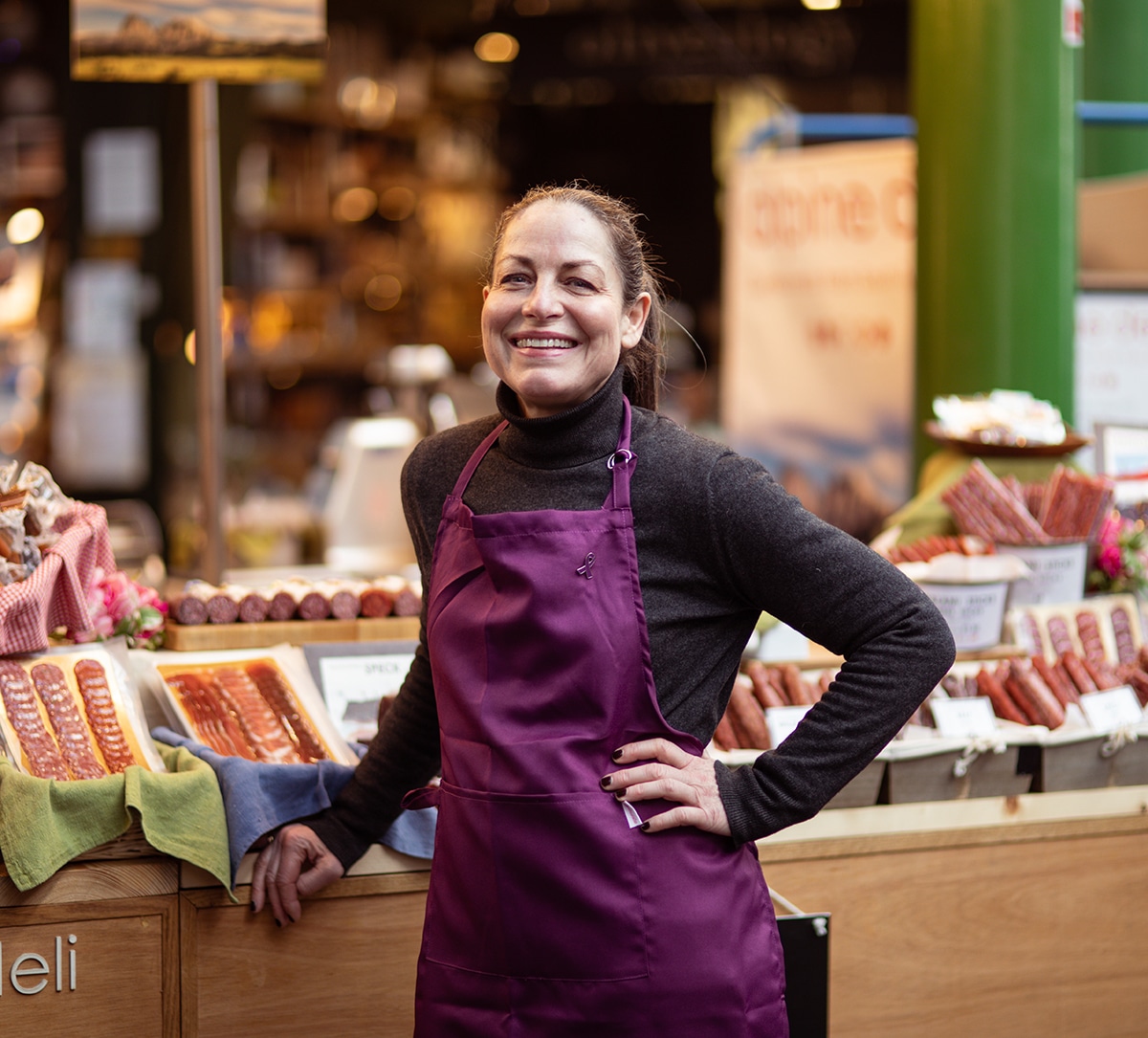
To mark International Women’s Day, some of Borough Market’s female traders, staff and trustees share their experiences as women in the food industry. Today, Thea Wunderer of Alpine Deli on market trading, female charcuterie lovers and the changing face of butchery
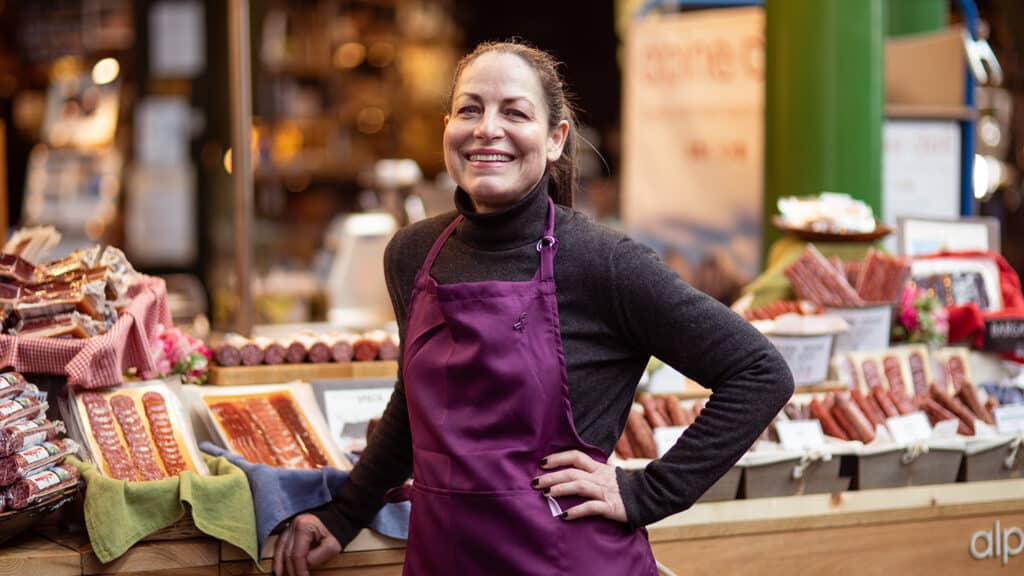
“I THINK THIS IDEA THAT CURED MEAT IS A MASCULINE FOOD IS A PERCEPTION THAT ISN’T TRUE ANYMORE”
Interview: Clare Finney
I had always thought of charcuterie as being something that men were more likely to be drawn towards, but I’m not so sure that’s the case these days. I think this idea that cured meat is a masculine food is a perception that isn’t true anymore. At Alpine Deli, there are so many female customers who love cured meat and buy it for themselves, not for their husbands or boyfriends – and I love to see that.
In fact, I think the gender balance of my customers at Borough Market is pretty even. That is also completely normal in Spain and France – and Italy, where I come from. I grew up with cured meat products. The hams, salamis and sausages I sell are all from my hometown in South Tyrol, in the far north of Italy. My dad was a farmer and had a restaurant in the village, so I’ve always been close to the food industry. One thing led to another, and in time I ended up bringing produce from back home to sell here in London.
My customers are very mixed, but the making of charcuterie does remain male-dominated. That is slowly changing, though. I find there are more and more female butchers. Just look at Wyndham House Poultry in the Market, which is mostly female, and at Ginger Pig – there are female butchers there, too. There is no reason why that shouldn’t be the case. Meat can be interesting to anyone; it is life, after all.
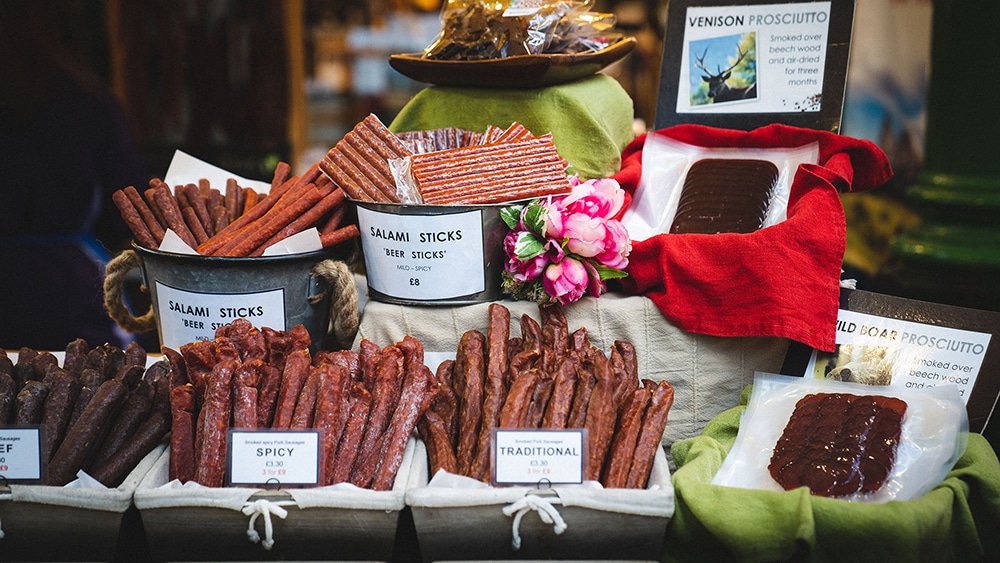
As for the world of being a market trader, I don’t think that’s a particularly male or female thing. There are loads of women working at Borough Market now, selling brilliant produce. I certainly wouldn’t say I’ve faced more challenges on account of being female. The job itself is tough, regardless of who you are and what you’re selling. You have to be quick and resilient to deal with different people and different situations. If something breaks, you have to know how to fix it, or find a solution to quickly replace it. It’s physically tough, setting up the stall and being on your feet all day. And let’s not forget the weather conditions: the cold, the wind and the rain.
I’ve been at Borough Market for 13 years now, and every year I’ve found myself with more customers and more regulars. Maybe it’s a me thing, maybe it’s a woman thing, I don’t know, but I see this as me doing something I’m passionate about, and I think that’s the reason I’ve been successful. I’ve put everything into it and I’m always here, so I’m a familiar face. That said, I’ve been very lucky in having a lot of support. I would not have been able to do this on my own, without the people around me. I was a girl from the Italian mountains, coming to a big city in a different country. Step by step, with plenty of encouragement, I’ve achieved something I’m proud of.


Women of Borough Market: Dawn
To mark International Women’s Day, some of Borough Market’s female traders, staff and trustees share their experiences as women in the food industry. Today, Dawn Smith of Pimento Hill on Jamaican women, ageism and marmalade
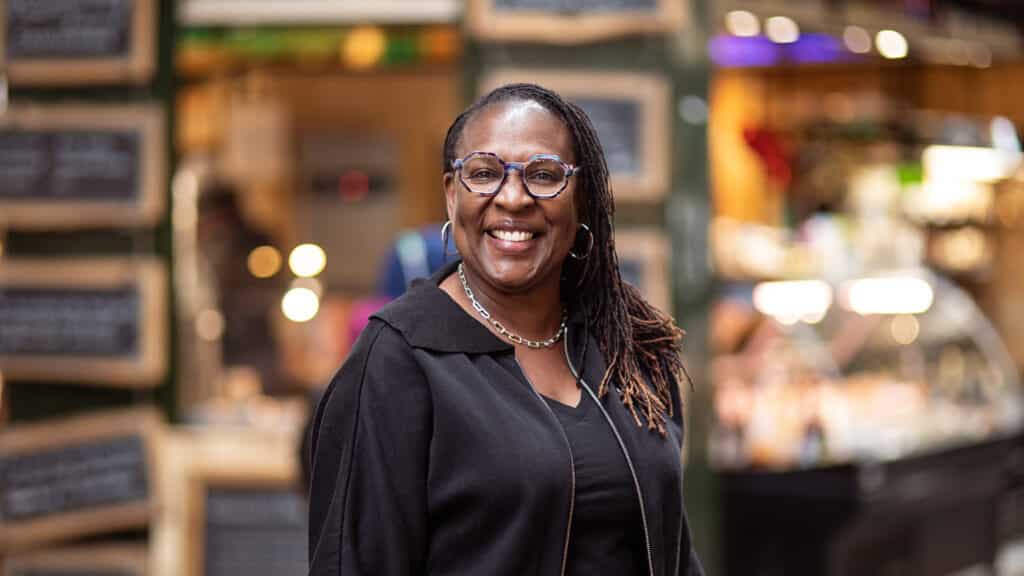
“WOMEN AND GIRLS ARE WORKING MORE AND DOING MORE. THEY RECOGNISE IT’S THEIR TIME. IT’S OUR TIME.”
Interview: Ellie Costigan
I’ve always been a foodie. I don’t know any Caribbean woman who isn’t – we do love our food! The inspiration for my company, Pimento Hill, was born out of that. I wanted to be independent, do something that gave me pleasure and stretched me a bit – and I haven’t been disappointed. I’m proud to say I’ve been at Borough Market for more than 12 years now, and I feel I’ve made my mark.
The food I produce is the food I grew up eating in Jamaica. I never thought I’d end up making it; I always saw myself more as the end user! I started making jerk seasoning because I thought I could do it better than what was available in the shops. The rest is just based on what I like. One of my favourite products is my marmalade. I’m a marmalade girl. I was raised on it. Before my mum passed away, there was a lady at the church she went to who would always make a pot of marmalade for her to take home for me.
In Jamaica, women don’t normally play a huge role in commercial food production. Back in the day, women took care of the kids and the household, and the men went out and worked. However, over the years mechanical and tech developments have meant farming has become a whole lot easier, physically, so women are now taking on that role. Young women are going off to agricultural school and learning not just how to grow food but understanding the economics behind the food industry. It’s a coming of age for us. This generation of women and girls are working more and doing more. They recognise it’s their time. It’s our time.
That’s not to say there aren’t still inequalities in the food industry, both in Jamaica and in the UK. Ageism is a problem: there’s a big focus on young people, yet there are so many older women out there who would love to start their own businesses. We’re losing out on all that experience. These women need more support.
There are lots of women working here at the Market, but there are still fewer female traders than male – and there are not a lot of black women. Having an awareness of that makes you operate differently. It’s a lot of pressure. I’d like to see that change, and I hope it will. Hopefully, I’m inspiring other black women to do the same as me and start their own businesses.
Women of Borough Market: Marianna
To mark International Women’s Day, Marianna Kolokotroni of Oliveology talks Greek food, female farmers and motherhood
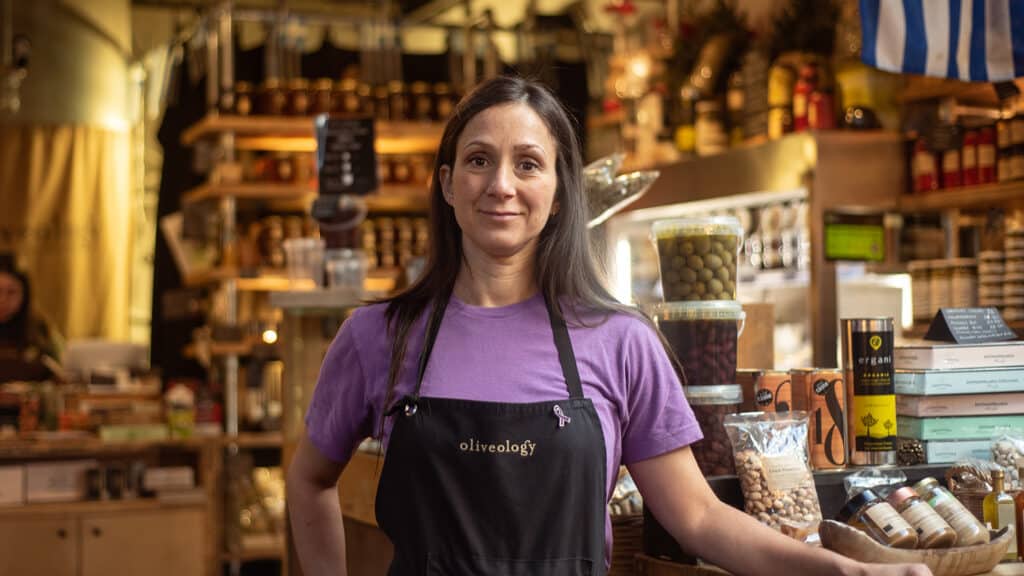
“LOTS OF MY WHOLESALE CUSTOMERS ARE FEMALE-LED OR FEMALE-OWNED BUSINESSES. THERE’S A LOT OF LOYALTY THERE.”
Interview: Ellie Costigan
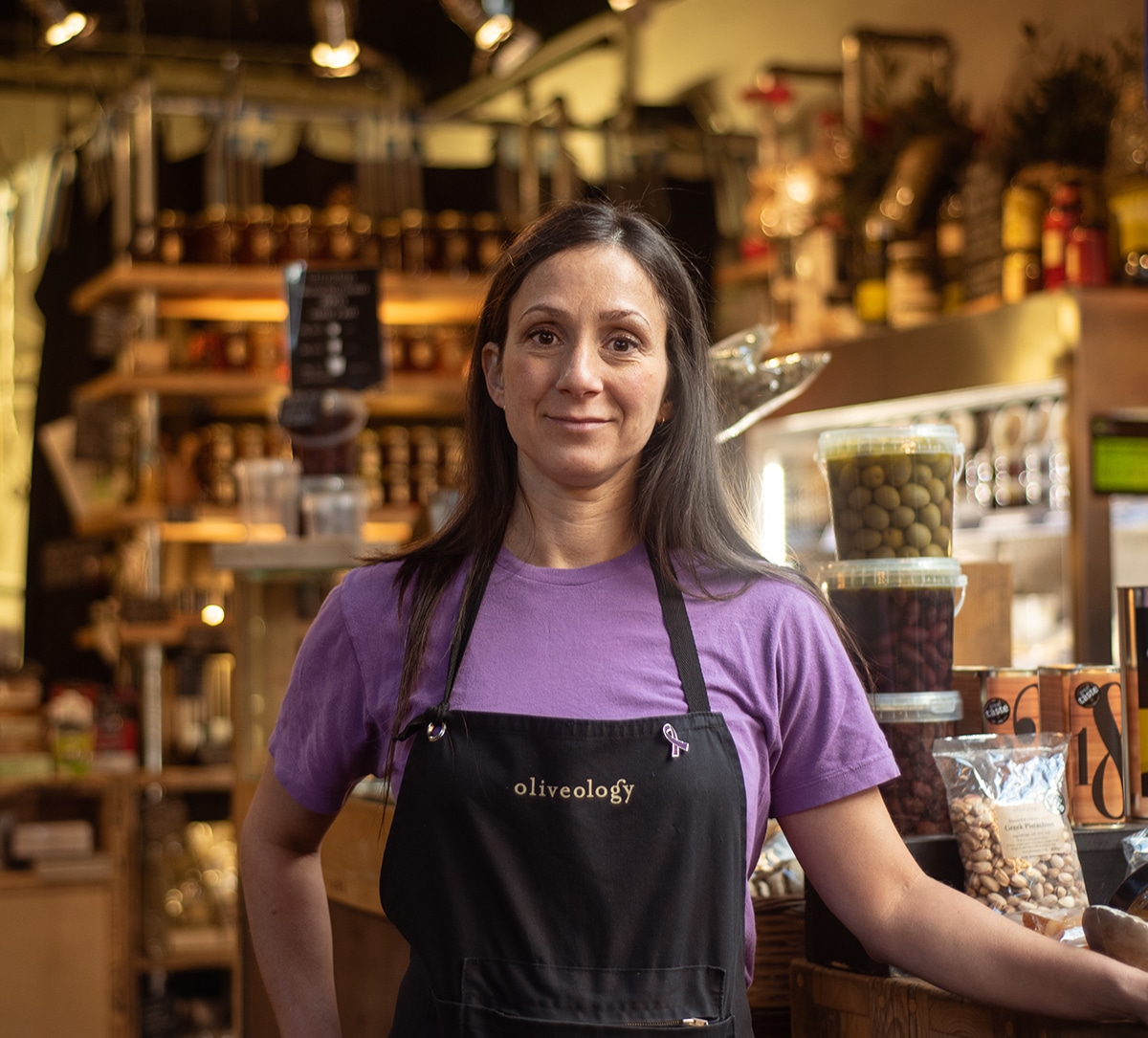
I was brought up helping my mum and grandmother in the kitchen – they were both amazing cooks. We’d prepare meals together, dry and preserve things, make jams and molasses. Food has always been a really big part of my life, so it was natural to want to work with it.
When I came to the UK to study, I really missed Greek food. Finding the ingredients of my heritage was difficult, so I’d bring everything back with me. My mum would stuff my suitcase with olives, honey – even tomatoes and lemons, it’s crazy! I was upset that Greek products were really underrepresented outside of Greece. Starting Oliveology was a way of bringing me closer to my heritage and childhood. All of the things I have learned, experienced, cooked and tasted, I can pass on to others.
I am very passionate about organic farming and very interested in how farmers grow things. Interestingly, a lot of the producers I work with are women. In Greece women still commonly run the household, but things have started to change and more women are becoming involved in farming. My herb producer, who works with semi-cultivated, semi-wild land, is a woman. My truffle supplier is a woman. My honey is produced by a couple: the husband does the beekeeping and the wife runs the business. All of my producers are really small scale and the whole family is usually involved.

I am close with a lot of women in the Market, too. We support each other. We go through similar things, so we compare experiences and share tips. Lots of my wholesale customers are female-led or female-owned businesses, which I don’t think is a coincidence. There’s a lot of loyalty there.
Everyone who works with me is similarly passionate about our food and its provenance. We want people to value the quality of the food they put on their plate and understand why it matters – how your shopping choices affect your body, the farmers, the land, everything. For me, that’s more important than the financial aspect. Even if I lose money, I will never compromise. It’s quite an emotional approach. Maybe that’s to do with the fact that I’m a woman – or it might just be my personality.
I think that becoming a mother has shaped the way I approach my business, and food generally. When you own the company, there’s no maternity leave – you can’t take a year off – so it’s been hard. But you learn to adapt, and you keep going. I bring my son Harry along to everything. He has been part of my team from a very young age! Luckily, everything I sell is perfect for a child – what I would advocate for adults to eat I also want for my own child.
We’ve always done cookery classes and food workshops for adults. Now, we’ve started doing kids’ cooking workshops too. I want to inspire children to try different things from a young age, explore different textures, learn where food comes from and what real ingredients look like. I think it’s really important. I get Harry involved a lot in preparing and cooking food and I’m trying to inspire other mums to do the same.
Edible histories: Welsh food
For St David’s day, Mark Riddaway, author of Borough Market: Edible Histories, tells the story of Welsh food and explains the cruel joke behind Welsh rarebit
WELSH FOOD CONTAINS A SMALL YET ENVIABLE PALETTE OF INGREDIENTS, THE REFLECTION OF A UNIQUE TOPOGRAPHY
If there was one thing about Wales that everyone in Tudor England knew, it was that the Welsh couldn’t get enough of toasted cheese: a dish known in Wales as ‘caws pobi’. In The Merie Tales of the Mad Men of Gotam, a collection of stories attributed to the writer Andrew Boorde, a good laugh was had at this particular culinary obsession.
St Peter, so the story went, found himself in deep trouble with God for letting too many Welshmen into heaven. Standing outside the pearly gates, St Peter “cried with a loud voice, ‘Caws pobi! Caws pobi!’, that is as much as to say, ‘Roasted cheese!’ Which thing the Welshmen hearing ran out of heaven at great pace… And when St Peter saw them all out he suddenly went into heaven and locked the door! And so appeared all the Welshmen out!”
The fact that the Welsh could be tempted out of eternal celestial bliss by something as mundane as a cheese toastie says something quite profound about the history of Welsh food. In most countries, the story of the national cuisine is told through tales of great feasts, of palace kitchens, of exotic imports and elaborate dishes. In Wales, the food that defines the nation’s culinary history – including that addictive caws pobi – is the food of the poor, of the pastoral Celts, of the peasantry, passed down through a rich oral tradition.
Think of a classic Welsh foodstuff and it will be almost certainly be the product not of fancy, well-equipped kitchens but of humble fireplaces; cooked in a single large pot or baked on a bakestone. Think of cawl, one of the most famous of Welsh dishes, a simple broth of vegetables and meat (usually bacon) but with a thousand regional and local variations. After potatoes were introduced to Wales, their starchy bulk became integral to many of these hearty soups, but otherwise a cawl dished up today would be much the same as any produced by a medieval farmer’s wife, cooking over an open fire. Welsh cakes offer a similar echo of domestic simplicity, baked on a stone or a griddle rather than in anything as highfalutin as an oven.
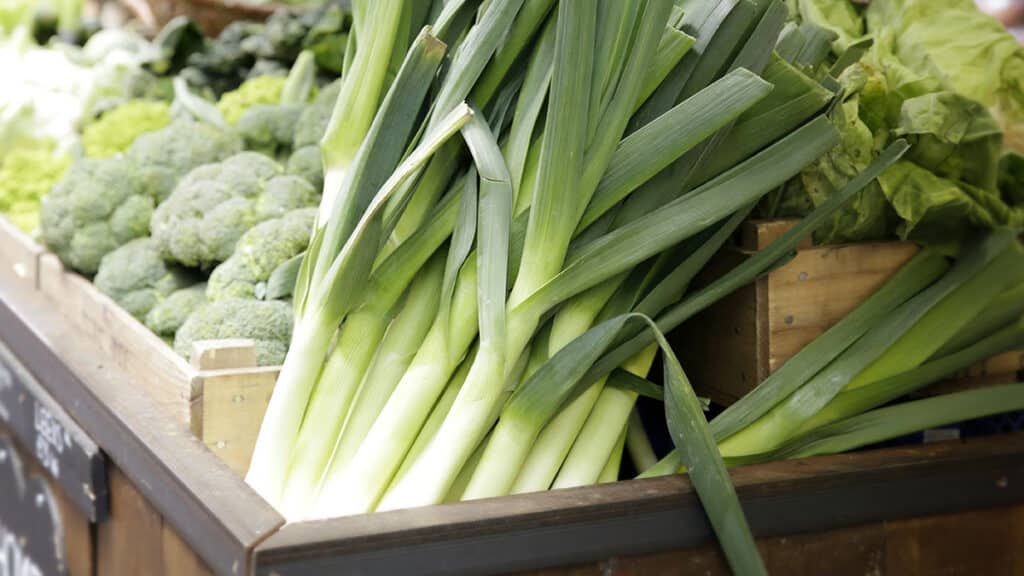
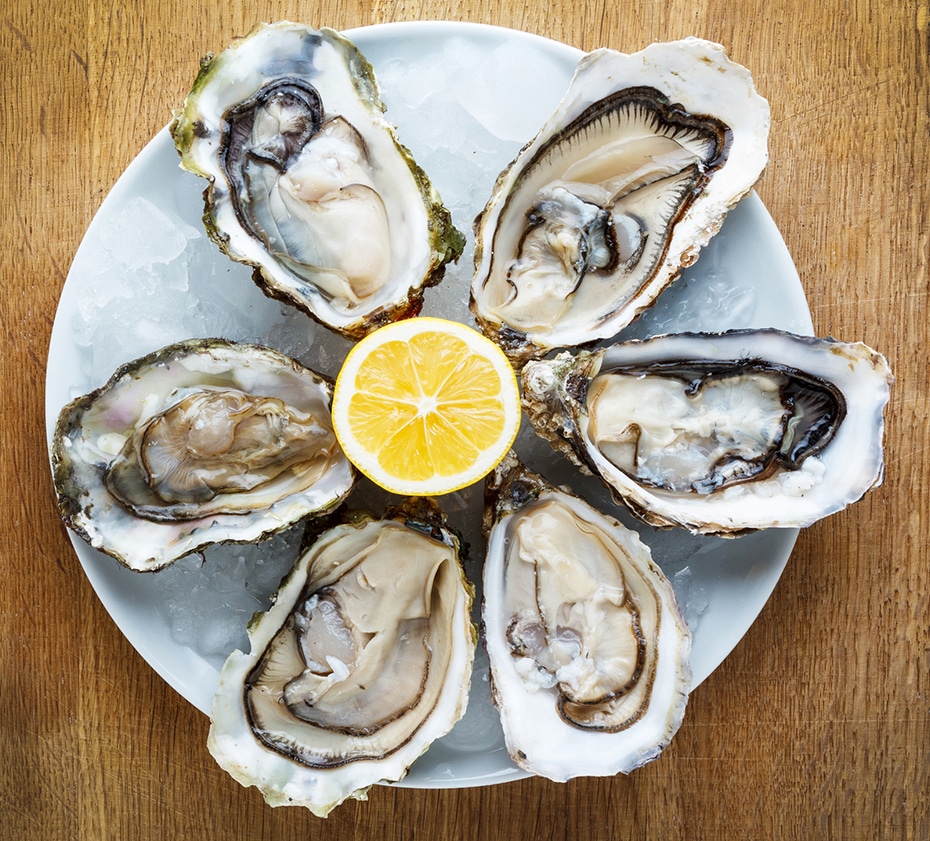
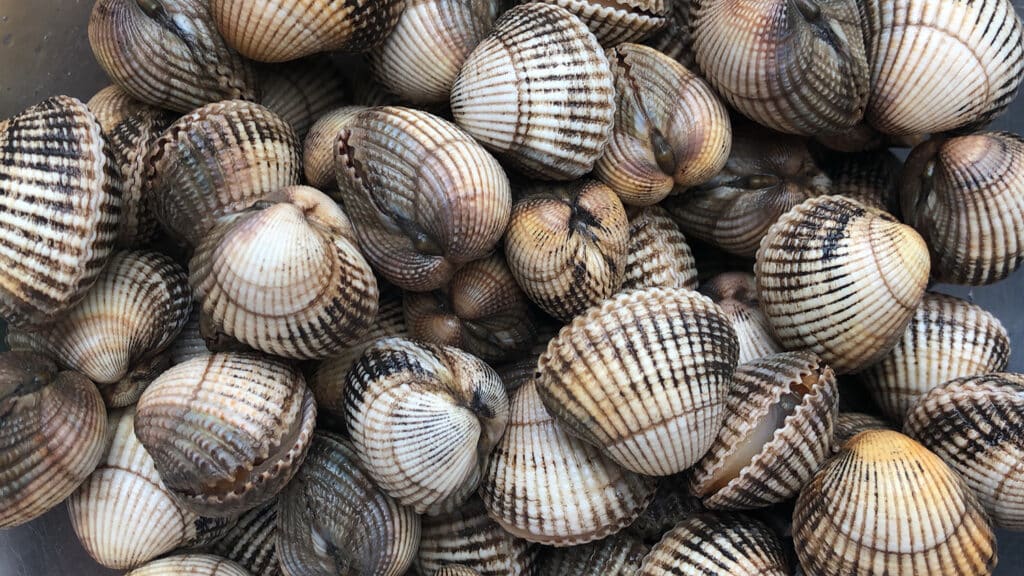
The history of Welsh food is one of a small yet enviable palette of ingredients, a reflection of the nation’s unique topography: mutton, lamb, pork, beef and dairy from the hillside pastures; barley, oats and rye from the upland farms; leeks, brassicas and root vegetables from the fields; mackerel, herring and cockles (pictured top) from the sea; salmon, brown trout and sewin (Welsh sea trout) from the rivers. And salt, lots of salt.
The Celts were big believers in the culinary and preservative miracles possible through the heavy use of salt, and archaeological evidence of salt-making abounds at Iron Age sites throughout Wales. As well as being used in the preservation of meat, salt was – and still is – central to the production of Welsh butter. In this dairy-loving nation, butter was for centuries the only viable way of bringing luxurious fats and flavours to an otherwise frugal peasant diet. Proper Welsh butter still contains enough salt to make a cardiologist weep. Delicious though.
Cheese, too, was both popular and, for centuries, heavily salted. A clause in the medieval Welsh legal code known as the Laws of Hywel Dda suggests that cheese was commonly soaked in brine. According to the law, while the cheese was still in the brine it belonged to the wife, once out of the brine (and therefore presumably ready to eat) it belonged to the husband. Lucky old wife.
While we’re on the subject of cheese, let us address the sticky subject of Welsh rarebit. Caws pobi is Welsh, but Welsh rarebit categorically isn’t. The word ‘rarebit’ is a corruption of ‘rabbit’, and most likely has its roots in a racist English joke. In the 17th and 18th centuries, the English used the epithet ‘Welsh’ to mock things for being a bit crap: using a ‘Welsh comb’ meant brushing your hair with your fingers, a ‘Welsh cricket’ was a louse. Welsh rabbit was a dish containing absolutely no rabbit, eaten by poor people who couldn’t afford anything as luxurious as meat. Cheese on toast wasn’t known as Welsh rarebit because the Welsh ate it (although, as we’ve seen, they clearly did); it was known as that because the English, who were equally partial to a spot of melted cheese, liked to be horrid about their Celtic neighbours.
One terrible irony for the Welsh was that, for all their enjoyment of toasted cheese, the very best cheese for toasting was made across the border in England. The acidity of Welsh soil has always made Welsh milk better suited to the production of soft cheeses, meaning that West Country cheddar – the epitome of sharp, melty loveliness, much coveted by lovers of caws pobi – was consumed in large quantities throughout Wales.
Thankfully, Welsh farmers had the perfect asset for trading at Somerset markets, enabling them to buy as much hard cheese as they needed: Welsh sheep. Mutton and lamb from the Welsh hills was much prized, so the trade in this most meltingly tender and flavoursome of beasts was a rich one. Most of the best meat was, however, destined for wealthy English tables, leaving the Welsh diet short on meat and long on cabbage, leeks and one less widely used green vegetable: seaweed.
Plentiful and hugely nutritious, a type of seaweed known as laver has long been plucked from Welsh beaches, boiled for several hours, then chopped or pureed into a soft, evenly textured paste known as laverbread (‘bara lawr’ in Welsh). Edmund Gibson’s 1695 translation of William Camden’s Britannia contains a description of “a kind of alga or sea-weed” being made into “a sort of food call’d lhavan”: “Having gather’d the weed, they wash it clean from sand and slime, and sweat it between two tile-stones; then they shred it small, and knead it well, as they do dough for bread, and make it up into great balls or rolls, which some eat raw, and others, fry’d with oatmeal and butter.”
Served with bacon and cockles, laverbread became a central part of the Welsh breakfast, fuelling the back-breaking work of mining communities, and it remains one of the most unusual and distinctive of Welsh dishes. Whether or not it’d be enough to drag a Welshman out of heaven is a matter of conjecture.

Frost fare
The food and drink of the Frost Fairs and where to find it in today’s Borough Market
“JUST BECAUSE WE CAN’T SLIDE AROUND ON THE RIVER LIKE FROST FAIR REVELLERS DOESN’T MEAN WE CAN’T EAT AND DRINK LIKE THEM”
A major appeal of the Frost Fairs – the spontaneous festivals that erupted on the frozen Thames between the 16th and 19th centuries – was the party food sold by traders out on the ice. Climate change means that the river will probably never freeze again, and even if it did, we can assume that modern standards of health and safety would prevent any such revelry. But just because we can’t slide around on the river like Frost Fair revellers doesn’t mean we can’t eat and drink like Frost Fair revellers – and to do that, Borough Market is the perfect place to start.
Beef
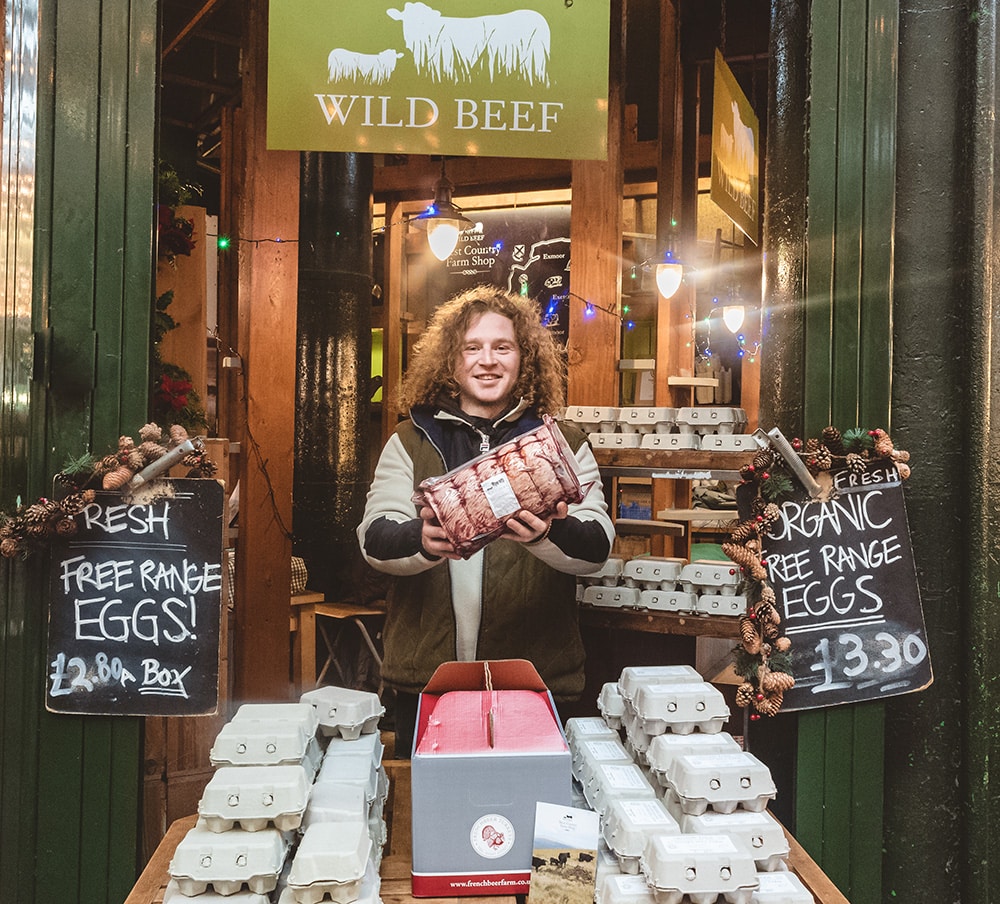
A Frost Fair simply wouldn’t have been a Frost Fair without large hunks of meat roasting over open fires. Whole pigs and sheep were fairly commonplace, but the real star of the show was usually an ox, driven down from Smithfield Market, dispatched with great ceremony by a butcher wearing “a laced cambric apron, a silver-handled steel, and a hat and feathers”, then spit-roasted whole for days on end – an incredible spectacle and proof of the extraordinary solidity of the ice. Borough Market isn’t the place to come for either a live ox or a whole beef carcass, but at Wild Beef, Ginger Pig and Northfield Farm you’ll find magnificent roasting joints large enough to feed a multitude. Most importantly, the animals they come from will have lived a happy life grazing on pasture, much like those of yesteryear.
Gin
Let’s be honest: the Frost Fairs, while also a venue for shopping, sport, music, theatre and dance, were largely an excuse for Londoners to get completely lashed. “As many tuns of ale and brandy flow / Above the ice, as waters do below,” wrote one wit. In contemporary sources there are mentions of beer and ale, purl (ale infused with wormwood), canary and sack (two names for sweet Spanish wines), brandy and rum. This being London, though, gin was the thing. Imagine Hogarth’s famous Gin Lane print, but with the steps of St Giles replaced by an ice sheet. Borough’s East London Liquor Co. is among the finest of London’s current crop of gin makers and while theirs is a drink markedly less rough than anything that would have been sold on the ice, it’s no less capable of fueling a party.
Gingerbread
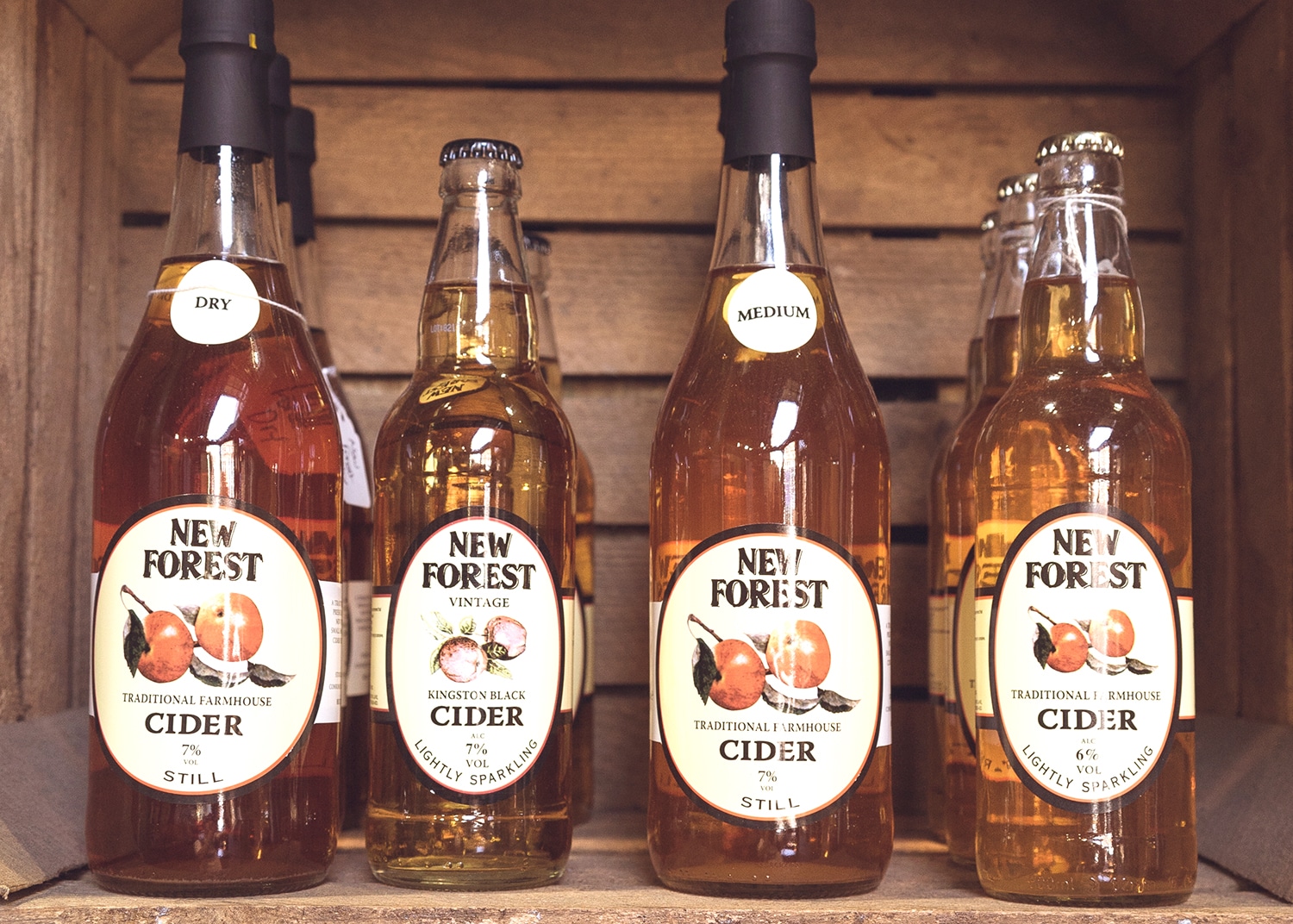
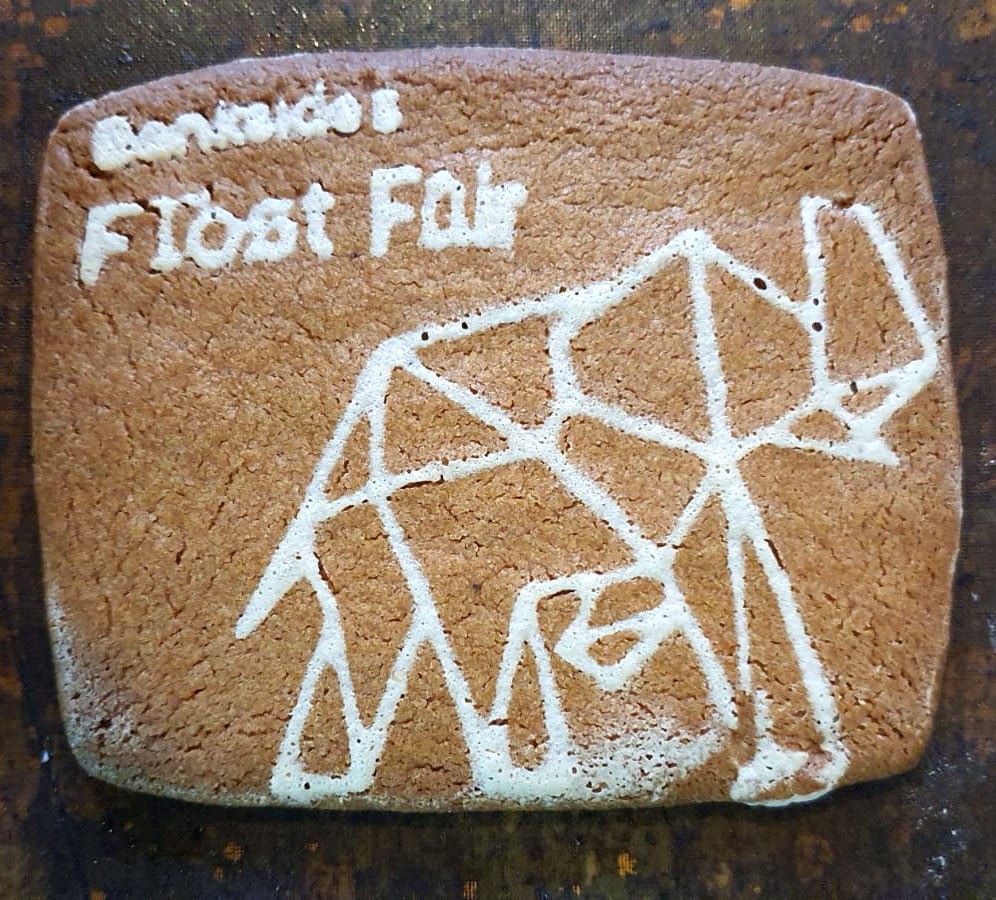
From first until last, gingerbread was a staple treat of the Frost Fairs. In 1814, it was among the three consumables (together with gin and beer, inevitably) that one observer noted as having “a plentiful store” among the event’s vendors. Sweetened with honey or sugar and packed with candied fruits and exotic spices, the gingerbread of the past would have been deeper, denser and more cake-like than the biscuits we now associate with the name. The Cinnamon Tree Bakery has produced a special gingerbread to mark the Frost Fairs, emblazoned with an elephant illustration in honour of the (almost certainly mythical) appearance of an elephant on the ice. Handmade in Camberwell, these beautiful biscuits are flavoured with the same wintery spices that the Frost Fair bakers would have employed in their craft: nutmeg, mace, cinnamon and cardamom as well as ginger.
Coffee
If the weather’s cold enough to freeze the Thames solid, you’re definitely going to want a hot drink. Coffee was a regular staple of these impromptu festivals, as were tea and hot chocolate. At the time of the 1684 Frost Fair, coffee was incredibly fashionable. London’s very first coffeehouse had opened in 1652, sparking a surge in demand for this bitter Arabian decoction. In 1675, Charles II made an ill-fated attempt at banning its sale, believing that cafes were magnets for political malcontents, but when the King appeared at the Frost Fair nine years later, the drink was all the rage. Within a century, coffee’s popularity would be overtaken by that of tea, but it has recently regained its status as London’s chosen source of caffeine. Borough Market is home to the very best of this magical bean’s importers and roasters, including Monmouth Coffee Company, The Colombian Coffee Company and Change Please.
Cheshire cheese
In accounts of the Frost Fairs, there are several mentions of bread and cheese being sold – and specifically Cheshire cheese. In the 17th and 18th centuries, cheesemakers from Cheshire absolutely dominated the London market. Cheshire was the English cheese, in the way that cheddar is today. But whereas once the northwest was home to hundreds of producers of raw milk, clothbound, farmhouse Cheshire, today there’s just one: Appleby’s. Sold by Neal’s Yard Dairy, Appleby’s Cheshire has the same juicy acidity and characteristic crumble that ice-bound Georgian cheese lovers would have enjoyed, if they could really taste anything after all that gin.
Pies
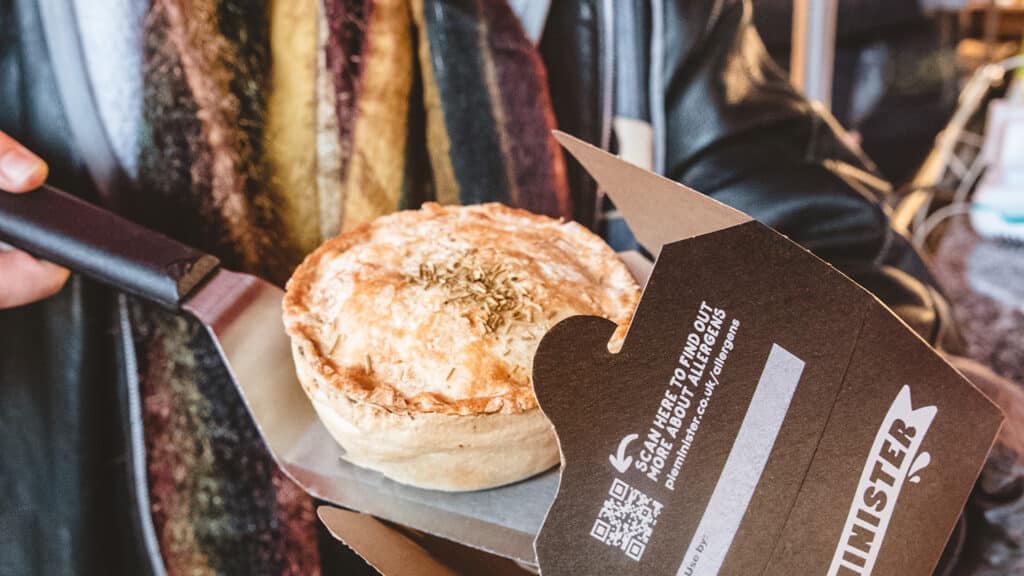
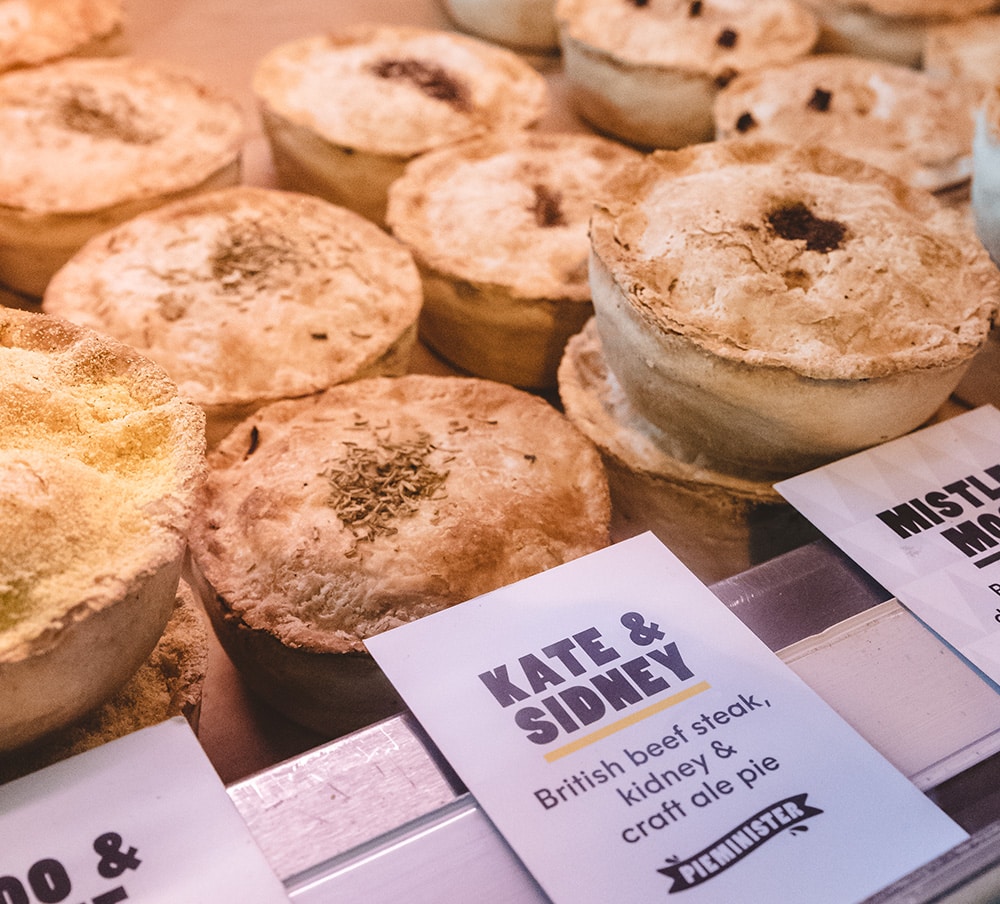
The pie has been one of the cornerstones of English cuisine since long before the Frost Fairs. Filling pastry with meat or fruit is something we can’t help but do as a people, like playing ball sports and drinking to excess. Just as it was absolutely inevitable that drinking sessions and games of football would break out on the ice (“And football playing there was day by day, / Some broke their legs, and some their arms they say,” wrote one poet in 1684), so too was it completely assured that piemakers would find a brisk trade among the revellers. The very same would no doubt happen today. Pieminister’s Kate and Sidney pie, filled with generous amounts of steak, kidney and ale – a proper cold-weather soul warmer – would be the perfect place to start.

Dancing on ice
Mark Riddaway tells the remarkable story of the Frost Fairs, a heady tale of food, festivities and the occasional disaster
Dancing on ice
Mark Riddaway, author of Borough Market: Edible Histories, tells the story of the Frost Fairs – spontaneous festivals of food, dancing and sport that would erupt on the Thames whenever the river froze over
“THE FREEZING WINTER WAS A TIME OF GREAT DISTRESS FOR MANY, BUT DOWN ON THE THAMES A CHEERIER MOOD PREVAILED”
It was Monday 6th February 1814, the early hours of the morning. For a full week, an extraordinary esplanade of ice had spanned the Thames between Blackfriars and London Bridge, but signs of structural distress were starting to appear. It had rained heavily on the Sunday evening and the groan of cracking ice was clearly audible. As one observer put it: “In short, this icy palace of Momus, this fairy frost work, was soon to be dissolved, and was doomed to vanish, like the baseless fabric of a vision – but leaving some wrecks behind.”
Among the wrecks in question were nine men who, despite the obvious danger, had chosen to spend yet another night out on the rigid river, drinking gin in a booth owned by the landlord of the nearby Feathers pub – one of many such constructions. Around 2am, the section of ice hosting their drinking den was shorn off by the tide and propelled along the Thames “with the quickness of lightning”. Responding to the crisis with a predictable lack of dexterity, the drinkers added to their peril by accidentally setting fire to the booth’s tarpaulin. Against all the odds, they managed to find refuge in a small boat that was freed by the thaw, but this was immediately dashed to pieces against one of the piers of Blackfriars Bridge. By some miracle, no one was killed.
The next day, these nine men weren’t the only Londoners left feeling sore. “Thousands of disappointed persons thronged the banks; and many a prentice boy and servant maid sighed unutterable things at the sudden and unlooked for destruction of the Frost Fair.” This was it. The 1814 Frost Fair – a spontaneous festival of food, drink, music, sport and shopping – had finished. There’d been many such events in the preceding centuries, and they’d all ended in a similar way: suddenly, disappointingly, dangerously. But this would be the last ever Frost Fair. The party was over.

Knowing the Thames as it is today, it seems incredible that this huge, fast-flowing river could have frozen sufficiently solid for thousands of inebriated revellers to dance on its surface for days on end. For this, our forebears were indebted to the climate of the Little Ice Age, a period of cooling in the North Atlantic region which extended from the 16th to the 19th centuries. The topography of the river also helped. Before steep embankments were erected later in the 19th century, the Bankside section of the Thames was a wider, shallower and slower-moving monster than it is today.
As a result, any long spell of sub-zero temperatures could turn the river into a rink. This happened in the winter of 1564-5, when New Year’s Eve celebrants out on the ice “plaied at the football” and “shot at prickes” (less alarming than it sounds: a prick was a type of archery target). Over the next few days, people “went on the Thames in greater numbers than in anie street of the Citie of London”. January 1608 saw more prick shooting, together with bowling, and dancing. Booths were set up by resourceful market traders, including “fruit-sellers, victuallers that sold beere and wine, shoemakers, and a barber’s tent.”
One of the biggest of the Frost Fairs came in 1684, in the coldest winter ever recorded in England. This was a time of great distress for the nation. “It was a severe judgment on the land,” observed the diarist John Evelyn, “trees not only splitting as if the lightning struck, but men and cattle perishing in divers places, and the very seas so locked up with ice, that no vessels could stir out or come in. The fowls, fish, and birds, and all our exotic plants and greens, universally perishing. Many parks of deer were destroyed, and all sorts of fuel so dear, that there were great contributions to preserve the poor alive.”
Meanwhile, down on the Thames, a cheerier mood prevailed. There were “sleds, sliding with skates, a bull-baiting, horse and coach-races, puppet-plays and interludes, cooks, tippling, and other lewd places.” It was, concluded Evelyn, “a bacchanalian triumph, or carnival on the water”. And Restoration London was very good at bacchanals. After periods of civil war and repressive Puritanism, the city – now under the louche leadership of Charles II – had been relearning how to party. As Londoners took that learning out onto the ice, even the King joined the fun.
We know that the royal family partied at the 1684 Frost Fair because their presence was marked by a commemorative print produced out on the ice. Printing would remain a lucrative staple of the fairs, with printers dragging their heavy typesetting equipment down to the river to fire off posters, poems, personalised gifts and even entire books. One of the best sources of information on the 1814 event is a heavy tome called Frostiana, most of the sections of which were seemingly churned out at the fair.
Visitors may have left with souvenir prints, but they came for the food and drink. One poem from 1684 described a “cheating, drunken, leud, and debauch’d crew” feasting on hot codlins (cooked apples), pancakes and all sorts of roasted poultry, washed down with sack (Spanish fortified wine), all procured from hastily erected booths, many of which featured hilarious signs (“The Flying Piss-pot” being a notable example). There were venders of coffee, tea and cocoa – alluringly exotic drinks only recently arrived from Arabia, China and the Americas respectively. Mostly, though – Brits being Brits – everyone got stuck into the booze. As one anonymous poet put it: “As many tuns of ale and brandy flow / Above the ice, as waters do below; / And folk do tipple, without fear to sink, / More liquors than the fish beneath do drink.”
In January 1716, the booze booths were back, peddling what one reporter described as “exhilarating liquors”. That same year, the Protestant Packet newspaper described sellers of port, Rhenish (a sweet German wine), bohea tea (the cheapest tea on the market), tobacco, Cheshire cheese and the “whitest Brentford peas” (a rare example of anything vaguely healthy being bought on the ice). At every Frost Fair, there was always plenty of gingerbread and at least one spit-roasted ox. In 1739-40, a man called Hodgeson claimed the privilege of ceremonially killing the ox, which was brought down from Smithfield Market. This was, he claimed, a family tradition, “his father having knocked down the one roasted on the river in the Great Frost of 1684”.
All this eating, drinking and entertainment played out in a spirit of exhilarating anarchy. Unlike an official marketplace, there were no license fees here. No sheriffs, no weighing beams, no fixed start and finish times. In 1789, the London Chronicle described a booth with a sign stating: “Beere, wine, and spirituous liquors without a license!” A gingerbread seller delivered a similar happy message: “No shop tax, nor window duty.” The only vaguely authoritative presence came from burly boatmen rendered unemployed by the ice. Robbed of their income, they charged a toll to allow people onto the river. In 1789, these muscular entrepreneurs smashed up the ice close to the shore so that no one could sneak in without paying. To their credit, they did in return spend a lot of time saving the lives of those unfortunate souls too drunk, reckless or unlucky to avoid falling into the frigid waters.
There were plenty of these. In one little tale from Frostiana, “three prim young Quakeresses had a sort of semi-bathing, near London Bridge, and when landed on terra firma, made the best of their way through the Borough … amidst the shouts of an admiring populace.” Others, however, suffered a fate far worse than wolf whistles. In his poem Trivia (1716), John Gay told of the gory death of an apple-seller known as Doll: “The cracking crystal yields: she sinks, she dies, / Her head chopt from her lost shoulders, flies; / Pippins, she cried, but death her voice confounds, / And pip, pip, pip, along the ice resounds.” In 1814, “a plumber, named Davis, having imprudently ventured to cross with some lead in his hands, sank between two masses of ice, to rise no more.”
Such tragedies aside, the Frost Fairs represented the purest distillation of collective joy – and 1814’s week-long party meant they ended on a high note. “There were fires blazing, sausages frying, fiddlers tuning, horns blowing, and groups of dancers in incessant employment and requisition,” summarised the Illustrated London News. It all kicked off on 1st February with the familiar eruption of booths, ornamented with streamers, flags and signs, offering food, drink and entertainments. “Among the more curious of these was the ceremony of roasting a small sheep, which was toasted, or rather burnt, over a coal fire, placed in a large iron pan,” wrote the author of Frostiana. “For a view of this extraordinary spectacle, sixpence was demanded, and willingly paid. The delicate meat when done, was sold at a shilling a slice, and termed ‘Lapland mutton’.”
By the following day, a “grand mall” stretched from Blackfriars Bridge to London Bridge, “lined on each side with tradesmen of all descriptions.” As has been true of every public event in the history of Britain, a lot of what was sold was tourist tat: “Every day brought a fresh accession of pedlars to sell their wares; and the greatest rubbish of all sorts was raked up and sold at double and treble the original cost. Books and toys labelled ‘bought on the Thames’ were seen in profusion.”
While the entertainment was plentiful, it seems to have been a little less bloody than in previous years. “Skittles was played by several parties, and the drinking tents filled by females and their companions, dancing reels to the sound of fiddles, while others sat round large fires, drinking rum, grog, and other spirits.” For a change, there was no mention of fox hunting, bear baiting or bull fighting. No animals other than roasted oxen were ripped to shreds on the ice.
There is a prevailing legend that the 1814 fair featured the most extraordinary of all Frost Fair animals: an elephant, paraded around on the ice. While I would love this to be true, I haven’t found a single contemporary reference. Apparently, none of the event’s reporters deemed the appearance of a massive pachyderm sufficiently noteworthy to warrant inclusion in their accounts. Frostiana, for example, tells of “four donkeys, which trotted a nimble pace, and produced considerable merriment”, but remains tellingly silent on the matter of elephants.
The elephant, then, is almost certainly a myth, but it’s one we might still choose to believe. With so much adrenaline, anarchic joy and Old Tom gin coursing through the Frost Fairs, stranger things certainly happened. We shouldn’t let facts spoil the fun.
Mark Riddaway is the author of Borough Market: Edible Histories, available now in paperback
Lady marmalade
Jenny Chandler shares her experiences of making marmalade for the first time and offers tips to encourage nervous novices to get bottling while these tart oranges are still available
“I’VE NO MYSTICAL TIPS OR TRICKS PICKED UP FROM A ROSY-CHEEKED GRANNY AS SHE SKIMMED THE PRESERVING PAN”
I don’t hail from a long-line of marmalade makers so I’ve no mystical tips or tricks picked up from a rosy-cheeked granny as she skimmed the preserving pan. In fact, I’ve always felt slightly nervous about the whole business of jams, curds and preserves. I was a marmalade virgin until relatively recently – then I read a no-nonsense recipe by wine and food writer Fiona Beckett and I gave it a go. I was so amazed by how straightforward and rewarding the whole process was that I made another two batches. My marmalade is simply fabulous; it’s dark, it’s chunky and perfectly bittersweet.
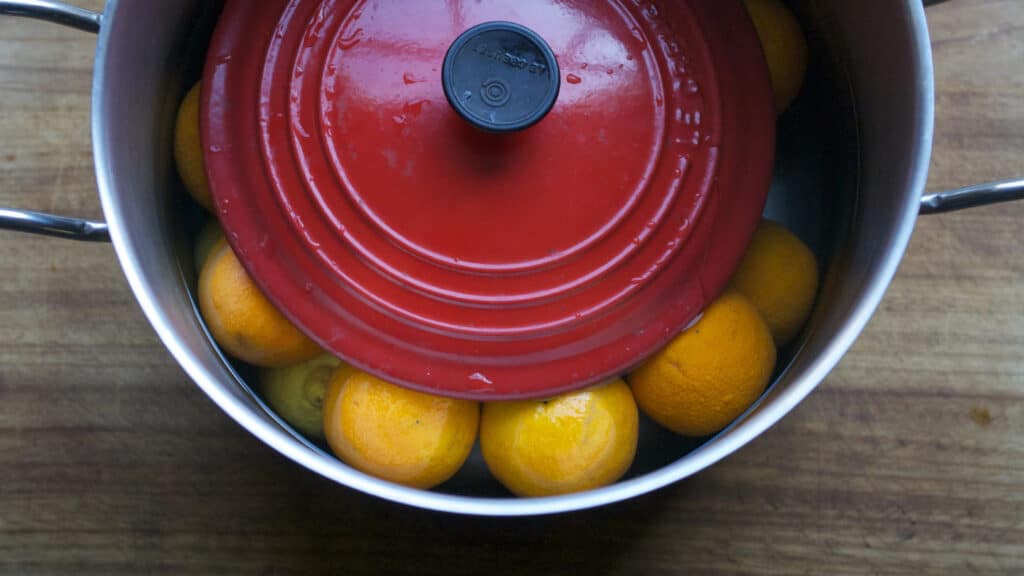
To start, you’ll need some Seville oranges. These bitter but beautifully fragrant fruits are only available for a couple of months, imported from Spain from December through to about mid-February. Available from Borough Market’s greengrocers, they’re good for cooking with, in marinades, cakes and pickles, but their most famous use is in marmalade.
Opinions are divided when it comes to marmalade methods, in fact it’s almost better not to ask for advice since everyone will have the ‘very best’ recipe. Purists seem to swear by slicing the fruit and leaving it to soak overnight, which apparently gives a more delicate, crystal-clear result than the quicker, boil-the-fruit-whole approach. I went for the latter and though I may not walk off with the WI trophy, my marmalade certainly knocks the socks off anything I’ve bought in the supermarket.
Experienced jam makers can jump the list of handy hints below, but as a novice I needed to go back to basics, and you may too.
The basics
— Unless you already own a preserving pan, or are planning on opening a B&B, I’d just stick to making the marmalade in a heavy stock pot or better still, if you happen to have one, the base of a pressure cooker.
— You need a piece of muslin in which to tie up the pips and pulp (they are rich in pectin, which sets the jam). No muslin? Well (and I know that this sounds rather unappetising but it’s very convenient!) a NEW pop sock will do nicely, just give it a rinse before using.
— A couple of plates in your freezer or fridge will help you when testing the ‘set’ of your marmalade.
— To sterilise jars you can place them in an oven at 130C for half an hour, or wash with cold water and zap, whilst damp, for 40 seconds in the microwave. The jars must be hot when you pour the hot marmalade into them, otherwise they could shatter.
— If your lids do not fit tightly then use a cellophane cover. A seal is important – otherwise your precious marmalade could go mouldy. It’s advisable to cover the surface of the marmalade with a disc of waxed paper too, if you are keeping the marmalade for any length of time.
— A jam funnel is a blessing, enabling you to ladle in the marmalade quickly and saving on time wiping sticky jars later. Otherwise just use a jug, but go carefully.
Read Jenny’s recipe for Seville orange marmalade
Discover more
Stirring stuff
Ahead of Stir-up Sunday, Ed Smith seeks out the perfect Christmas pudding recipe
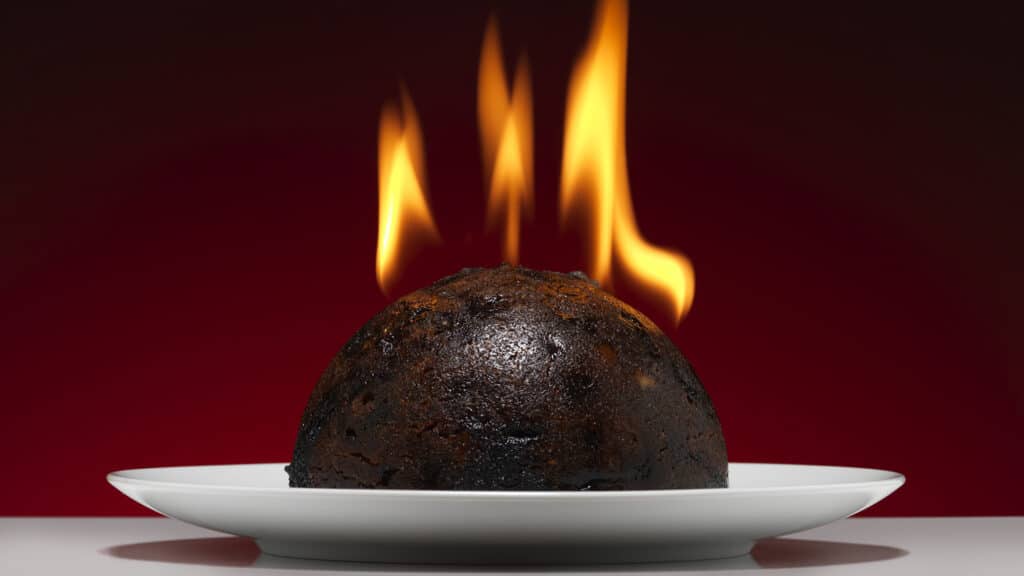
“THE CHRISTIAN REFRAIN ‘STIR UP, WE BESEECH THEE’ BECAME A REMINDER THAT YOU’D BETTER GET HOME AND MAKE A PUD”
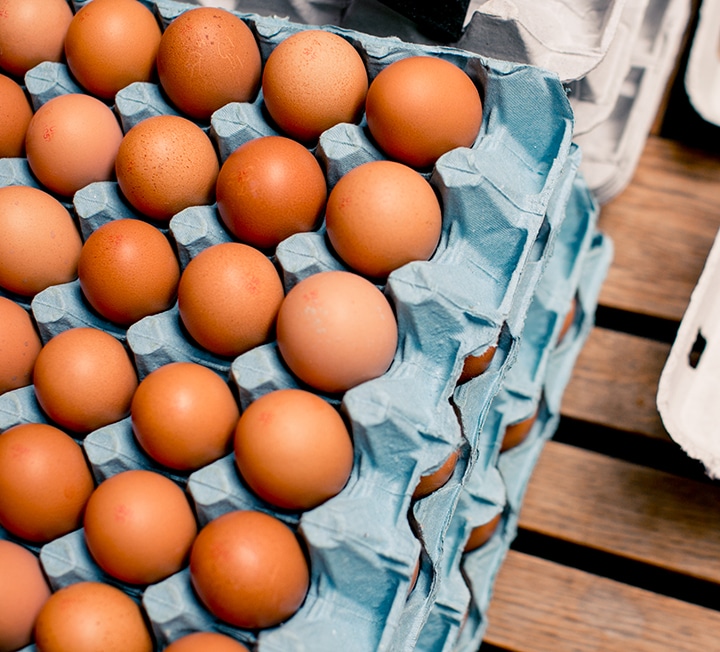
Mum’s always made Christmas pudding. Her routine is a tried and tested one: down comes the battered, spineless, almost loose-leaved, brown covered (and stained) Good Housekeeping recipe book; in goes a colossal amount of dried fruit, suet, breadcrumbs, eggs and a can of stout; then my brothers and I are invited to give it a good stir, make a wish and prod in some old coins (okay, we don’t head home for that stir any more, but mum still measures and mixes thoroughly, and those coins are chucked in for good measure).
This has always been a November process, though I can’t say that I was aware of the general concept of Stir-up Sunday until recently; I thought for a while that recent reference to such an event was something to do with Bake Off.
In fact, Stir-up Sunday is a real thing. It’s been a British tradition for as long as Christmas pudding has existed in its current form – there’s a happy correlation between a 500-year-old Church of England collect that’s read on the last Sunday before Advent (so, five Sundays before Christmas), and Victorian plum pudding’s tendency to get better with age.
Somewhere down the line, the Christian refrain “stir up, we beseech thee” became a reminder that you’d better get home and make a pud… otherwise there’ll be nothing for dessert on the big day once the goose carcass has been ravaged.
This year, Stir-up Sunday is 20th November. I like to eat Christmas pudding but, as mentioned, the recipe choice, shopping and measuring have always been mum’s domain, so looking into the origins of the dessert and at around 15 different recipes has been an interesting process.
The dried fruit varies. While there are always raisins (the ‘plum’ in plum pudding), we also see dried figs and apricots (Nigel Slater), prunes (Dan Lepard), sultanas, candied fruit (Good Housekeeping), dried cranberries and also booze-steeped fruit (Nigella – sherry).
Some add stout or porter (Delia, Good Housekeeping); others ignore alcohol but add treacle (Lepard). Nigella includes vodka as well as the sherry that went into the fruit – which seems totally pointless to me, given that vodka is a flavourless thing.
The ratio of breadcrumbs to flour is always different, though it seems more breadcrumbs make for a lighter result and older recipes appear to use many more eggs than the current trend (more eggs probably make a stiffer pud).
Then there’s the question of whether to include nuts or not. What about orange and lemon zest? Other ingredients creep in, like honey, grated quince (instead of apple, which is in most), candied ginger and its syrup too. Some just chuck in ready mixed spice, others specify some (or all) of ground cloves, ginger, cinnamon, nutmeg and mace. Maybe make it with butter instead of suet, a la Mary Berry?
There’s the matter of whether to steep the fruit (Nigella), soak the whole mix overnight (James Beard, Delia), make one large pudding or lots of little ones. And who’s got it right regarding how long to cook the pudding for? It’s always a two-stage thing – first on Stir-up Sunday and then again on Christmas Day. But that first cook seems to be anywhere between two to eight hours long, the suggestion being that the first lengthy cook and five weeks or so in a cool place help the pudding to ‘mature’. Crumbs, it’s a difficult choice and I’d be interested to know what others do.
For what it’s worth, I reckon Delia’s, which you can find on her website, looked like the most likely to be the right mix between tradition and trend, luxury and lightness. As it happens, I’m going to mix and soak and cook the Delia way, but try to incorporate a few ideas from others (prunes in a sherry steeped dried fruit mix, porter, crushed almonds and hazelnuts, grated quince). Fingers crossed and happy stirring.
The future of food in the climate crisis
Tom Hunt on the vital example that food markets can offer in the battle to reduce the impact of a broken food system
“TO MEND OUR BROKEN SYSTEMS AND LEARN TO REVALUE FOOD WE NEED TO RECONNECT WITH THE ORIGIN OF OUR FOOD”
Words: Tom Hunt
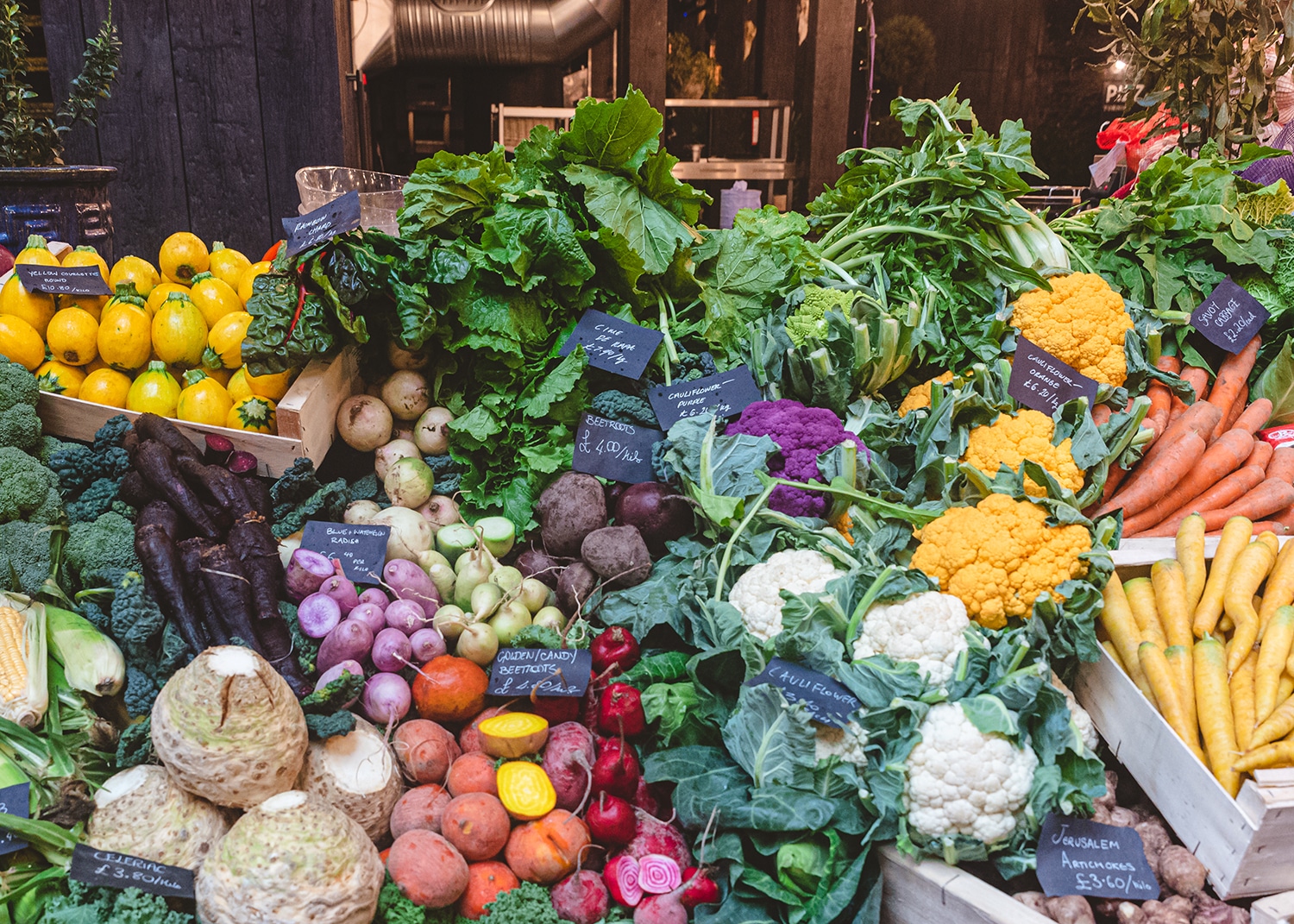
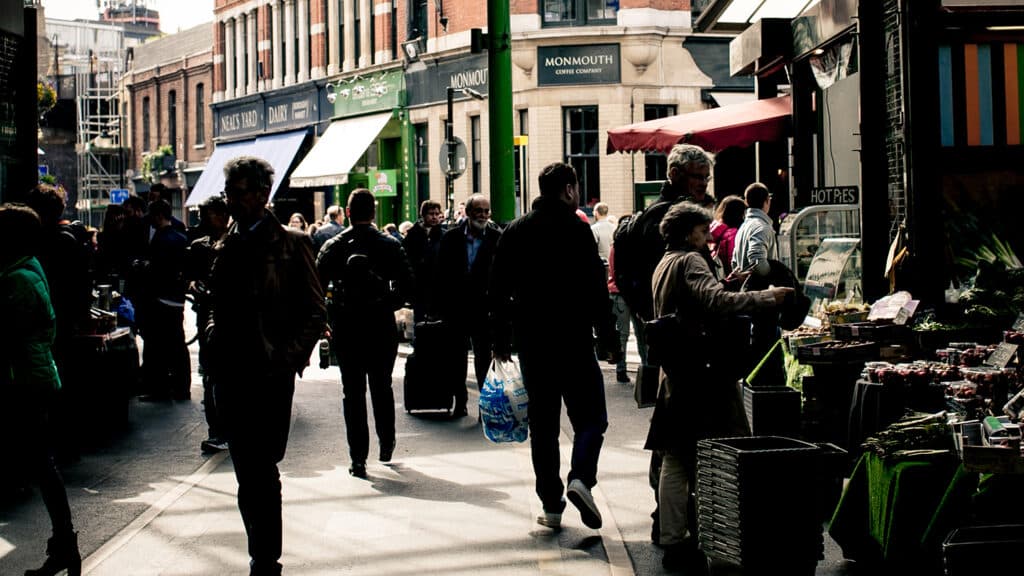
From the farm stalls to the world-class restaurants, Borough Market is a bubbling hub of sensory delights. However, it is far more than that. Produce markets like Borough Market are a keystone within sustainable food systems. They connect us, the eaters, with the web of producers who make our food. This brings myriad benefits to our communities from social, to economic, to ecological.
From farm to table, our food system is the biggest emitter of greenhouse gases. According to a paper published in Nature, food systems are responsible for just over a third of global anthropogenic greenhouse gas emissions. Of these, the vast majority (71 per cent) of emissions come from the use of land for agriculture or activities related to changes in land use, including deforestation and erosion. One of the most eye-opening figures is that 4.5 per cent comes from packaging alone.
Carolyn Steel is a leading thinker on food and cities and the author of the Sitopia: How Food Can Save the World (2020). Her concept of sitopia (‘food-place’, from the Greek ‘sitos’, meaning food, and ‘topos’, meaning place) provides a vision of a better food system that values food and the communities that surround it.
I asked Carolyn what role food markets play in a sitopian food system. She told me: “Food markets play an essential role in a sitopian food system, since they epitomise everything that sitopia is about: valuing food, close connections between city and country and putting good food at the heart of society. If we want to move towards a more regional, regenerative, sustainable food system, markets have a pivotal role to play, both in supporting the local food networks essential to such a system, and in engaging city-dwellers with food and inspiring them to care about what they eat.”
I also asked her how food markets can influence and contribute towards a carbon neutral community. “Building more resilient regional food systems based on regenerative agriculture will play a key part in helping us transition to a carbon neutral economy,” she replied. “Since food markets have a crucial role to play in helping us build such systems, they will form the natural heart of such a transition, both as food hubs serving local communities and as vital places of exchange between farmers and customers. The sociability of markets creates a positive feedback loop in which urban and rural communities come together to learn from each other and to embrace the challenges (and pleasures) of eating better to improve our lives and save the planet.”
Through our separate disciplines, Carolyn and I have both come to a similar conclusion: food has lost its true value. To mend our broken systems and learn to revalue food we need to reconnect with the origin of our food and, ultimately, nature. Shopping at a produce market brings us one step closer to our food’s origin. It allows us to interact with our food producers and farmers, shortening the food chain, cutting out the middleman.
Produce markets:
— Connect us with our food and farmers
— Stimulate food localism and increase the presence of farms local to cities
— Shorten the food chain
— Reduce packaging waste
— Reduce food waste
— Promote the decommodification of food
— Promote regenerative agriculture and carbon negative food
To reach carbon neutrality we need to lower emissions but also increase carbon capture to compensate for manmade carbon emissions. The oceans and earth are our planet’s natural carbon sinks. The oceans play the biggest role, but on land it’s our soil that captures almost 80 per cent of the carbon.
Certain foods can sequester carbon from the atmosphere. Foods that draw down more carbon than they emit are known as ‘carbon negative’. These include seaweed and bivalves such as oysters, mussels and clams, which store carbon in tissue and shell material. This is also true of some closed-loop farming systems like permaculture and agroforestry, a type of farming that includes trees within a diverse crop system.
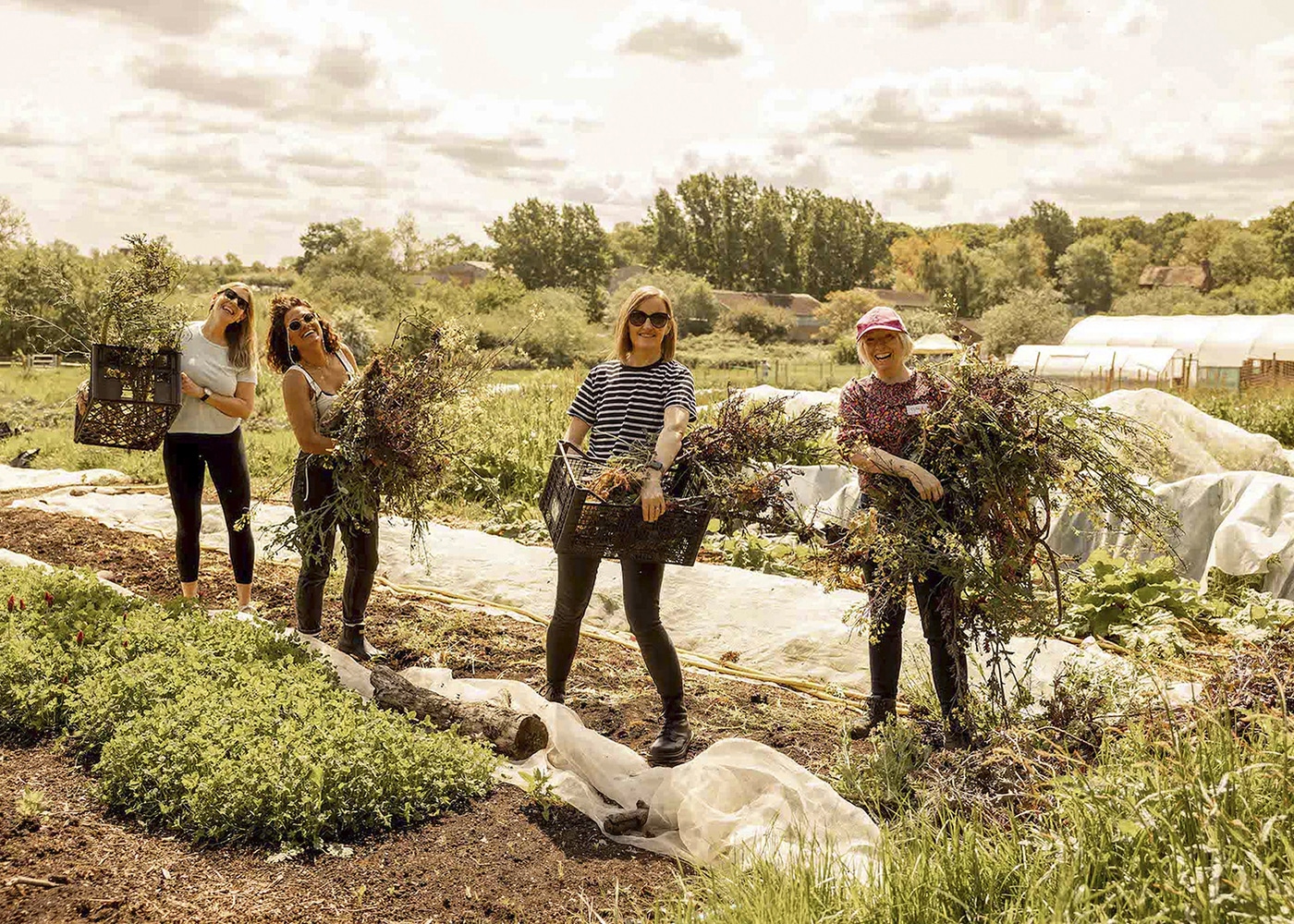
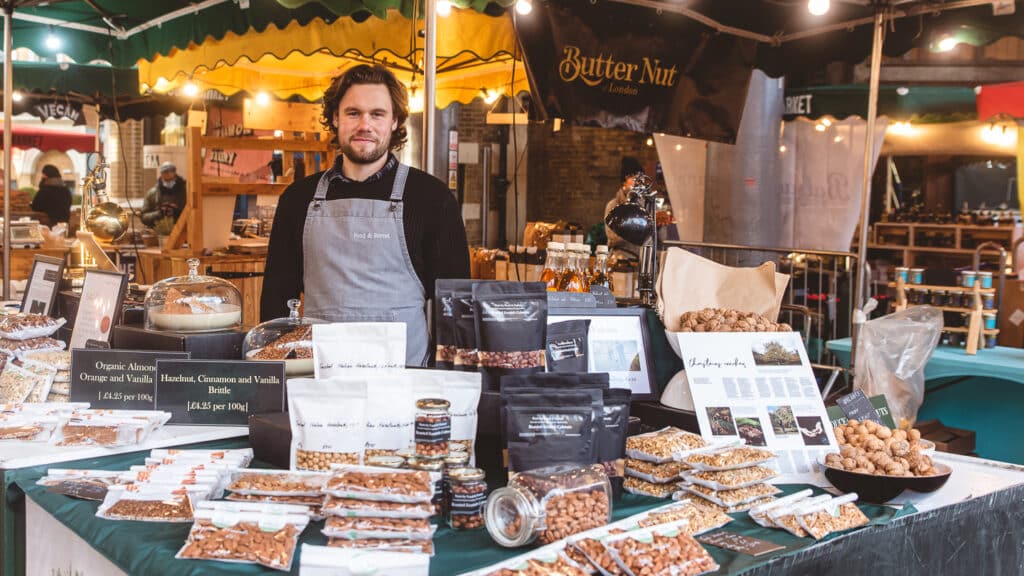
Some of the traders at Borough Market are practicing these regenerative forms of farming, including the Food & Forest nut stall, run by Charles Tebbutt. Food & Forest is a community interest company established to expand the use of agroforestry. In practice, this means creating the three key ingredients needed for alley cropping to flourish: demand for produce, production capacity, and a well-structured grant system.
The sort of better farming practices that you might find at a food market help reduce emissions and sequester carbon by building soil with organic matter. Better soil increases nutrition and therefore flavour. That’s why organic and agroecological produce doesn’t just do good. It tastes good too.