Land of the living
Why dozens of Market traders are choosing to become accredited as Living Wage Employers
“THE TRUST’S FOCUS IS ON ENCOURAGING EVEN MORE OF THE MARKET’S TRADERS TO GAIN ACCREDITATION OF THEIR OWN”
Image: Sim Canetty-Clarke
If in recent months you happen to have browsed the trader listings on this website, you may have noticed atop a growing number of their profiles a colourful logo of interlinking circles containing the words ‘Living Wage Employer’.

So, what does that mean? Administered by a charity called the Living Wage Foundation, this independent accreditation assures shoppers that every employee of the business in question is guaranteed a level of pay that meets their essential needs.
‘Living’, by this definition, is about more than just surviving. The Foundation’s minimum rate, which is updated every year, reflects the changing cost of a ‘basket’ of goods and services deemed necessary for a happy, fulfilling, dignified life. As well as having a roof over your head, food in the fridge and clothes to wear, that might include an annual holiday, a trip to the cinema, a birthday celebration – simple pleasures that far too many workers in the UK are forced to forgo. The current London Living Wage for over-18s is £13.85, much higher than the statutory rates of £11.44 for over-21s and £8.60 for under-21s. As costs go up, so too will that all-important number.
The charitable trust that runs Borough Market has been a Living Wage Employer since 2016, meaning that the dozens of people whose hard work makes this place tick, from the cleaners and security staff to the office workers behind the scenes, know exactly where they stand. Now, the trust’s focus is on encouraging even more of the Market’s traders to gain accreditation of their own.
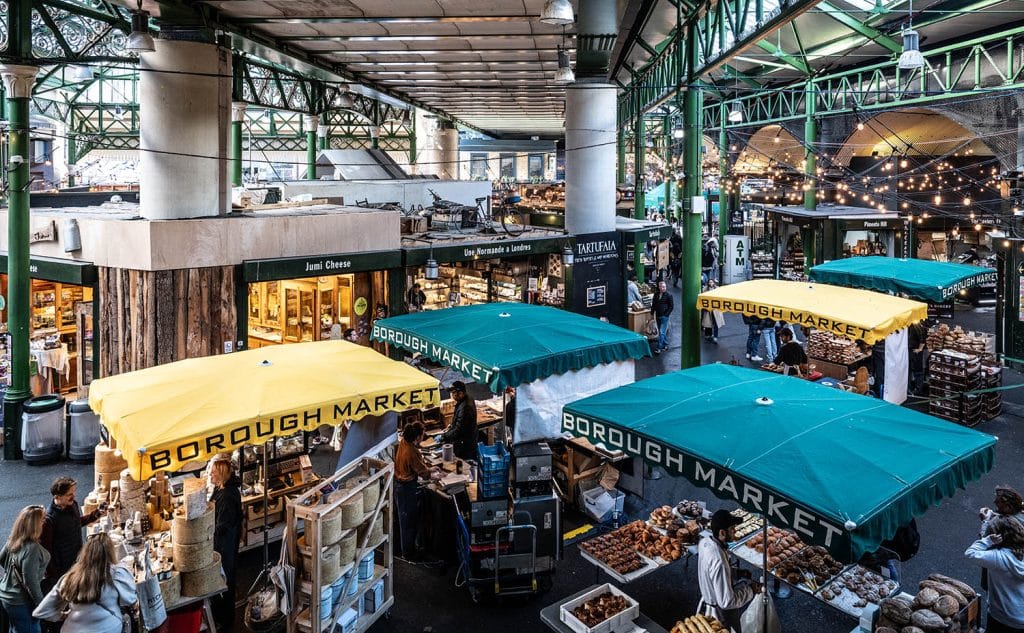
The moral imperatives may be obvious, but the benefits for employers of gaining the accreditation go much further than a clear conscience. “The viability of this industry relies on people wanting to work in it,” says Jon Thrupp of Mons Cheesemongers, one of the first businesses to join the Market’s growing ranks of accredited traders. The Living Wage offers a compelling reason for potential new recruits to give it a go.
Like most traders, Jon’s business has always been committed to paying its people properly, but the accreditation fixes the parameters of that commitment in a way that can be easily understood by all concerned. “To a younger generation of people looking for employment in London, which has never got any cheaper, it’s a quick way of communicating that we’re trying to make it fair from the beginning,” he explains. A proper wage, he continues, shouldn’t be something “you have to earn a right to after many years of service”.
Coles Loomi, manager of Jumi Cheese, another trader that proudly sports that colourful logo, strongly agrees: “It’s an amazing way to tell people who are interested in starting a career in the cheese world: ‘We’ve got you; this is the baseline, guaranteed.’”
Borough Market’s accredited Living Wage Employers
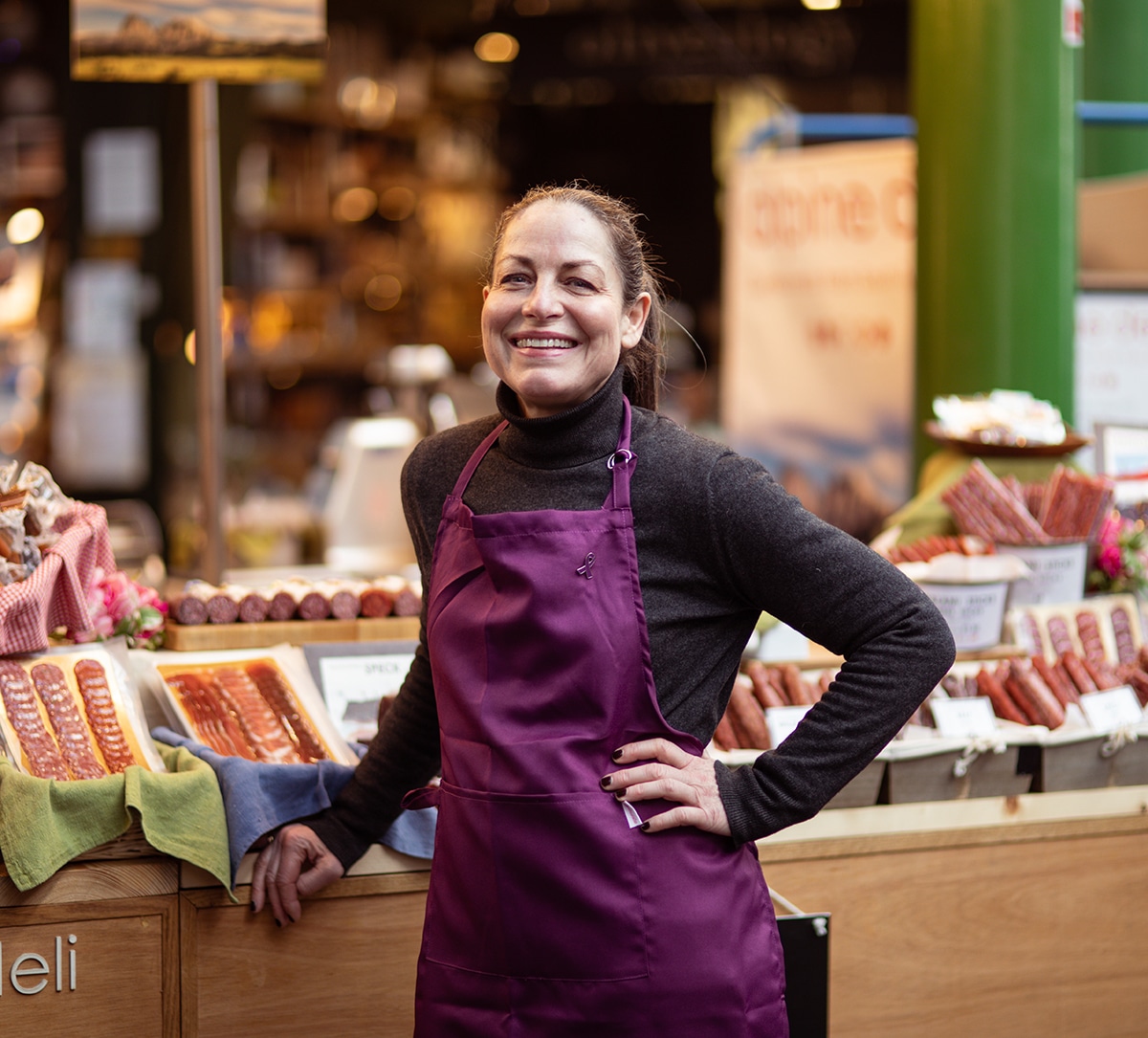
- Alpine Deli
- Artisan Foods
- Bianca Mora
- Borough Olives
- Condiment Pantry
- Date Sultan
- Gastronomica
- Gourmet Goat
- Gujarati Rasoi
- Hickson & Daughter
- Horn Ok Please
- Humble Crumble
- Jumi Cheese
- Khanom Krok
- La Pepia
- Moishe’s Bagelry & Bakery
- Mons Cheesemongers
- Nana Fanny’s
- Pieminister
- Pochi
- Porteña
- Raya
- Richard Haward’s Oysters
- Shuk
- Tea2You
- The Black Pig
- The Cinnamon Tree Bakery
- The French Comte
- The Parma Ham and Mozzarella Stand
- The Tinned Fish Market
- Trethowan Brothers
- Wiltshire Chilli Farm
Happy hours
Borough Market CEO Jane Swift on why the charitable trust that runs the Market has been accredited as a Living Hours Employer

Defining Borough Market food
Borough Market trustee Shane Holland on why the Market has introduced its first-ever Food Policy and what this means for the Market’s food
“WHILE MANY PEOPLE HAVE A STRONG SENSE OF WHAT BOROUGH MARKET DOES, THOSE PERCEPTIONS CAN VARY QUITE WIDELY”
Imagery: Sophia Spring
Within the Slow Food movement, where I work, we have a pleasingly pithy way of describing the food that aligns with our ethos: “Good, clean and fair.” The way we judge that involves a lot of specialist knowledge, but the message is simplicity itself. If you buy produce with a Slow Food Ark of Taste accreditation, you can be confident that its character and the method of its production fit with those three straightforward descriptors.
As well as being Executive Chair of Slow Food UK, I volunteer as a trustee on the board of the charity that runs Borough Market. If you asked 10 people to describe Borough Market’s food, those same three words – good, clean and fair – might well feature quite prominently, but so would 20 or so others, several of which might completely contradict each other.
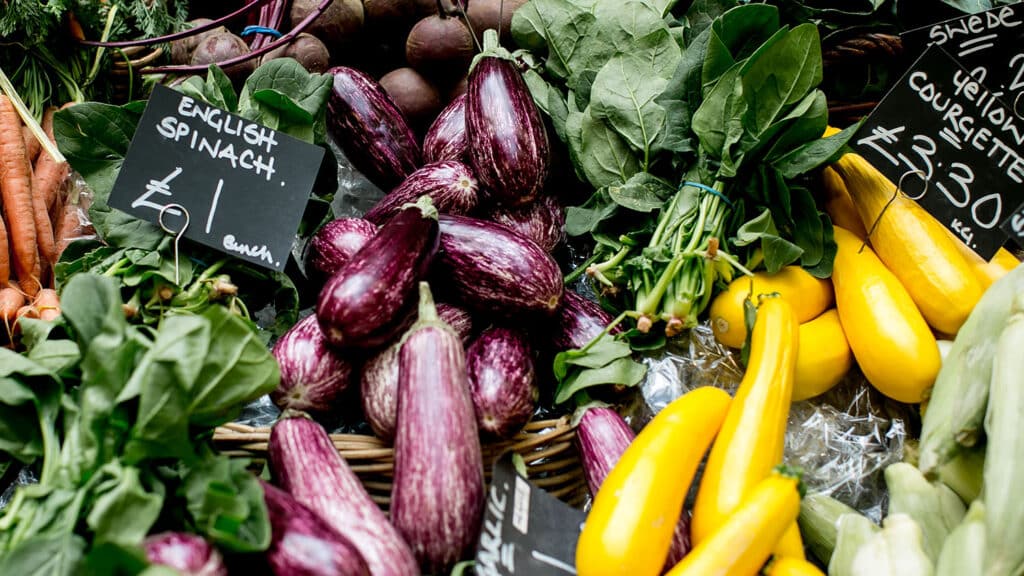
The thing is that while most people who know Borough Market have a strong sense of what it is and what it does, those perceptions can vary quite widely – and for good reasons. The Market of today wasn’t planned out around a clear set of well-defined criteria; instead, it grew organically over many years, shaped by the ideas and hard work of a large and disparate band of traders, trustees and staff. As a result, it’s a complicated, colourful place (which is a big part of its appeal). We have produce and street food, producers and merchants, restaurants and events spaces. Our traders span the world, from Southwark to Southeast Asia, selling an incredible breadth of food, from everyday basics to expensive luxuries. Clearly, there are some threads that bind it all together – there are many examples of extremely high-quality food, of sustainable production, of ethical sourcing – but these had never previously been analysed and defined.
That is why my fellow trustees and I have recently published the trust’s first-ever Food Policy. We want shoppers to know with absolute certainty what Borough Market food means, in a way that can be shared, tested and – when necessary – challenged. We want to offer the Market’s leaders a coherent basis for their strategies and plans. And we want to be able to shout from the rooftops about Borough Market’s approach, knowing that the institution’s high profile makes its messaging hugely influential.
Produced after a thorough process that kicked off in 2019 with focus groups, interviews and surveys designed to draw out the thoughts of traders and other stakeholders, the Food Policy presents a detailed set of principles, organised under nine headings: quality, environmental sustainability, social & economic sustainability, animal welfare, knowledge & transparency, opportunity, health, variety, and accessibility.
There are far too many points in the policy to summarise them all in a single paragraph, but some do stand out. Supply chains should be as short as possible, with priority given to foods that are produced by the trader or sourced directly from the producer. There should be equity of reward throughout the supply chain. The food sold here should be produced in a way that has a demonstrably less damaging effect on the environment than that of large-scale producers and retailers. No one should be offering ultra-processed foods, regardless of their calorie level. High animal welfare standards should be expected not just of traders specialising in meat, fish and dairy, but those that feature animal products anywhere in the supply chain. The range of food should reflect the diversity of our community, and this diversity should also be seen in how and by whom the food is sold and promoted.
It is a set of principles that will guide not just what the individual traders sell, but how the entire institution operates – the balance of the Market’s offering, the selection of traders and tenants, the development of staff, even the catering of our meetings.
Although many of the conditions contained within the policy are already very much in evidence within the Market, what we’re offering here isn’t a focused snapshot of what Borough Market is today; it’s a vision for what Borough Market will be in the years to come. And there is a lot of work still to be done.
As with everything – and particularly within an ecosystem as vibrant and complex as that of Borough Market – the devil is in the detail. Our next challenge will be to turn our broad principles into detailed set of standards for each category of food in the Market. To do that, we will be working closely with traders and external experts to ensure that we understand the unique character of each sector and set rules that are truly meaningful.
For example, fulfilling the requirement that traders display good knowledge of “where their food came from, how it was produced and who produced it” is a relatively simple demand for a butcher who only sells British meat and whose work is already directed by stringent government rules around traceability. It is much harder for a spice trader who operates within the vast spider’s web of a global wholesale marketplace and who rarely has the option of buying directly from a producer. We want both our meat and our spices to be as traceable as possible, but what that means in each case will be slightly different. With some of the principles in the policy, we will be able to create simple standards that apply across the board; with others we will need more nuanced, sector-specific rules. What does environmental sustainability look like in the context of sea fishing, as opposed to fruit horticulture? These distinctions really matter.
Once they are completed, those detailed standards will be published alongside the current policy – transparency is, after all, once of the key tenets of the entire exercise. Anyone who wants to see the nuts and bolts, will be able to do so. For most people, understanding our principles will be enough. Admittedly, it takes a lot more than three words to get them across, but they are clear and simple nonetheless.
Shane Holland is Vice Chair Elect of the Borough Market Board of Trustees and Executive Chair of Slow Food UK
Borough Market Food Policy
Explore the Borough Market trust’s new Food Policy, which sets out the principles that will define the Market’s approach to food for years to come
Beet surrender
Angela Clutton on how, after growing up despising the pickled beetroots of her youth, she came to fall in love with this most sweet and earthy of autumnal vegetables
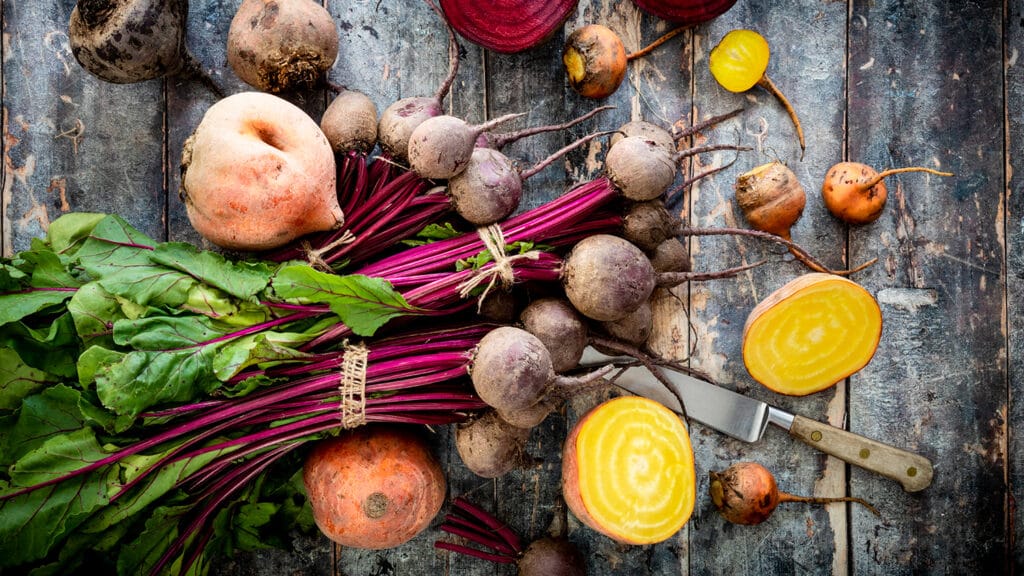
“LIKE MANY A CHILD OF THE 70S AND 80S, THE BEETROOT OF MY FORMATIVE YEARS CAME CRINKLE-CUT AND PICKLED”
Images: Regula Ysewijn
Millennials and Generation Zed-ers, how I envy you the beetroot roasts, carpaccio salads and blended dips you have grown up with. Because like many a child of the seventies and eighties, the beetroot of my formative years came crinkle-cut and pickled. And I loathed everything about it: the inevitable staining of fingers and favourite dresses, the smell and, most of all, the taste.
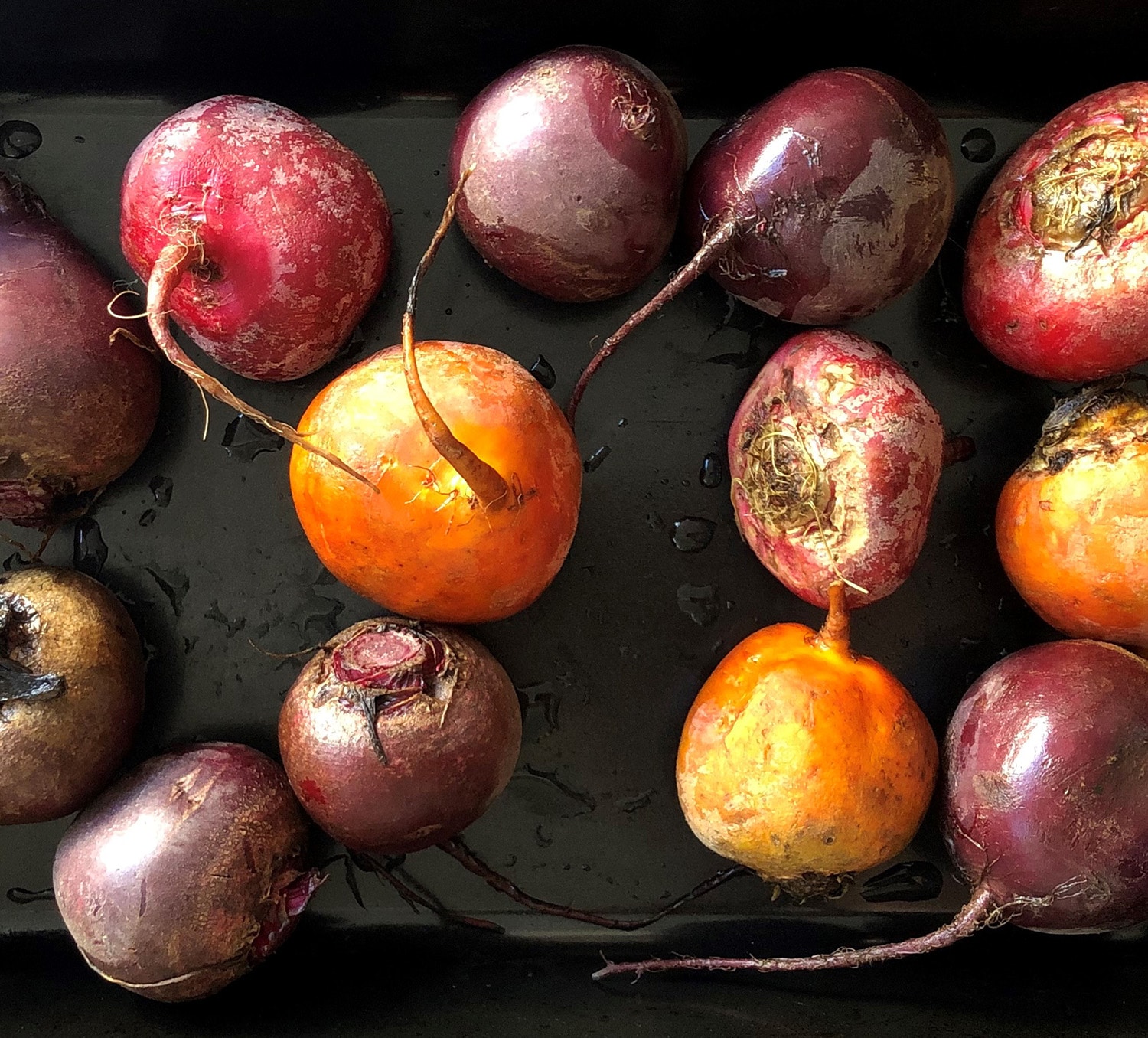
It would be many years before I realised that beetroot came in anything other than a jar and saw for the first time a true beetroot, one with actual roots and leaves attached, its rough skin just waiting to reveal the glistening sweet flesh underneath. Ideally, it’ll have a little soil still on there too – soil that is somehow redolent of the deep earthiness of flavour that beetroots carry and that came as a taste revelation to me. These days, I can’t imagine not having beetroots in my cooking life and whenever I use them, I try to bear in mind that they’re at their best when prepared in ways that protect and embrace that earthy flavour.
Sure, beetroots can be boiled or steamed. Know, though, that even when a few centimetres of the roots and tops are left on as a precaution, it is inevitable that some of the colour – and flavour – will bleed out into the water. Roasting is the way to go for achieving the deepest intensity of flavour. All the better with some sprigs of woody herbs, garlic cloves and a few tablespoons of red wine vinegar in the roasting tin to help the flavours along. Cooked and cooled, their skins slide off with the barest rub of your thumb, leaving them ready to partner with the glorious autumnal produce that clever old Mother Nature, with her unerring knack of knowing exactly what goes with what, has arranged to have in season at just the same time.
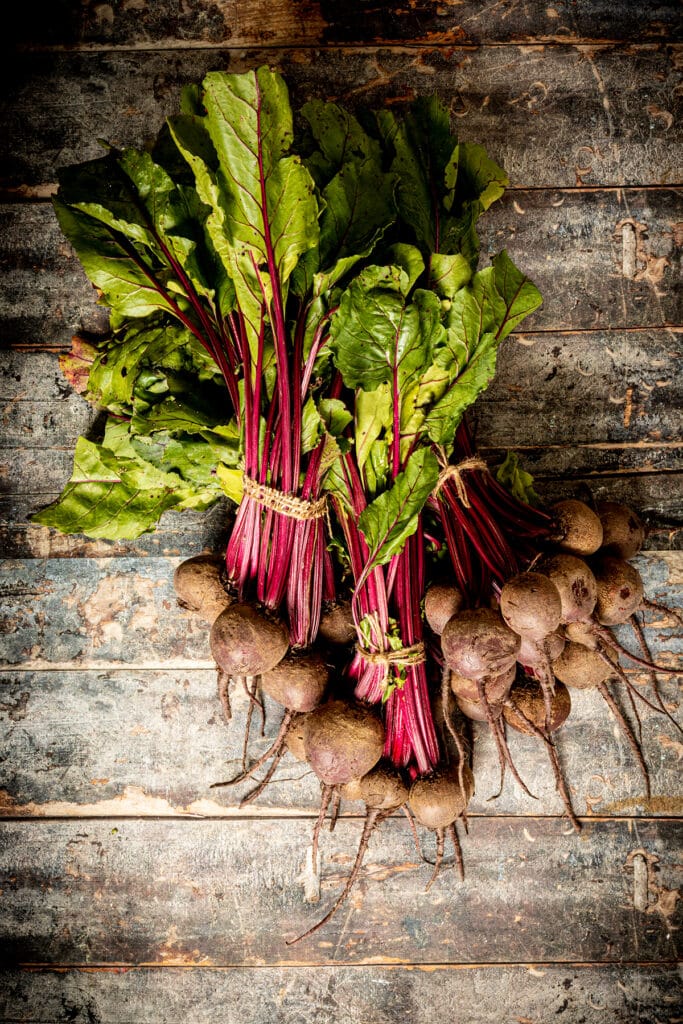
Think about beetroot as a perfect fit for game meats, maybe roasted with shallots and a slug of port wine for venison steaks. Or as a foil for autumn’s blackberries, plums or figs, the acidity of the fruits balancing the beetroot’s sweetness. It’s the same, too, when winter’s oranges start to appear. One of my go-to, midweek-favourite, cold-weather dishes is roasting beetroot with chunky sausages and a hefty squeeze of halved orange, the spent fruit thrown into the roasting tin too. Served alongside will be the beetroot tops’ leaves, stir-fried in the way I might do some swiss chard, beetroot’s botanical cousin.
The sharpness of the fruits against the sweetness of beetroot is a clue to how successful beetroot is with soused herring or mackerel. And given sousing is just pickling with a slightly snazzier name, I can’t for too much longer avoid admitting that, now I’m a self-declared vinegar obsessive, I see that pickled beetroot can be a very fine thing indeed. Inspiration comes from chefs such as Yotam Ottolenghi, who offers a ferment of beetroot with turnips in his Jerusalem cookbook, or Olia Hercules, who has so many gorgeous recipes for fermented or pickled beets.
Those writers and many others tell us of beetroot’s connection with the culinary heritage that runs through the Middle East, the Caucasus and into eastern Europe – a spread of nations whose mention in the context of beetroot means I’m swiftly headed to one thing: borscht. Borscht seems to have sometimes become a bit of a catch-all word for any beetroot soup, yet there is an authenticity to the many variations that come with different nations, all of which make it with the produce they have in abundance, in a way that suits their lifestyle.
Borscht is almost always made with dill, and often with horseradish – two more flavour partners we would all do well to remember. It might be chilled, or not. Light, or rib-sticking. Vegetarian, or made with meat stocks or chunks of pork. Blended smooth, or with the elements left whole and distinctive.
Blending beetroot makes me think too of glorious beetroot dips: baked, then blitzed with yoghurt and some of the many flavours it has a natural affinity for. That could be dill and horseradish, yes; or perhaps cumin, walnuts, mustard, garlic or capers. I have become a huge fan of heaping beetroot dip on rye for lunch, or in a bowl for flatbread with a drizzling of the very best extra virgin olive oil I can lay my hands on.
My Great Beetroot Epiphany has so far centred on cooked beetroot, but what about using it raw? That can be just as fabulous. Try grating some into latkes to give more colour and sweetness than the traditional potato. Grate into a carrot salad, finely chop for a remoulade with celeriac, or use in a winter leaf salad for gravadlax. ‘Carpaccio’ beetroot salads can be made by simply slicing raw beetroots as thinly as your fingers or a mandoline will provide and styling the circles on a platter – a dressing of sherry vinegar, olive oil and pounded walnuts works exceptionally well here.
That’s a beauty of a dish that becomes extra Instagram-able if you use a mixture of beetroot varieties. Modern cooks may not have quite so many different shapes and sizes and colours of beetroot as were around in the 19th century, when beetroot first properly burst onto the culinary scene, but we do okay. Keep an eye out for gorgeous golden beetroots, or the choggia ‘candy-stripe’ variety that give the classic ruby-red globes a run for their money. Note that the choggias are best used raw, as their stripes can sadly disappear on cooking.
The ‘candy’ name of the choggias is a nod to their colour but also to the inherent sweetness I have been banging on about here, and which makes them such a joy in savoury dishes. It does not, however – for my money, anyway – make them anything like so useful or joyous in sweet cooking. I just cannot get my head or tastebuds around using beetroot in the chocolate cakes, brownies, mousses and more that I know lots of people enjoy. I don’t know if I can ever fully escape the feeling and flavour of the earth. Even beetroot ice cream is a thing. Just not my thing.
I shouldn’t say that, though, when I haven’t actually tried it. Maybe you have, and maybe it is fabulous. And isn’t this just the kind of beetroot prejudice that first got me into my anti-beetroot bind all those years ago? Perhaps we should all be more open-minded about cooking with beetroots and beet leaves, and enjoy the diversity of ways they make autumn’s meals zing with colour and flavour.
Discover more
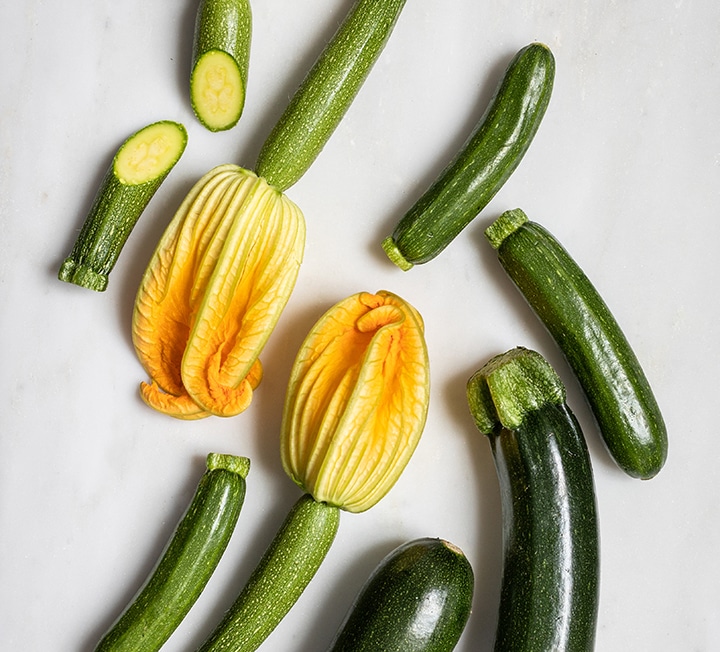
Hidden charms: kohlrabi
Determined that you should never judge a book by its cover, Ed Smith explores the hidden charms of some of the Market’s less obviously alluring ingredients. This time: kohlrabi
“PEEL BACK THAT SKIN AND YOU’VE A VEGETABLE YOU CAN COOK IN EVERY WAY YOU WOULD A ROOT LIKE A PARSNIP OR CELERIAC”
Image: Ed Smith
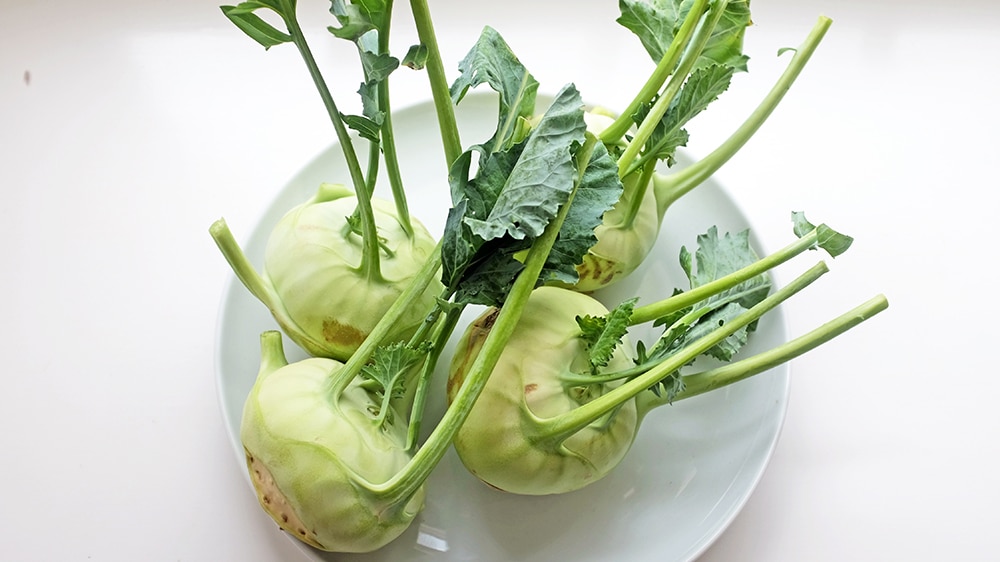
By my guestimation, kohlrabis landed in the UK about 20 years ago, like stout green sputniks or aliens from a Pixar movie sent to colonise our greengrocers. These weird looking vegetables are thick skinned and knobbly, sometimes with arms sprouting from them, and frankly pretty unapproachable.
Head across the Channel, down and left a bit, though, and you’ll find they’ve been a staple in our Germanic cousins’ diets for, well, pretty much ever. In fact, the etymology of kohlrabi (in German, ‘kohl’ means cabbage and ‘rabi’ is turnip) provides strong clues both to its heritage and what you might do with it.
Though it looks like a root vegetable, the kohlrabi is a brassica (like cabbage or broccoli), having been artificially bred as the swollen growth of a wild cabbage species. This helps explain the taste, which is similar to the stem part of broccoli – kind of sweet, a little bit peppery, a little bit cabbagey, and a little bit nothing at all.
In looks and texture, however, it is more like a turnip. Like turnips, kohlrabis have a fairly high water content, but are tough and almost impossibly crunchy and bitter when left raw and whole; you really wouldn’t want to bite into one as if it were an apple.
None of this is tempting you to buy and cook a kohlrabi yet, is it? Well, let’s start to turn this grubby stem into a flowering plant. Or at least something that’ll please the table come dinner time.
Kohlrabis are multi-talented. Peel back that skin and you’ve a vegetable you can cook in pretty much every way you would a root like a parsnip or celeriac. Dice it roughly, sweat in a little butter before pouring vegetable or chicken stock over the top, and before long you’ll be able to blitz it into a lovely autumnal soup.
You could add stilton, as you would to broccoli, apple as you might to parsnip, or cream and horseradish in the same way you might jazz up a bowl of blitzed beetroot. They roast fairly well, too, particularly when added to a mixed tray of squash and parsnips. I personally think they are perhaps a little too watery and bland to turn into a decent smash or purée.
Perhaps my favourite way to use a kohlrabi, however, is also a reminder of its versatility. For while kohlrabis do cook well, you can eat it raw if you slice it very thinly, ideally using a mandolin. At 1-2mm thick, kohlrabis are crisp and refreshing, the pepperiness is more pronounced, and are a wonderful carrier of citrus flavours and fresh herbs. A grand example is the kohlrabi and shrimp salad I once found on the menu at St John restaurant in Farringdon; I could eat it by the bucketful.
There’s more: if you salt thin slices of kohlrabi and wait for a few minutes, the slices become pliable, and can be artfully draped over other ingredients, or more usefully used as an edible holder for canapés, like vegetable tacos. Cut slices of mandolined kohlrabi into strips, and you can mix up a quick remoulade with yoghurt, mustard and parsley.
All of which means, I think, that this unappealing alien is, in fact, an amiable jack of all trades – a vegetable with which you should experiment if you’re not already well acquainted.
See Ed’s recipe for kohlrabi, spinach & smoked mackerel gratin.
The family stone
Rosie Birkett on the joyful memories and recipe ideas sparked by the arrival each summer of stone fruits
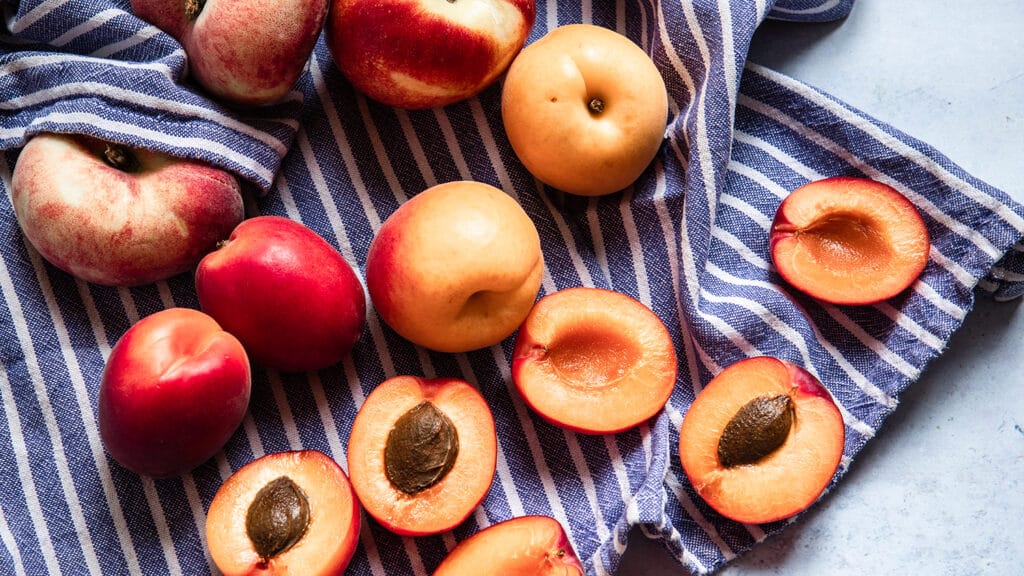
“THERE’S SOMETHING OUTRAGEOUSLY, ALMOST ILLICITLY GOOD ABOUT A WARM, FLESHY MOUTHFUL OF PEACH”
Images: Regula Ysewijn
A bag of ripe peaches heralds the summer. It summons flashbacks to moments suspended in time like peaches preserved in syrup: soporific garden lunches with bowls of peaches and cream; a lone, slightly squashed orb wrapped in kitchen roll at the bottom of my schoolbag – a sweet, longed-for, reviving joy after an ascetic hour of dreaded double maths.
I can be on the Walthamstow marshes, surrounded by nettles, fox poo and teenagers playing football and feel like I’m in the south of France if I’m biting into a perfectly plump peach – its honeyed juices dribbling shamelessly down my chin. There’s something outrageously, almost illicitly good about a fleshy mouthful of peach that’s been left to get warm-to-bursting in the sunshine, and if I’m hauling our meals to the park to escape our stifling London apartment in high summer, these make for a blissful dessert, just as they are.
Along with sublimely fragranced white peaches from France and Italy, flat peaches are a favourite. Slightly less fuzzy than their rounder siblings, their headily perfumed, pale flesh has an extra sweet flavour with a whiff of almond. Originally grown in China – where the peach originated – from a mutation of the common peach, they have become popular across Europe in the last few decades, but make sure you look out for the organic, Spanish-grown versions rather than the sad, plastic-wrapped imports from further afield. One of my favourite ways to use them is baking them into a light, almondy upside-down cake with cherries and basil. The soft fruit keeps the cake moist, sort of self-saucing it, while the basil lends a fragrant edge and the flaked almonds an irresistible crunch. With the addition of a luscious spoonful of clotted cream or creme fraiche (Neal’s Yard Dairy, I’m looking at you), it’s everything I want in a cake.
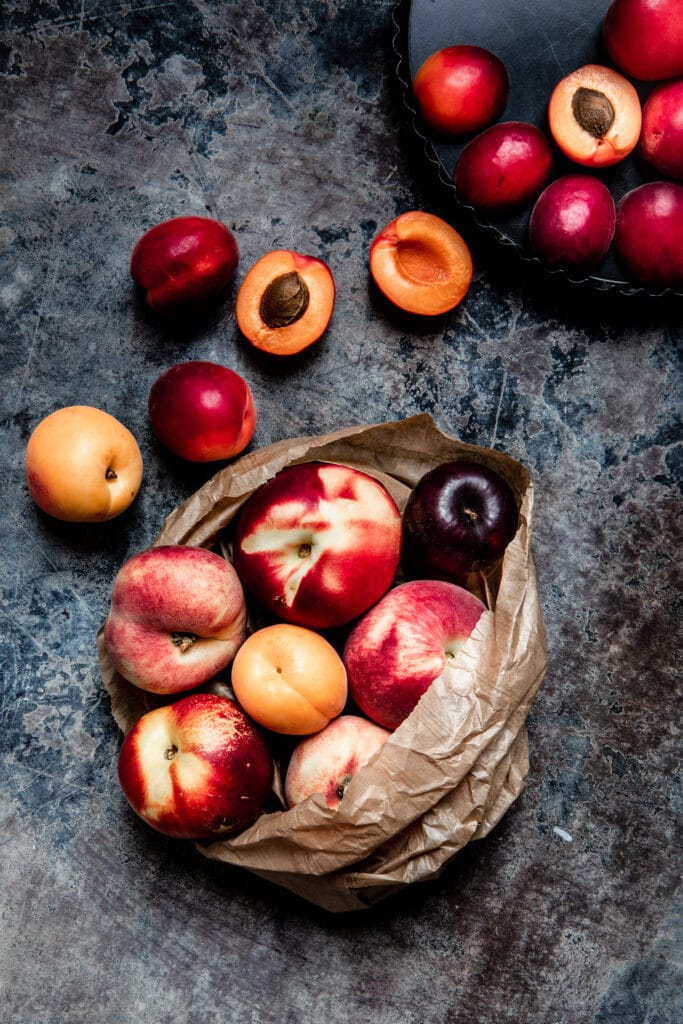
Almonds and peaches are a happy combination much-loved by the Italians, particularly in the classic dish of ‘pesche ripiene’, or stuffed peaches. The version from my battered, browned copy of Elizabeth David’s Italian Food has been a staple at our kitchen table for years. It calls for six yellow peaches, three ounces of crushed macaroons (in the 1950s, this meant amaretti biscuits), one egg yolk, two tablespoons of sugar and an ounce of butter. You cut the peaches in half, scoop out the stones and mix a little of the pulp with the other ingredients, then stuff it back into the peach, baking them in a buttered dish for around half an hour. I’ve made several versions over the years, replacing the amaretti with flaked almonds or the egg yolk with more butter, and (sorry Elizabeth) adding a splash of sweet white wine, prosecco or rosé to proceedings when the mood’s taken me.
If you’ve not tried before, have a go at pickling peaches. When left to bathe in a sweet solution of good quality white wine vinegar, sugar, fennel seeds and peppercorns (or whichever aromatics you might fancy), they take on an incredible complexity and depth of flavour, and a balanced acidity that makes a wonderful accompaniment for fatty, grilled, meaty things like pork chops or great hunks of hard, nutty cheese such as comte or manchego. The skins will wrinkle with time but don’t worry about that – you can just peel them off.
In a similar vein, peaches are marvellous in substantial salads. I love them paired with the peppery, slightly citrussy flavour of celery leaves, tossed with a sharp goat’s curd, sourdough croutons and prosciutto and strewn with anise herbs like chervil or tarragon. At a late-summer supperclub a few years ago, I served a version of this with Cornish pork belly that had been slow braised in whey and then crisped up under a hot grill. There’s something magical about crispy pork crackling eaten with yielding peachy flesh.
Apricots, with their smooth, deep golden skins blushing hot pink, are another wonder of the warmer months. If the flesh is mealy and the flavour one-note, they can underwhelm – but even these can be rescued with a gentle roasting in the oven or caramelising in the pan, or by poaching in a wine-based syrup. I like to poach whole apricots in sweetened rosé with lemon zest and fresh lavender – the floral, herbaceous notes of the purple flowers add a pleasing complexity, and the poaching concentrates the flavour. I use these in all manner of desserts: baked into tarts, or eaten with whipped cream cut with a little natural yoghurt and topped with crushed shortbread and chopped nuts.
Very good apricots have a unique sharpness that makes them ideal for patisserie. Paired with sweet, vivid green pistachio frangipane, they really sing. I’ve made various ensembles, from blondies to more classical tarts with flaky, buttery pastry. My absolute favourite, though, is to bake them into a biscuity, hazelnut pastry tart shell with a sharp, muscovado-laced buttermilk filling that retains an irresistible wobble once baked, dressing the fruit with tangy, silky custard upon slicing.
Growing up in Kent, plums were the fruit that defined the late summers of my childhood. I still remember my unexpected delight at biting into the dusky reddish-purple skin of my dad’s homegrown plums to find something juicy, sweet and sharp – better than anything I could have bought from the school tuck shop (and that’s saying something, for I was its best customer, loading up on Wham bars and pink shrimps daily – it’s a miracle I’ve still got teeth). In recent years, I’ve become partial to greengages, enjoying their fresh, tangy flesh in dairy-rich desserts and salads with peppery leaves, or in my favourite breakfast compote, made with whole almonds or cobnuts, ideal on hot buttered crumpets or mounds of good yoghurt.
Small wild plums, similar to mirabelles, grow copiously on the marshes where I live. I’ve roasted pork on top of them so that its juices mingle with their blistered skins. I’ve even had a go at salt-fermenting some, inspired by the Japanese delicacy of umeboshi. The resulting shrivelled, concentrated, wonderfully sour fruits were a revelation, so I served them in a dashi-like broth at my residency at Carousel in Marylebone, which I had the unplanned audacity to dish up to some real life Japanese people, visiting from Tokyo. Thankfully, they approved of my approximation – or else were just too polite to let on.
Discover more

Q&A: Steven Brown
The farmer responsible for 13 Acre Orchard on regenerative systems, eliminating waste and the support provided by greedy chickens
“EVERYTHING GROWS BY ITSELF. MY JOB IS TO MITIGATE ANY ISSUES THAT MIGHT CAUSE PROBLEMS FOR THAT GROWTH”
Interview: Mark Riddaway
Most farmers are born to the role, their roots dug in deep across the generations. Not Steven Brown. “I never really thought I’d be doing this,” he says. “I just always wanted to spend my life outside. Long story short, it turned out the way I could spend the most time outside was through farming.” What began as a series of outdoor jobs became a genuine vocation after Steven found work on a permaculture farm – an approach to food production informed by the natural interplay that allows complex, diverse ecosystems to thrive in the wild. “You look around and there are thousands of trees, wildflowers, shrubs and crops, all squeezed together into this tiny space,” he says. “I started to read a lot about the positive influence this type of farming can have. It really helped shape the way I see the world.”
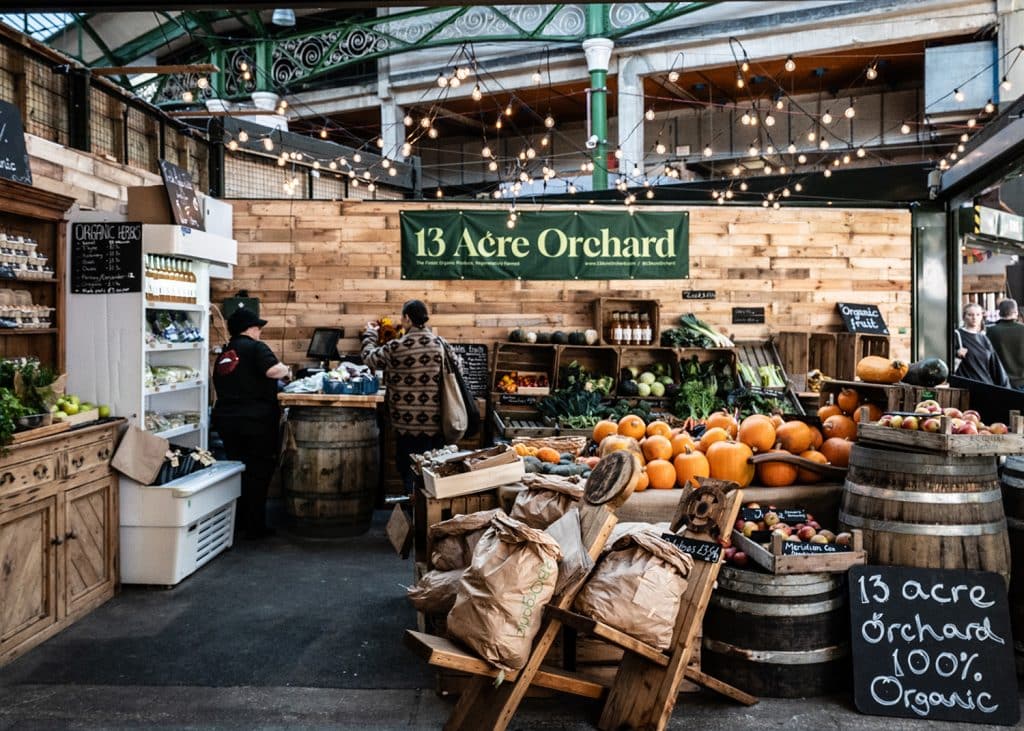
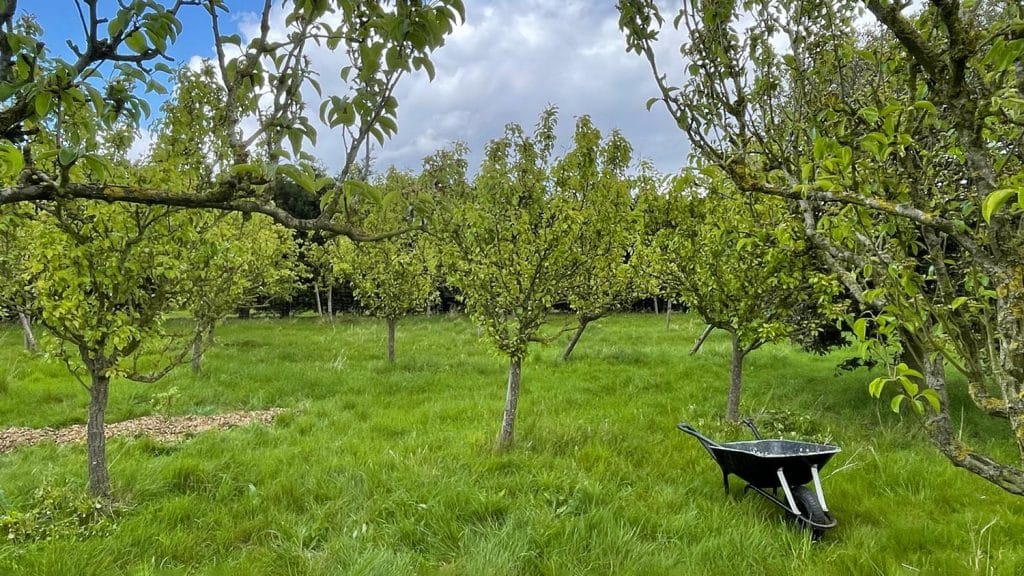
Steven’s evolving worldview is now being applied in a small but systematic way at 13 Acre Orchard, a beautiful plantation of fruit trees and vegetable patches on a farm close to Saffron Walden in Essex. For the past three years, almost entirely unaided, he has been slowly transforming this patch of land into a regenerative farming system, the produce from which he sells at the new 13 Acre Orchard stand at Borough Market.
How did you come to be running 13 Acre Orchard?
I grew up in this area. A friend of mine introduced me to Laura, who owns the farm. She’d just had a son, and the workload involved in running the orchard was proving too much – even without having children, it’s a lot. The first time we met, I spent a couple of hours walking around the farm while she explained that was involved, and I was thinking, she’s got to be nuts, this is ridiculous, how are you supposed to do all this? But I still came back the next week to have another look. I did a bit of research, I made the visit a few times, and every time I came here it felt a bit more realistic – a big challenge, but possible. I thought, let’s just take the world as it is and see what happens. I’d worked with trees before at the other permaculture place, but nothing on this scale. It’s been non-stop since then. I’ve been working flat out, all the while trying to figure out how to do this, how to improve the land.
You describe what you do at 13 Acre Orchard as ‘regenerative’ farming. In simple terms, what does that mean?
It starts with the idea that a farmer is there to look after the land. In a regenerative structure, the land you’re looking after will improve as you’re farming. As you grow your vegetables or raise your livestock, or whatever it is you’re doing, you’re putting more carbon into the soil, you’re looking at how water moves through the landscape, you’re creating more wildflowers, more insects are coming, there’s a growing abundance of everything, from microscopic life up to bigger things like birds. There are lots of different elements you can add in, but the main thing I’m concentrating on is building the soil health and depth, creating biodiversity on a microscopic level – more bacteria and fungi, microarthropods and macroarthropods. If you can feed those things, they in turn feed the trees, so you don’t need the fertilisers. That process also results in the carbon sequestering that people talk about us needing more of. You’re sticking carbon straight in the ground, and that’s helping the trees to be healthier as well.
So, you’re intervening in those natural cycles far less than a conventional farmer would do…
Yes, it grows by itself. Your job as the farmer is to mitigate any issues that might cause problems for that growth. Compaction in the soil is the big one. Too much water can also cause problems, as can water in the wrong places. To mitigate that, putting a pond into the landscape can bring all the water together while also creating an environment which is beneficial for different plants, so you get more pond life and healthier trees.
What are you currently growing at 13 Acre Orchard?
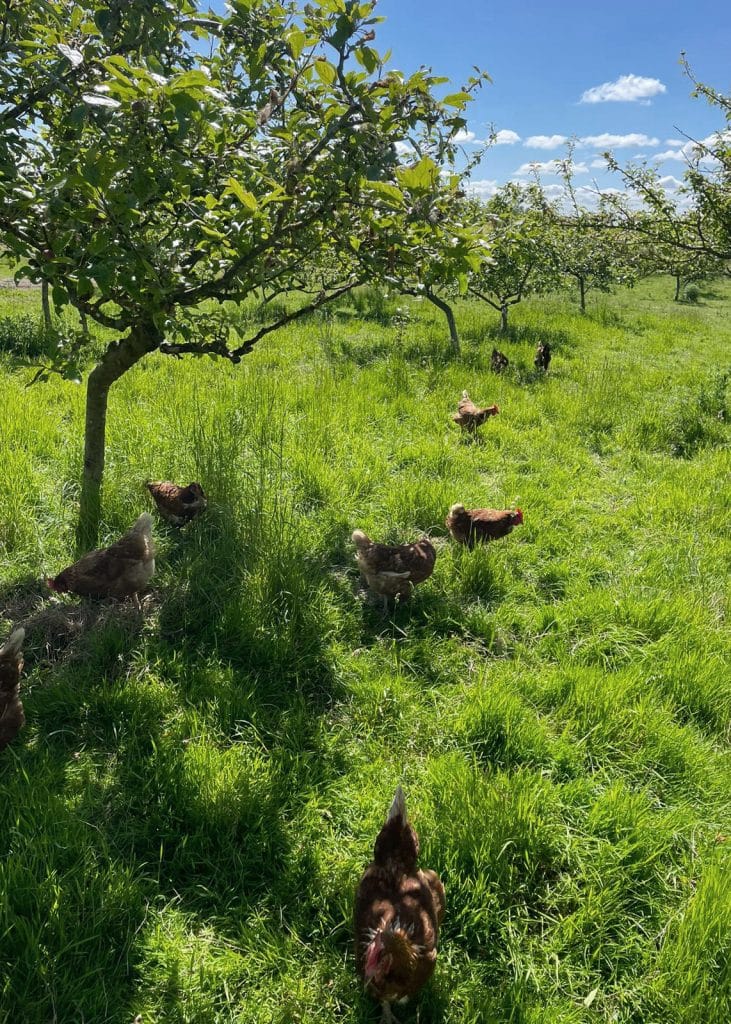
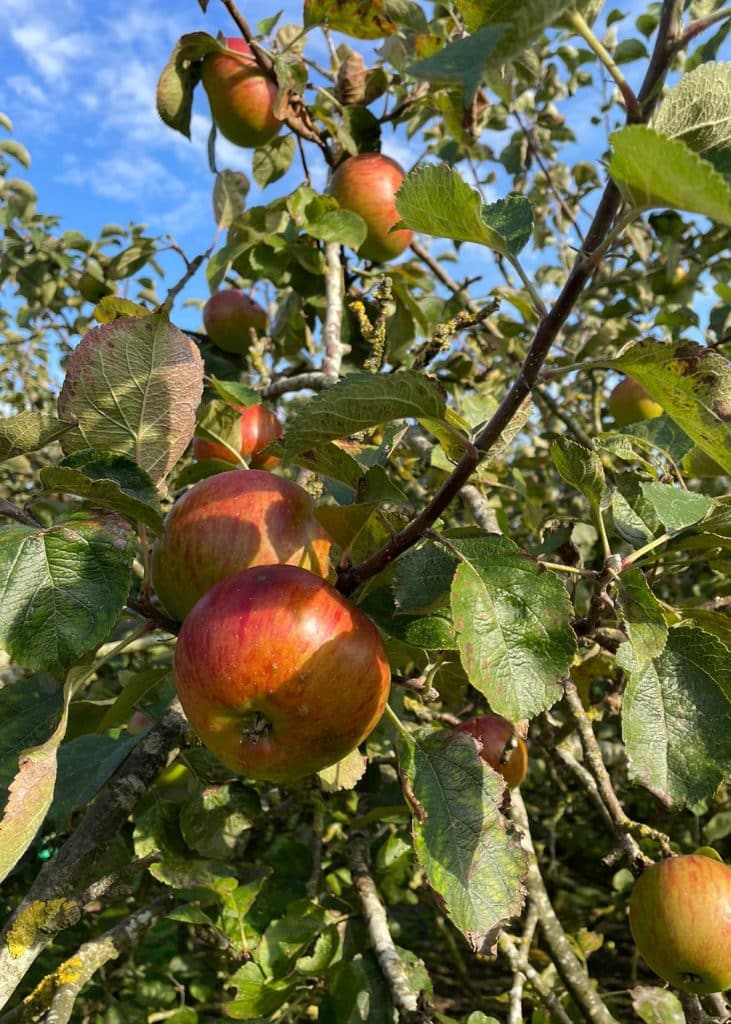
Mostly, it’s apples, plums and pears. We have chickens for eggs – Laura looks after all the chickens still. They live under the apple trees and eat lots of the insects that would normally cause problems to the apples. They also produce plenty of natural fertiliser.
We also have a small vegetable garden, which we’re looking to expand, and we’re going to possibly do some flowers very soon too. My long-term plan is to incorporate a lot more growth within the orchard in a way that benefits the trees. Rhubarb, for example, grows well under fruit trees. It will come up at the beginning of the season and grow up big and help the trees to grow. Later in the year I’ll grow another crop within the same space. There’s a world of possibilities – it’s a bit overwhelming at times, but all very, very exciting.
What do you do to ensure that as little as possible is wasted?
We juice the apples that nobody would want to buy. After extracting the juice, you’re left with a pulp, and we use that pulp to make fruit jelly. My mum makes all the fruit jellies and jams – she’s been doing that her whole life, basically. Anything we can’t use gets made into compost, which goes into the vegetable garden and around the trees. Any cardboard waste is also getting incorporated into the compost. The idea is that there is no waste anywhere along the way. At some point in the future, hopefully we’ll be able to use potato starch as pallet wrap – at that point, I don’t think we would have any waste at, because that’ll go into compost as well. It can be done!
You’re also selling produce sourced from other farms. What’s the nature of that relationship?
So, the idea is to build a network of farms that share a similar way of doing things – regenerative, organic, however you want to label it. Ultimately, it’s people growing good food in a positive way. For example, there’s one guy that’s growing peas, but he’s growing wild flowers mixed into the crop. So, you’ve got a field of peas, but with an under-layer of wild flowers. Across a whole field, you end up with millions of extra flowers, and there are lots more insects because of that. We’re looking for people like him who are doing interesting things with farming, we’re buying stuff from them and putting it out into central London. We want this to be the main hub for regenerative agriculture in London.
What can we look forward to seeing on the stand in the coming months?
There’ll still be lots of apples. There’s going to be plenty of squash. There are mushrooms, carrots, beetroot. Brussels sprouts will be coming in, all the Christmas stuff. We’re getting everything ready for Christmas now. We’re trying to work the shop so it’s completely seasonal. There’s still loads of food around now; the challenge will be, at certain times of the year, that there isn’t much growing. But that’s tomorrow’s problem!
Do you enjoy selling food direct to the public through markets?
Yes, it’s good fun. Whether or not people like what you’re doing, you get such a quick reaction. Luckily for me, more people like it than don’t, so they keep coming back each week. We see lots of the same faces, week in, week out, which is nice. It’s like holding 200 brief conversations simultaneously.
By the standards of modern farming, yours is a very small operation. Are the things you do to support the environment replicable on a larger scale?
Yes, regenerative farming is definitely something you can do in a way that would look from the outside more like traditional agriculture – like standard fields of crops. There is a tension in some people’s minds between modern farming and the environment, but I think you can combine the two. To give the devil its due, the farmers who are doing that large-scale monocropping are producing huge amounts of food, which simply wasn’t possible before. I think it’s entirely feasible that you can combine these two schools of thought so you’re getting the best of both worlds. Regenerative farming doesn’t have to be limited to little orchards like this.
Discover more


Cupboard love: pistachios
Ed Smith on why pistachio nuts are an essential component of his kitchen cupboard
“YES, THEY’RE A TEMPTING BAR SNACK, BUT THE POTENTIAL OF PISTACHIOS GOES FAR BEYOND THAT OF A DRINKING PARTNER”
Image: Regula Ysewijn
I didn’t grow up thinking pistachios were something we should cook with. Which is not to say I don’t have fond memories of them. In fact, I have strong recollections of Tuesday night binges – the time of the week when my dad sat down to work through his accounts, with a bottle of red and some salty bites to get him through the grind. Initially, the snacks were small bags of Mini Cheddars or dry-roasted peanuts. Then, as my brothers and I got bigger and our begging hands more greedy, grab-bags of Kettle Chips and Mignons Morceaux. At some point he got fed up of sharing, and it was one bag for him and one for us. And then, as a sign that he had become really frustrated by the thieving tribe he had spawned, the nibbles became pistachios – fiddly, dusty, salty pistachios in shells, which, though delicious, quickly lost the interest of boys who were supposed to be asleep, such was the effort of opening them. Dad and pistachios 1: Boys and their bedtime 0.
Now, I see pistachios in a very different light. Yes, they’re a tempting bar snack. But at a time when Middle Eastern, central Asian and eastern Mediterranean cuisines have opened up to us Brits, it’s clear that the potential of pistachios goes far beyond that of a drinking partner.
There are some food products in which pistachios shine like the diamonds they are: mortadella from Bologna is one example, Sicilian pistachio ice cream another. But we should recognise them as an ingredient to use at home, too. Blitz them in the food processor and bake near-fluorescent frangipane-style tarts (particularly good when embellished with raspberries) or make them into a crumb to form a cheesecake base or crumble (as suggested in The Borough Market Cookbook, by the way). Keep blending them into a paste and there’s material for custards, crème pâtissière and ice cream of your own. They’re savoury but also sweet and creamy – akin to a grassy sunflower seed crossed with an almond, perhaps.
On which note, it’s worth pointing out that pistachios are not nuts but seeds, the shells of which split open with an audible pop upon ripening. You can buy them roasted and salted in their shells, of course. But the very best pistachios I’ve ever tasted (and I would write this on any other organisation’s website too) are the raw, unsalted, shelled pistachios imported by Oliveology from Sparta and sold at the Market.
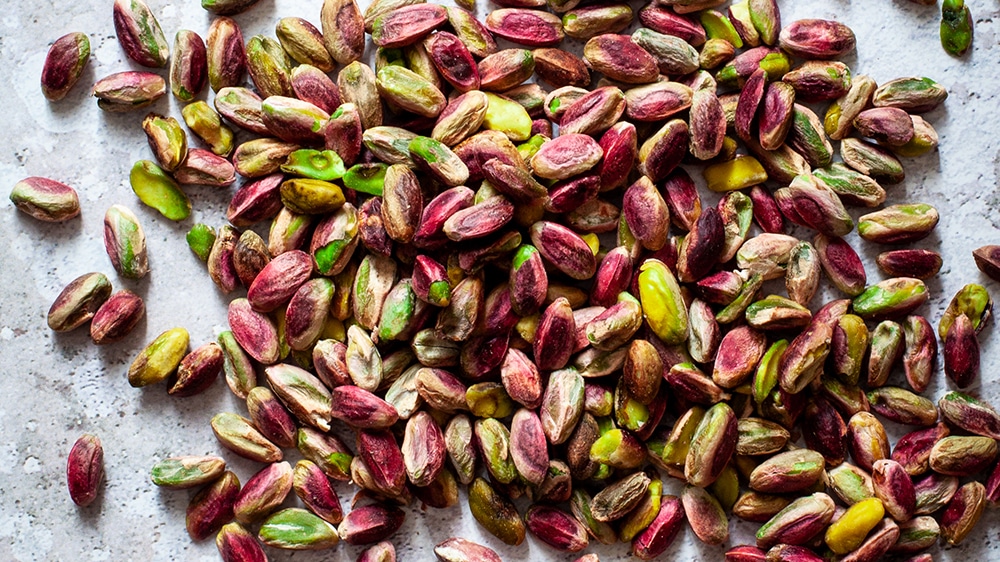
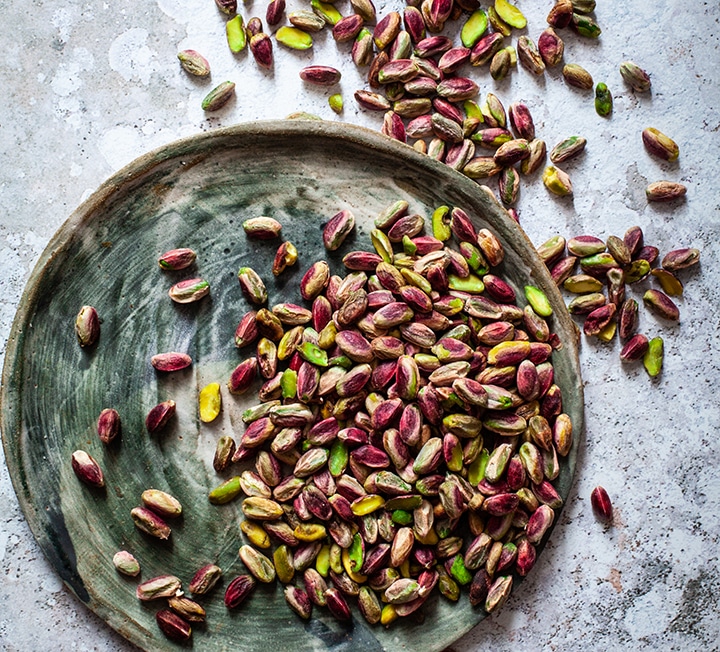
We do eat with our eyes, and if you stop by their stall, you’ll see that a bag of these are an absolute feast: bright purple skins and even brighter chlorophyll-green centres jump straight out of the cellophane. As it happens, that visual treat is echoed in the eating – the moreish flavours of my youth are amplified and emboldened. These pistachios are many times sweeter than my memories, as bright in flavour as they are in colour. Juicy too. Honestly, try them: you’ll immediately see why, in my opinion, you must always have a bag of them to hand.
They’re the ideal store cupboard ingredient, ready to embellish and improve a multitude of dishes, both savoury and sweet. You could, if you wish, chop half a bag finely, stir into honey and layer between sheets and sheets of buttered filo. But I’ve found I’m more likely to use them a few handfuls at a time: scattered over breakfast (yoghurt and fruit, or porridge); as part of a sort-of-gremolata to supercharge simple lunches (Ottolenghi-style crisp or sharp salads, with labneh or mozzarella); stirred into rice or grain-based platters for flavour, crunch and colour alongside dried fruits, fresh herbs and citrus; used in snacks and treats like chocolate bark and brownies; and on creamy desserts too (trifle, panna cotta). A sprinkling of raw, unsalted pistachios punches above its weight and is never superfluous in the way, dare I say it, pomegranate seeds can be.
If you’d like to do a little more than simply chop and scatter, consider the dukkah suggestion below. The spices, sesame seeds and flaked salt bounce so well off the pistachios in this versatile garnish. As with Oliveology’s pistachios, once you’ve tried it, it may well (read: should) become a constant presence on your shelves.
Pistachio dukkah
Put 1 tsp cumin, 2 tsp coriander seeds and 8-10 black peppercorns in a small heavy-bottomed pan and toast gently on a low hob for 3-5 mins until fragrant but not browned. Decant to a pestle and mortar. Add 4 tsp sesame seeds to the pan and toast those for 2-3 mins until golden. Grind the spices to a powder while keeping an eye on the sesame seeds.
Run a knife through 50g raw, unsalted pistachios a number of times until coarsely chopped (not fine or a powder, but not just split into one or two pieces). Add these and 4 tsp sesame seeds to the spices, along with 2 tsp flaky sea salt and, if you want a little kick, 1 tsp Aleppo chilli flakes too. Mix well and store in an airtight container at room temperature until needed. A homemade jar of this Egyptian garnish can be used to add a new dimension to a wide variety of dishes and meals. Dip some great bread first into olive oil and then into the dukkah. Use it to embellish hummus or baba ghanoush-style dips. Sprinkle it over roasted vegetables, honey-vinaigrette greens like green beans or mangetout and sugar snaps, or fresh cheeses like burrata, ricotta, curd. Or scatter it on platters of yoghurt-dressed charred and chopped kale or other leafy salads.
My cherry amour
Angela Clutton on her life-long love of the oh-so-fleeting cherry season and the recent resurgence of this beautiful native fruit
“WE’D EAT SO MANY CHERRIES OUR FINGERS AND TONGUES BORE THE FRUITY, JUICY STAINS FOR A GOOD WHILE AFTERWARDS”
Images: Regula Ysewijn
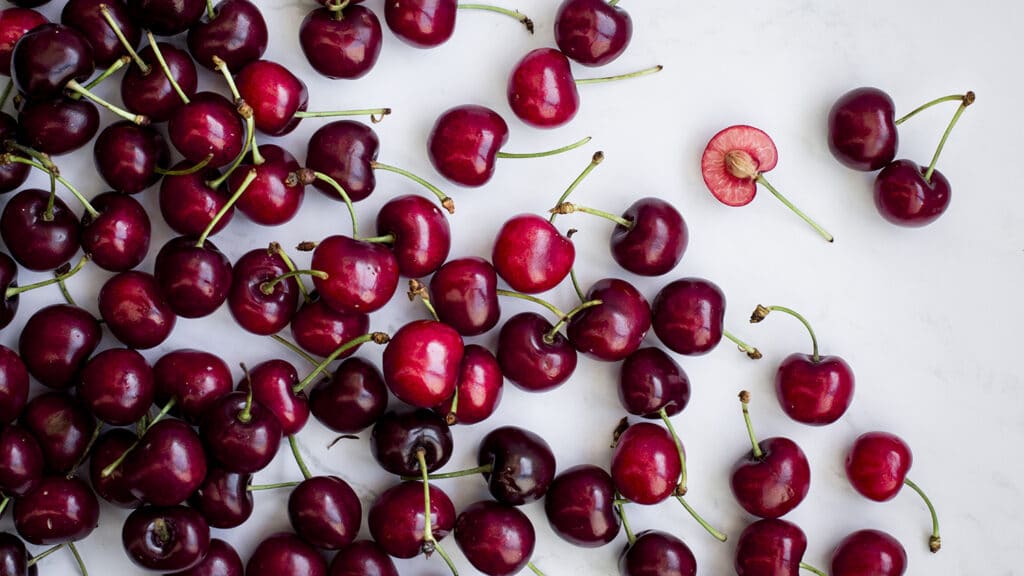
As a child, summer meant for me afternoons sitting on the grass, squabbling with my sisters, dangling cherries on their stalks from our ears as makeshift earrings. We’d eat so many our fingers and tongues bore the fruity, juicy stains for a good while afterwards. Cherries are no less intrinsically linked in my heart with the arrival of summer these days – but now what I wonder at is all the many things I will be able to do with them in the kitchen, revelling in their depth of flavour, the range of colours, and the breadth of varieties.
From the deep red colour and sweetness of a stella, sasha or venus cherry, through to the pale rainier or napoleon cherries – there are so many interesting, delicious types to look out for as the season progresses. Some are heritage varieties, some are new breeds or strains. Many represent the most enormously heartening revival of Britain’s cherry orchards.
In the 1950s we had around 18,000 acres of cherry fruit orchards in the UK. By the end of the century that was down to a slightly heartbreaking 1,000 acres. So much changed in that 50 years in how we produce, sell and buy produce. British cherries – like many other native fruits – were the loser. The sprawling size of cherry trees made them undesirable to farm given the need to maximise crops and acreage.
Even worse, cherries have a very short cropping season – running from June to early August, it is even shorter than the British summer itself. For British farmers, cherries were not a priority crop. Little wonder we have ended up at a point where the vast majority of the cherries we eat in Britain are imported from the USA or Turkey.
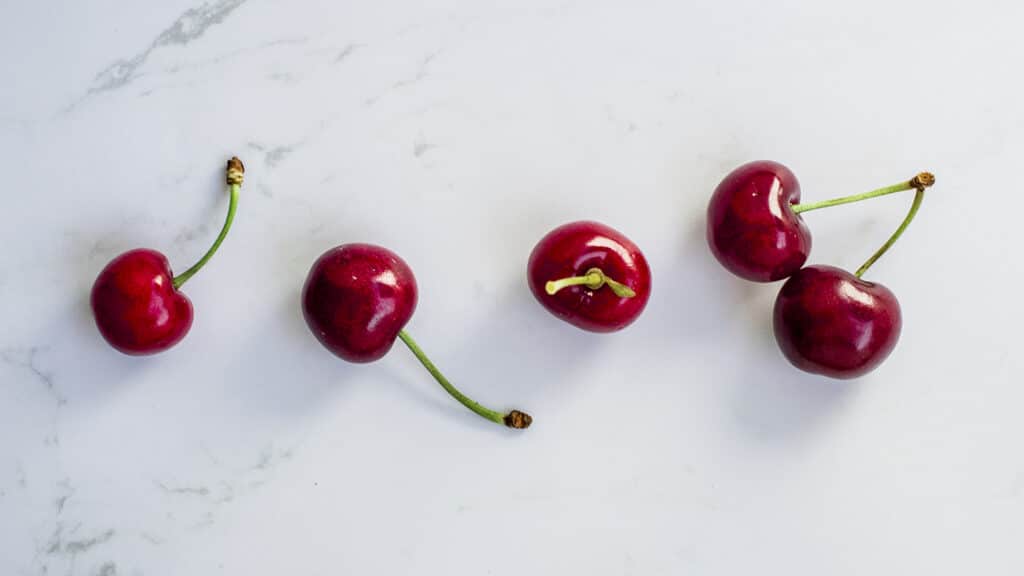
All of which makes the recent resurgence of British cherry orchards hugely encouraging. It is a modest resurgence, admittedly, but the more of us who choose to buy British cherries, the more of a chance there is of it continuing. As consumers we are – we all hope, anyway – more understanding than ever of the importance of buying seasonally and trying to seek out produce that has not been flown in from thousands of miles away. Smaller trees are being bred to help farmers make the choice to give over fruit-yielding space. Producers are putting the work in to come up with varieties that taste absolutely outstanding.
Brogdale Farm is leading the charge, as it is with so many other orchard fruits. As the home of the National Fruit Collection it preserves more than 325 different cherry varieties – not all of them produced on a sufficient scale to sell – which feels all the more fitting for being in Kent, the county that since the 1500s has been at the heart of the British cherry harvest.
That was the period when cherry orchards were first properly established in this country as a crop for more than just private use or in monastic gardens. Kent was chosen partly because it was close to London for transporting and selling the cherries; partly also because its sandy, well-drained soil is perfect for cherry trees to flourish. Take a drive or an amble through modern Kent in the spring and you will still be wowed by the ethereal spectacle of its blossoms, and then again in the summer by its delicious fruits. When you see Kent cherries for sale, I urge you to buy them. They will be so sweetly compulsive to eat I bet you end up with similarly pink-stained fingers to mine as a little girl.
Very little can be more refreshing – or easier to prepare – on a scorcher of a day than cherries gleaming with freshness, piled up on crushed ice with some basil leaves torn over. Fancy getting a bit fancier? Then how about a fruit fool made by sitting pitted cherries for a couple of hours in brandy and ground cinnamon, before lightly pureeing them and forking through a 50-50 mix of Greek yoghurt and whipped cream. A few mint leaves will complete the elegance. Pitting in this case is essential, but for most other cherry recipes is optional. An option I tend to go for using my trusty cherry-pitter tool, which makes removing the stones barely any faff at all – and I think probably less faff than taking them out as you eat.
Cherry ice cream is one of my absolute favourite summer ices; a gorgeous, slightly silly colour from the fruit, with a depth of flavour that I think beats strawberry ice-cream hands-down. Then there are cherry tarts, cherryade that again evokes memories for me of childhood summers, and cherry soup, which navigates skilfully a very tricky line between sweet and savoury.
When it comes to savoury cooking, sour cherries such as the morello variety are the usual choice. I can see why, with their helpful combination of sweetness and acidity. But don’t discount sweet or semi-sweet cherries for savoury dishes. If anything, the sweetness can work even better as a contrast (although you might need a dash of vinegar to compensate for the lack of acidity the sour cherries have). Try throwing a handful of cherries in at the end of cooking duck, lamb or pigeon and they’ll take on enough of the meat’s juices to make for a cohesive balance and when served alongside the meat, offering a richly fruity hit.
I mentioned earlier the shortness of the cherry season – an undoubted shame but one that makes it all the more appealing for cooks to find ways of extending how we can enjoy them. At the end of every summer, my fridge always has a good few jars of cherry jam, and even more jars of ‘cocktail cherries’ macerating in maraschino, brandy and spices – my stand-by for year-round garnishing of negronis, Manhattans or old fashioneds, and also an excellent emergency pudding with ice-cream and some of the boozy juices poured over the top as a makeshift sauce. But what am I doing, talking about the end of summer like this? Don’t listen. All you need to focus on right now are thoughts of how you will use the summer’s cherries to create lifelong food memories.
Discover more
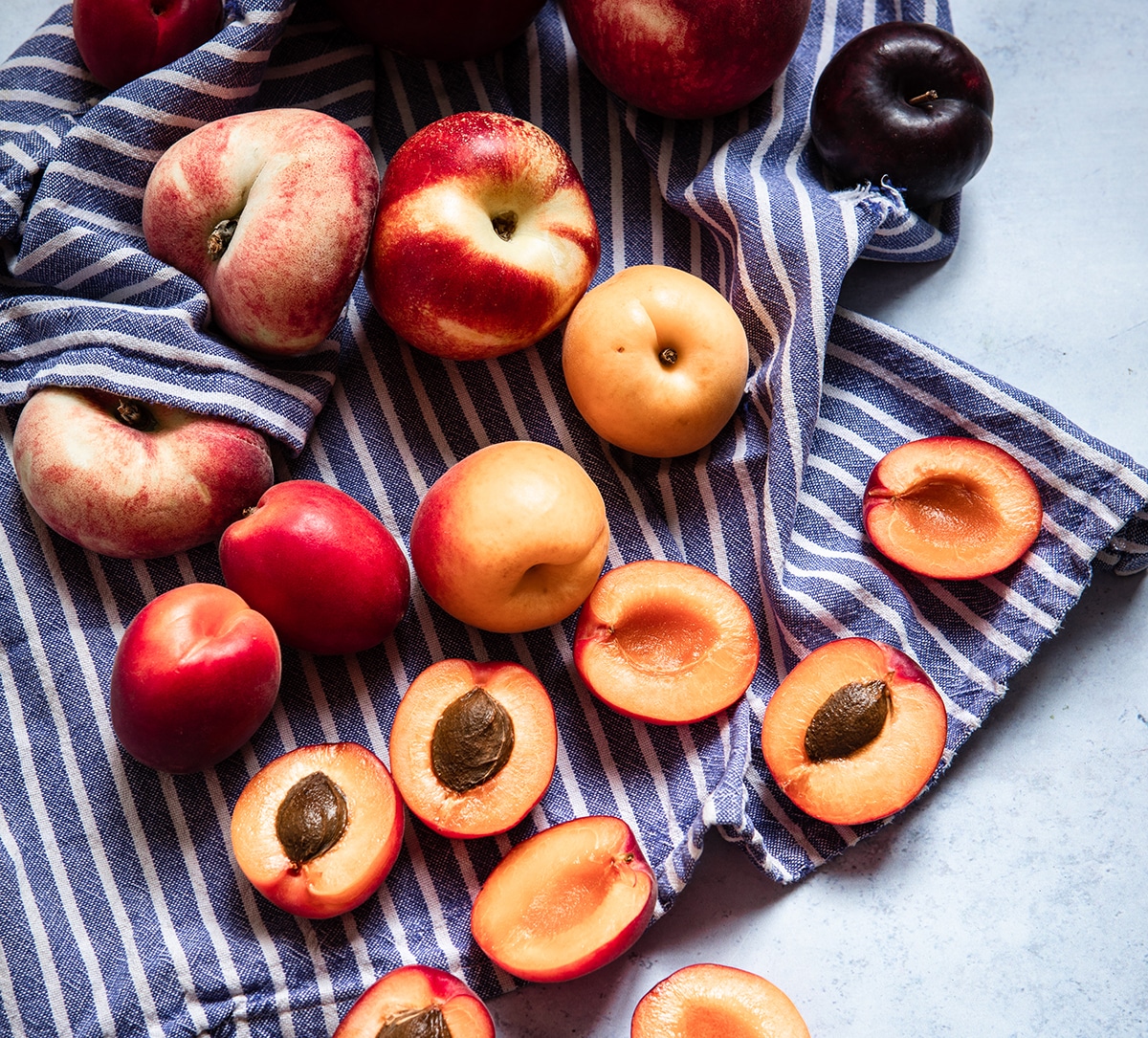
Borough Market: The Knowledge
Discover Borough Market’s stunning new cookbook, full of inspiration and insight, featuring 80-plus recipes by Angela Clutton
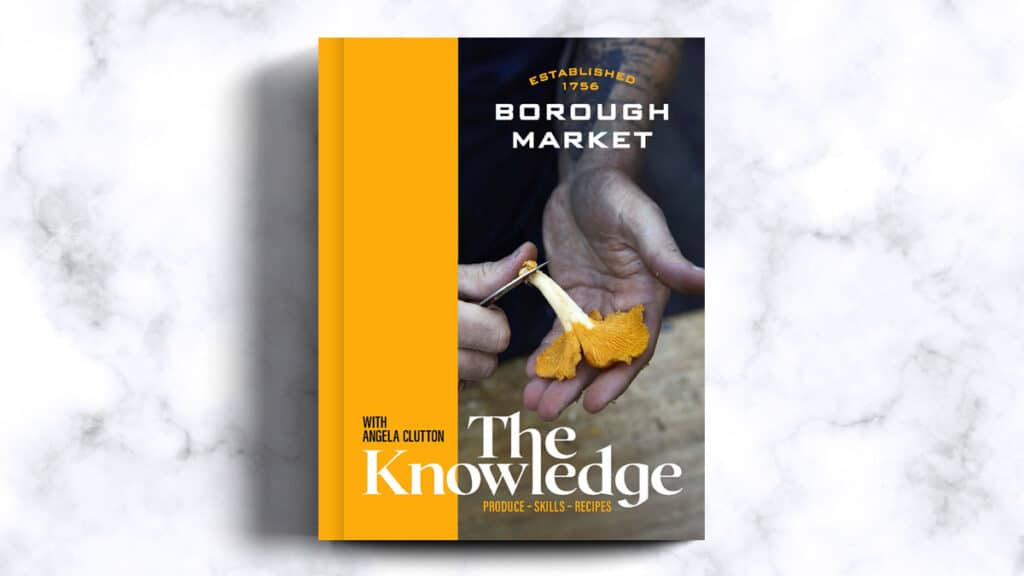
We are very excited to announce the upcoming publication of our new cookbook, Borough Market: The Knowledge. Available from 27 October, the book is rooted in the passion and expertise of the traders who form the beating heart of the Market.
Across eight chapters, each devoted to a different category of stall, from the butchers to the greengrocers to the cheesemongers, that collective knowledge is brought to life through more than 80 recipes by Angela Clutton, award-winning food writer and presenter. With typical warmth and clarity, Angela explores how the traders’ expertise can be brought to bear in turning Market produce into stunning dishes. The book also distils their wisdom into features, interviews, tips and guides that demystify unfamiliar ingredients and processes, and explains not just what to buy (and why) but how to store it, cook it and serve it.
Recipes include:
— Roasted Cod’s Head with Clams and Seaweed
— Beef, Leek and Ale Pie
— Parsnip Gnocchi and Smoked Garlic Butter
— Moong Dal Dosa with Masala Potatoes and Tomato Chutney
— Jasmine Tea Loaf with Salted Lime Butter
— Ginger and Pink Peppercorn Baked Cheesecake.
Borough Market: The Knowledge, beautifully photographed by Kim Lightbody, is the third Borough Market book to be published by Hodder & Stoughton, following the success of The Borough Market Cookbook and Borough Market: Edible Histories. It is available now for pre-order.


Q&A: Elizabeth Haigh
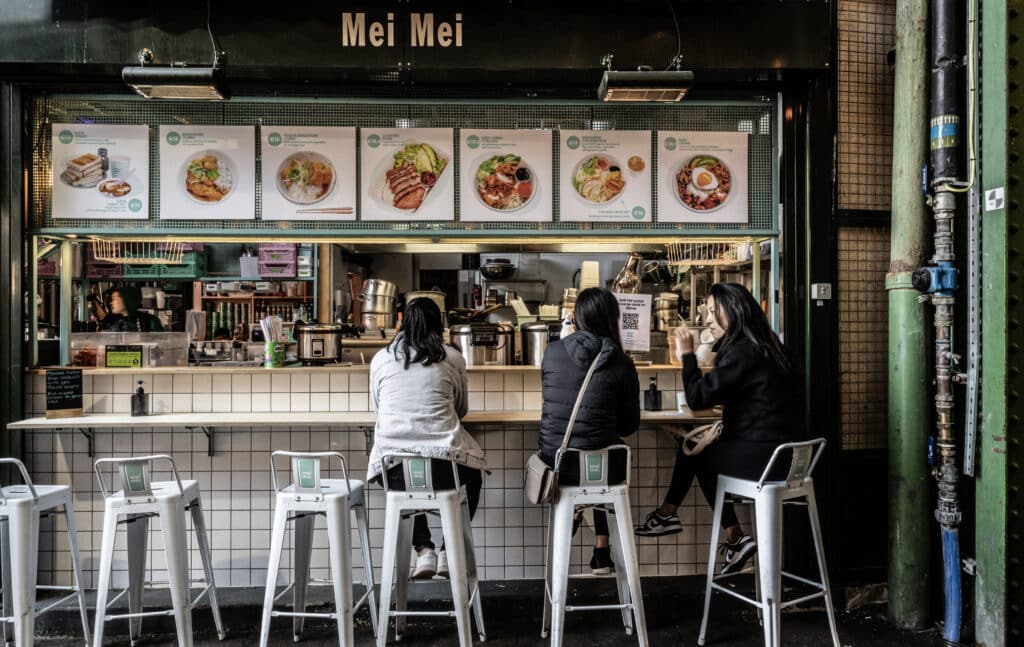
The chef-owner of Mei Mei on Singaporean cuisine, ‘kopitiam’ culture and the importance of measuring from the heart
“THE BEST THING ABOUT THE FOOD FROM SINGAPORE IS THAT IT’S A COMBINATION OF MANY DIFFERENT CULTURES”
Interview: Ellie Costigan / Portrait: Steele Haigh
Elizabeth Haigh established herself as a chef to watch back in 2011, when she competed on MasterChef aged just 24. As its inaugural head chef, she helped east London restaurant Pidgin win a Michelin star, before setting out on her own with a mission to bring her heritage Singaporean cuisine to the masses. “There are not enough Singaporean-Malaysian restaurants,” she says. “Everyone can name a Chinese restaurant, an Indian restaurant, a Vietnamese restaurant in London. How many Singaporean restaurants can people name? Not enough. Representation matters.” Mei Mei is her answer to that shortage: a Singaporean ‘kopitiam’ in Borough Market Kitchen.
What’s your strongest early memory of food?
As far back as I can remember, we would eat round the dinner table together as a family. We would be eating so quickly and hastily that we wouldn’t be having a conversation, but it was just the nicest thing – being with my family, having this tradition every night. We would usually eat quite late, because my mum worked late, but she would always prepare fresh food. It’s something I’m trying to continue with Riley, my son. There’s a lot of distractions now – TV, YouTube – so I really push the importance of having that time together.
You say that there’s no such thing as ‘typical’ Singaporean cuisine. What defines it for you personally?
It’s like trying to define what London food is: you can’t. The best thing about the food from Singapore – and London – is that it’s a combination of many different cultures. Everyone brings their own influences and knowledge. What I love about being in Singapore and the cuisine there is that there’s an undeniable respect for everyone’s background.
Something that’s definitely common, though, is chilli – we’re not talking blow-your-socks-off chilli, but heat. There are a lot of aromatic ingredients such as lemongrass and galangal – that’s very common in all the food right across the country. Galangal is called blue ginger back home. It’s as aromatic as lemongrass but with slightly more fragrant notes. It’s distinctive to our cooking. As is pandan, a leafy green with a unique flavour profile – savoury and sweet at the same time. It’s a key ingredient in the Hainanese chicken rice. There’s also never enough garlic in a Singaporean’s eyes.
When did you discover your passion for cooking?
My mum never let me cook at home. I studied architecture at university, so it was 18-hour days studying, working from home mostly. Before that, if I was feeling a bit down my mum would always say: “Let me make you that herbal soup that makes you feel better.” I found I was really lacking that instant comfort and the luxury of someone cooking for me. I tried to recreate some of the dishes, but I just didn’t have the knowledge and didn’t have access to the ingredients, even though I was in London. I’d go into Chinese supermarkets and think, what is all this?! I don’t know what any of these things are. I would pester her on the phone: “Mum, how do I make that crispy roast pork?” She’d say: “You just prick the skin, put it in the oven and cook it.” I’d be like, there’s probably a bit more to that?!
For her, it’s second nature, so to ask her to quantify things was so hard. There’s a Malaysian phrase, ‘agak agak’, which means ‘your ancestors will tell you when it’s enough’, so basically measuring from the heart. Jamie Oliver westernised it with a swish of this, a slosh of that – it’s the same with our cooking. It’s about going with your gut. That’s what my mum was trying to teach me.

How accurately do the dishes at Mei Mei reflect your mother’s recipes?
We don’t try to recreate them, but we treat the recipes with respect. It’s not going to be authentic, because we use chickens from here in the UK, not ‘kampung’ chickens, which means village chickens. We don’t use the same lemongrass and chilli – the chillies over there are vastly different from the Dutch chillies we have here. Even the lemongrass and galangal – everything is a lot fresher there, because obviously these things have to travel to get to the UK. We try to adapt it so that it works in Britain, while being respectful of tradition. I think we have achieved it, because we do get a lot of people telling us our food reminds them of home. We had a customer here last night for dinner who said: “That barbecue makes me feel like I’m back in the hawker.” That’s exactly what we wanted.
How did you go from training to be an architect to becoming a chef?
I did four years of my architecture course before I realised I wasn’t entirely happy. I was spending all my time in the kitchen cooking and watching MasterChef, and I just felt more satisfied doing that than I did studying or working in the studio. My friend dared me to apply for MasterChef and I got on. I did well in it – or well enough, I didn’t win it – and I enjoyed being around people who were likeminded about food. People of all ages, all with that similar passion. I’d never considered a career in cooking until then, because I was pushed into the university route. I wish I’d had the guts to follow my true passion.
I’m more of an artist, so the design and creative process of architecture really fascinated me and I think that translated easily to being a chef. There’s also a lot of time management, money management, people management – you need to understand people, listen to customers and clients, so becoming a chef wasn’t too hard a transition. The hardest thing was giving up evenings and weekends, birthdays, holidays, weddings. Everything. Your social life, basically. But in exchange I I’ve gained all this invaluable knowledge and skill. It was important to me to start my own business so I could pass on that knowledge.
Did you always want to open your own restaurant?
When I left Pidgin, I wanted to open a restaurant. I had many failed attempts – it’s a lot harder than you might think. But we’ve always wanted a restaurant and I had a very distinct vision of what it should be. I wanted to have an open plan kitchen, so you could see all the chefs cooking, working away. It’s a very visual thing. It feels like you’re in a hawker – or kopitiam, as I say.
Tell us more about the kopitiam concept. What’s the cultural significance?
Kopitiams and hawkers are literally all over Singapore and they run day and night. ‘Kopi’ is coffee, ‘tiam’ is shop. Kopitiam; coffee shop. They are integral to the culture of Singapore. In every community, in every area, you will have a kopitiam. I will go down in the morning in my vest and slippers, have my teh tarik, order my kaya toast – both of which we serve at Mei Mei – and sit there. No one will interrupt you. The aunties and uncles will be chatting happily. One thing to know about Singaporeans is, we are loud. Very loud.
In Singapore, you will go out for breakfast, lunch, dinner, supper, tea, elevenses – rarely will people eat in or cook at home, unless you have an au pair or a grandmother who cooks, because it’s so affordable to eat out. You start off in a kopitiam and then you might go to a hawker, which is a little collection of stands, each of which specialises in one dish. Maybe in one hawker there will be an uncle that does the best coffee. Next door to him there’ll be the best fish ball noodles. Next door to him will be a spot that does the best barbecue stingray and satays – a giant open charcoal barbecue with racks of food. They will be masters of those recipes because all they focus on is doing that one dish. They’ll put in 10,000 hours to master it.
What would you say is Mei Mei’s hero dish?
We specialise in Hainanese chicken rice – that’s our hero dish and it’s one of Singapore’s national dishes. It’s also the one dish I can eat at any time of the day and not be sick of. We’ve been here nearly two years and I’m still eating it every day. It’s very nourishing: chicken poached lightly, served cold but you have a hot soup with it, so it works well in winter and summer, then you have the spicy chilli to wake you up. Rice is the most important bit. It’s cooked in the chicken broth and fat with ginger and garlic. We like to think we’ve put our 10,000 hours into that dish. Definitely 10,000 chickens!