Blessed are the cheesemakers: Bermondsey Hard Pressed
Clare Finney tells the story behind an Alpine-style, Bermondsey-made cow’s milk cheese from Kappacasein
“BILL STAYS AS TRUE TO THE SPIRIT OF ALPINE CHEESE AS IS POSSIBLE WITHIN THE URBAN ENVIRONS OF SE1”
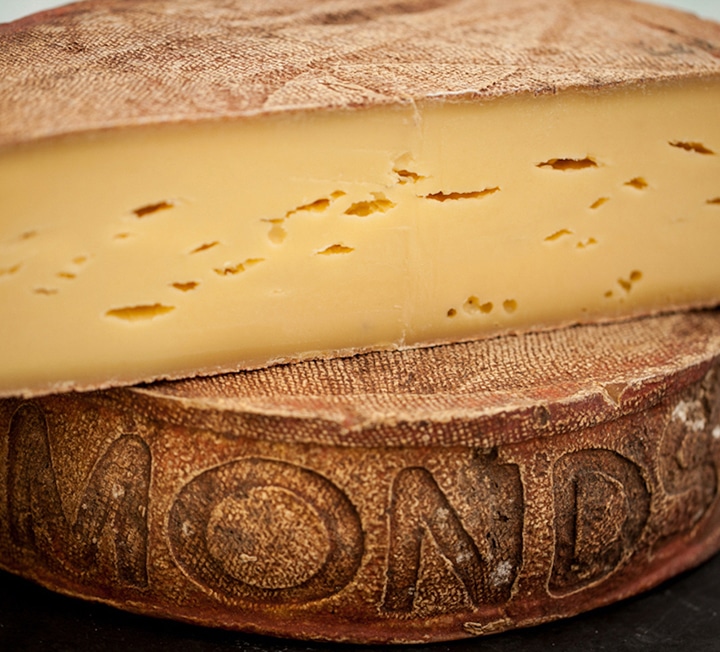
“I suppose the name is a bit of a pun,” Bill Oglethorpe grins, “on me being hard pressed to make cheese in Bermondsey.” It’s not a feat to be sniffed at, for all that Bill’s cheese is deeply aromatic. Though there are at least a handful of cheesemakers based in London today, back when Bill set up Kappacasein in a converted railway arch in Bermondsey in 2000, he was something of a pioneer.
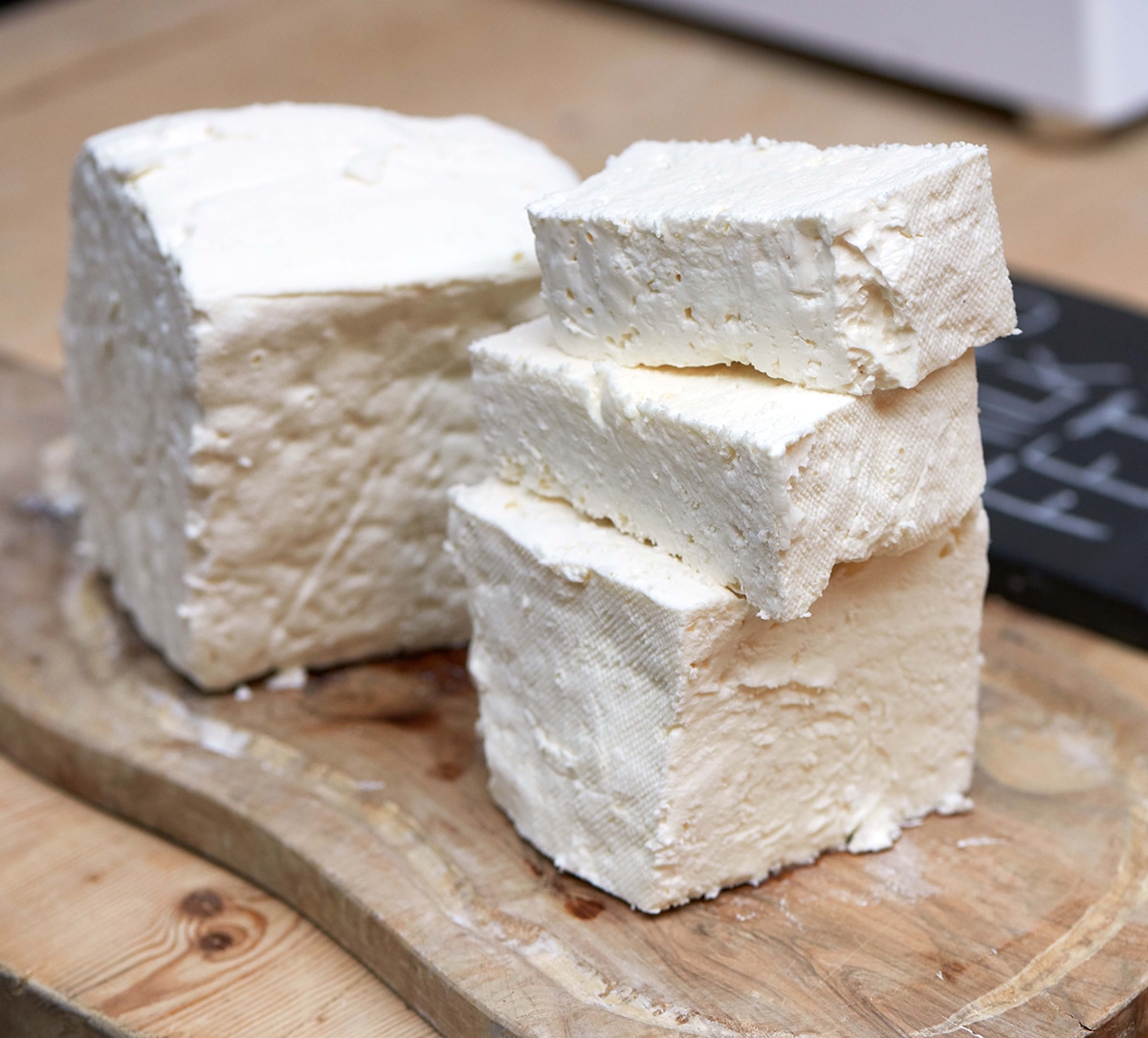
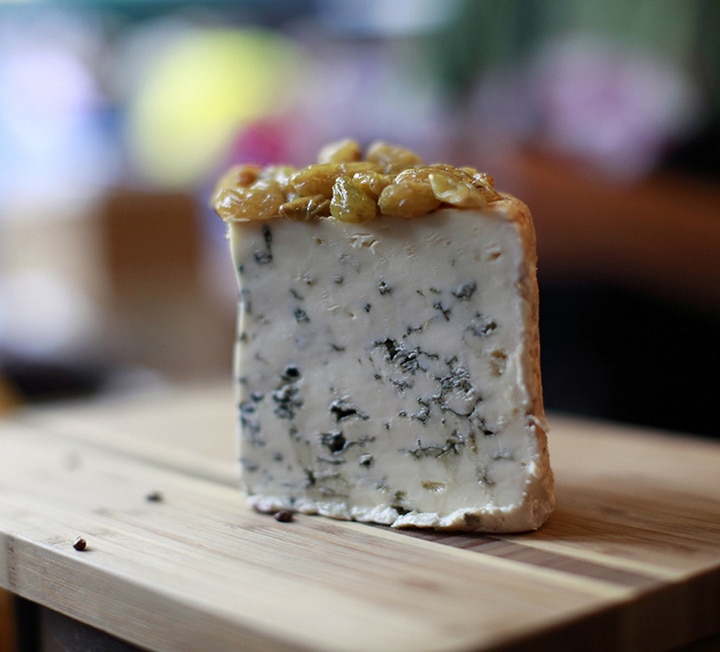
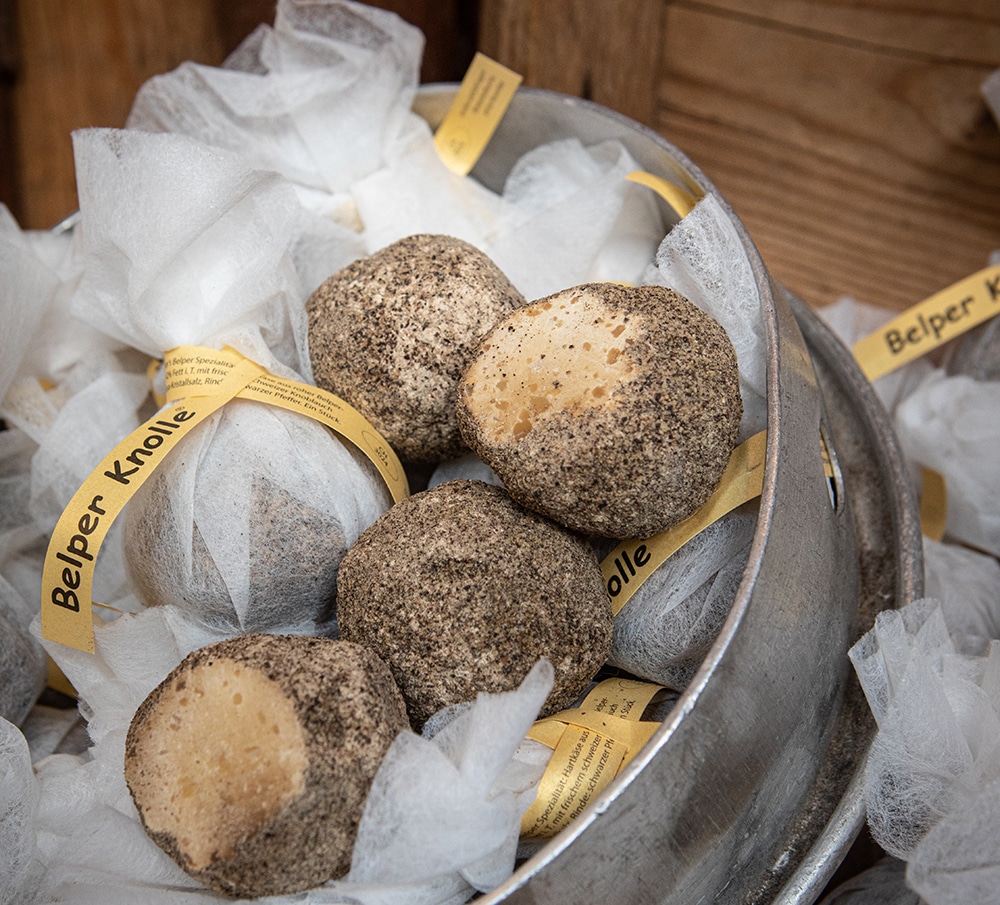
Bermondsey Hard Pressed was the first cheese he made, using a 100-year-old copper vat he brought over from Switzerland. A hard, alpine-style cheese modelled on L’Etivaz (Bill spent months working with veteran cheesemakers in the eponymous town before establishing Kappacasein), its long maturation time of 12 to 18 months – ”though I do get impatient sometimes, at 11 months,” he confesses – makes it well suited to the low, steady temperatures of the arch: even if “an alpage in the mountains in June, with a pasture full of wild flowers that have never been cultivated, would really be the ideal”.
Still, the arch was here, and it was available. What’s more, being in London Bill’s cheese are but a 10-minute bike ride away from his point of sale. He has his own retail stall at the Market, so he can sell his cheeses as well as melt them over potatoes and sourdough toast at his famous street food joint on Stoney Street. Where L’Etivaz was traditionally made to keep for a long time and be transported over long distances, Bill has no such problem. Nevertheless, he insists on staying as true to the spirit of alpine cheese as it is possible to do within the sprawling urban environs of SE1.
“In the Alps, of course, the cheesemakers go from one room, the milking parlour, to the next, the dairy,” he says, “but there is still a wait time to allow the milk to mature.” Here in London, this essential ‘wait time’ takes place not in stasis, but in the back of Bill’s specially adapted van. “We put the starter in when we collect the milk from the farm in Kent,” he says. “The milk is still warm from the cow, so the ripening takes place on the way back to Bermondsey. By the time it gets here, it’s ready.” A little bit of heat, to bring it up to 33C, some activated calves’ rennet, and “the acidification can start”.
Hard pressed isn’t just a pun, it is also a classification of cheese. “You have un-pressed – cheeses that are drained – semi-pressed, and hard-pressed cheeses.” By pressing and heating, he continues, you reduce the percentage of moisture in the cheese. “That means it can age for longer,” Bill explains, “because it is drier and more stable.” The press Kappacasein uses – a big, heavy thing, also hailing from Etivaz – is a hard taskmaster, as Bill has come to realise increasingly. “We’ve been making some of our wheels too small, and as a result I think we were over-pressing. The system is built for big cheeses, so we’ve started making ours bigger, so they can withstand the weight and reach the right texture.”
Another change Bill is instigating this year, inspired by L’Etivaz, is to only make his Bermondsey Hard Pressed in summer. “In Etivaz the cheese is made between May and October, when all of the herds are grazing on the wild, uncultivated pastures of the mountain side.” There are no mountains at Commonwork Organic Farms in Kent of course, but there are pastures with wild grasses, and for as long as is possible the cows are grazed outdoors. “The taste of the milk, and the cheese, is so much better for it,” says Bill. “I’ve been reading a lot about Buddhism recently, and one of their key principles is that change happens all the time and one should embrace it.” How better to put this philosophy into practise than to work with the seasons to further refine what is already the ultimate expression of positive change: aged, alpine-style, Bermondsey-made cheese.
Blessed are the cheesemakers: Bermondsey Hard Pressed
Clare Finney tells the story behind an Alpine-style, Bermondsey-made cow’s milk cheese from Kappacasein
“MASSAMAN ARRIVED IN SOUTHERN THAILAND FROM PERSIA, TRAILING EXOTIC AROMAS REDOLENT OF WESTERN ASIA”
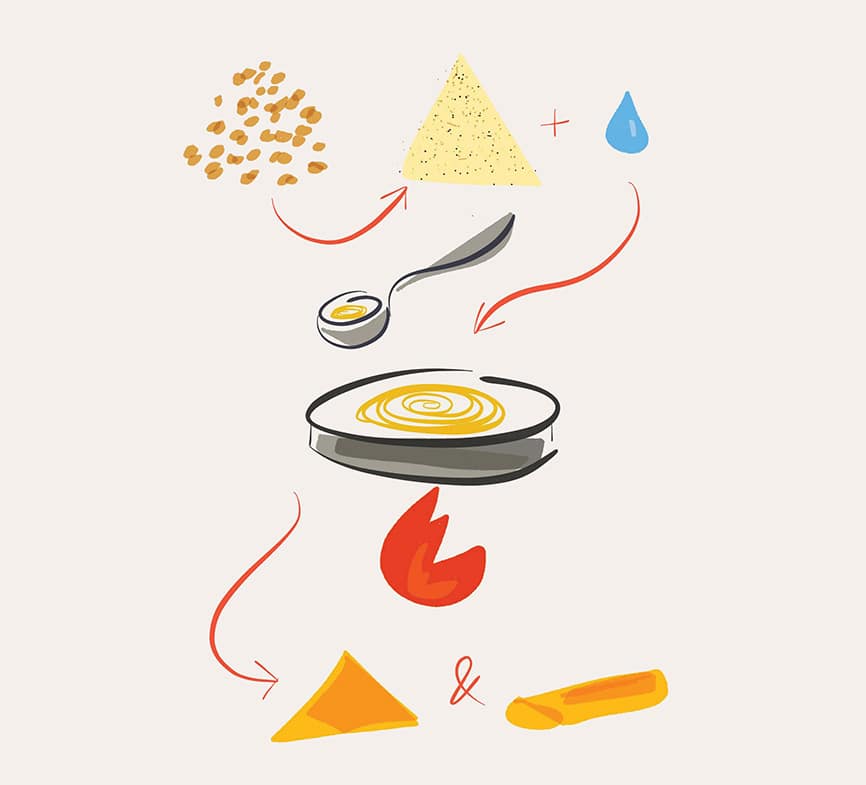
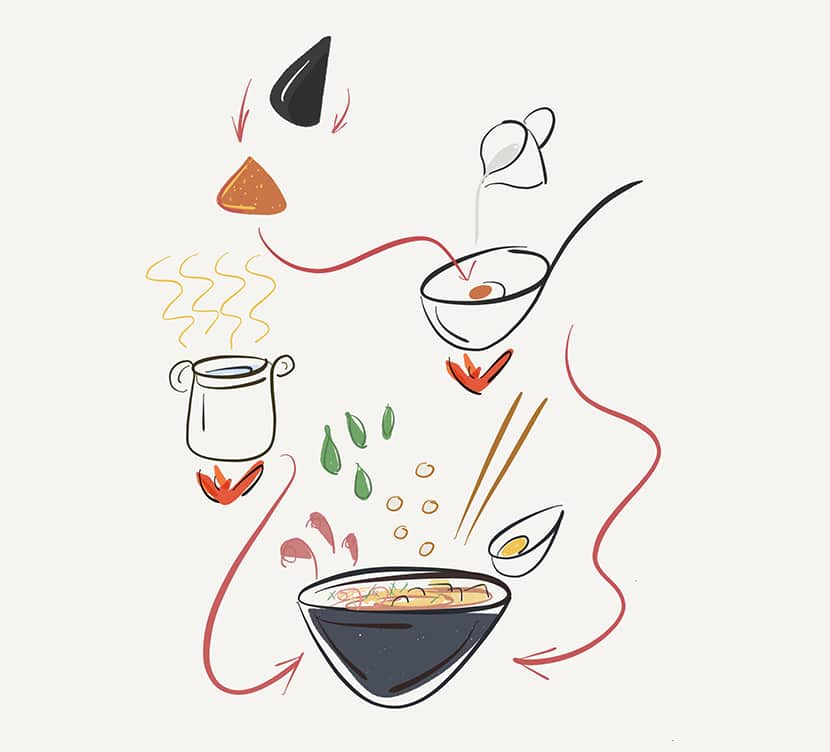
Illustration: Ed Smith
According to Thai food guru David Thompson, the perfect massaman (or mussaman) curry should be sweet, sour and salty – a holy trinity of virtues that makes devotees sigh with longing when they’ve finished their bowls.
The most complex of all Thai curries, massaman was once ranked by a global travel website as the single most delicious food on the planet. Legend holds that it arrived in southern Thailand from Persia in the 16th century, trailing exotic aromas redolent of western Asia, notably cardamom. And in deference to its Muslim heritage it is never made with pork; beef or chicken, cooked until butter-soft in a rich, thick and deftly spiced coconut sauce, are stars of the bowl.
Massaman is said to be the most time-consuming Thai curry; a long list of ingredients must be carefully prepared from scratch to yield invigorating flavours. Most southern Thai families have their own beloved massaman recipe passed down through generations, says Worawan Kamann, co-founder of Borough Market Kitchen’s Thai street food stall Khanom Krok. “But there are a lot of things that go into it, so it’s not something that’s cooked every day,” she says.
Born in Bangkok, Worawan was taught to make the stall’s chicken massaman with potatoes and peanuts by her grandmother. “She was an amazing cook right into her nineties,” Worawan recalls. “We would spend the whole day cooking it, shredding the coconut and doing all the preparation.”
And this, as ever, is the secret. Khanom Krok’s comforting massaman is made with love and care. Worawan has zero tolerance of short cuts, such as cooking the chicken and sauce separately then bunging them together to serve. This crime against massaman is prevalent in the UK, she sighs. “I stick to the way I learned as a child. I cook my chicken in the spicy sauce, so it sucks up all the flavours.”
The perfect balance of sweet and sour needs judicious application of palm sugar and tamarind juice, and a light hand with the chilli paste. “Massaman is not supposed to be very spicy,” Worawan says. “It’s meant to be quite a mild curry. That’s the traditional way.”
Spices
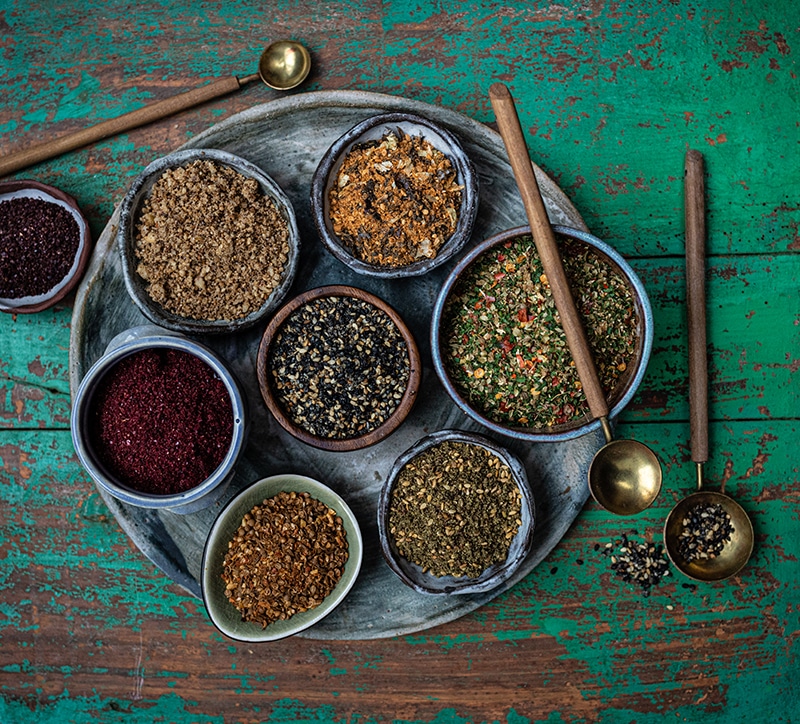
Dried spices are heavily roasted in a pan or wok and then used sparingly to impart an elusive fragrance. Cardamom is a stalwart, but other spices might include cinnamon, star anise, cloves, coriander seeds or cumin seeds.
Coconut
Coconut milk or cream or both, traditionally made by hand, forms the ballast of the rich sauce. First, it’s simmered in a pan or wok until it begins to separate or ‘crack’.
Chilli paste
A puree of chillies, garlic, shallots and other aromatics is cooked off in the boiling coconut along with the toasted spices, to smooth away their rough edges.
Seasonings
Palm sugar is added for sweetness, and tamarind (at the end) for a sprightly sour kick.
Meat
Chicken or beef pieces are slowly simmered until they reach the sweet spot between falling apart and undercooked.
Vegetables
Starchy vegetables are vital: white radish, potato or sweet potato.
Toppings
To finish, massaman might be showered with deep fried shallots and toasted peanuts for extra tastiness and crunch.
Discover more
Explore the Market
Borough Market began with a bridge
Mark Riddaway, author of Borough Market: Edible Histories, explores the rise, fall and rebirth of one of London’s most storied institutions

“AS LONDON GREW IN SIZE, THE BEDLAM ON BOROUGH HIGH STREET BEGAN TO AROUSE OPPOSITION WITHIN THE CORRIDORS OF POWER”
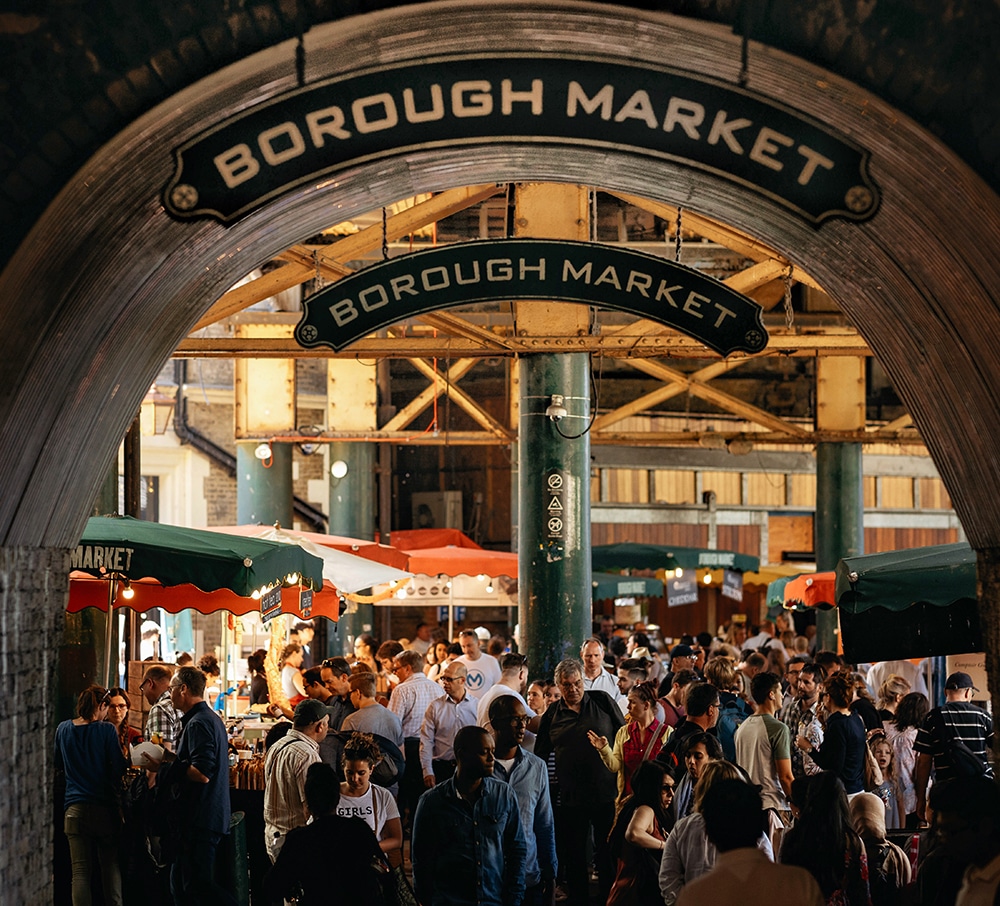
Borough Market began with a bridge. For hundreds of years, London was a small walled metropolis on the north bank of the Thames. Its southern neighbour, Southwark, was an altogether different place – a frontier settlement where different rules applied; a town of pubs and prostitutes, hawkers and hucksters, craftsmen and criminals. The only link between the two – in fact the only route into the City of London from anywhere south of the river – was London Bridge.
First constructed around 990AD, the bridge grew in importance as the city expanded. At its peak, it was a colourful, chaotic landmark – a far cry from today’s grey concrete slab. In fact, the word ‘bridge’ barely does justice to this heaving mass of people, animals and rickety buildings, which was more of a municipality in its own right than a mere river crossing – imagine a small but lively provincial town, all piled up to vertiginous heights in a condensed space and elevated on legs.
The road we now know as Borough High Street was the vital artery joining London to the ports and towns of the south. And as with any major access route anywhere in the world, the bridge, and the road that ran up to it, acted like a magnet for people wishing to sell things to travellers, especially after the murder of Thomas a Becket in 1170 turned Canterbury into a popular pilgrimage site. The presence of such commercial potential kicked off an epic struggle between authorities determined to regulate and tax the market and hordes of small traders who wanted to make as much money as possible with the least possible interference. This fight continued for centuries, enacted through the rather tedious medium of impenetrable paperwork.
The medieval market
For a long time, there were two legitimate marketplaces around Borough. The smaller of these started in the grounds of St Thomas’ Hospital, located at the southern entrance to London Bridge. In 1215, following a disastrous fire, the hospital moved to a new location on what is now St Thomas’ Street, on land that was then part of the manor of the Archbishop of Canterbury, and the market, which specialised in corn, was transferred to the doors of the new site. This market opened three days a week – Wednesday, Friday and Saturday.
A larger market, selling a wider range of produce and trading on Wednesdays and Fridays, found a home along the busy main highway near the foot of the bridge in the area known as the Guildable Manor, which was administered by the crown. Both markets caused constant irritation to the authorities across the river by providing stiff competition to the City of London’s own traders. In the 1270s the City forbade its citizens to go to Southwark to buy “corn, cattle, or other merchandise there”. It also banned traders from setting up on the bridge itself and clamped down on “regratresses” who bought bread in Southwark and resold it for a profit in the City.
But the City’s biggest problem with Southwark wasn’t its markets. The vagaries of the legal system at the time meant that any felon committing a crime in London could, in the words of a petition presented to the King in 1327, “stealthily flee to Southwark openly where no bailiff of the City can attach them”. Frustrated by seeing known criminals blowing raspberries at them from across the river, the City constantly lobbied the crown to hand over its rights to the Guildable Manor. In 1406, Henry IV finally granted London the right to arrest criminals found in Southwark and at the same time granted “assay and assize of bread, wine, and ale and other victuals and of any other things belonging to the clerk of the market of the King’s household”. Borough’s market had, to all intents and purposes, become an extension of London.
The residents of Southwark were far from happy about this encroachment of City types into their town, so fought hard to overturn the new grants, but further charters in 1444 and 1462 cemented the influence of London over the Guildable Manor and added the right to hold a three day fair every September. Southwark Fair would go on to become one of the biggest and most riotous events in London’s calendar.
In April 1550, for a price of just over £1,000 (£647 for the land, £333 for the liberties and £25 for expenses), Edward VI ended for good any debate about who ran Borough by selling Southwark to the City. In the same charter, it was agreed that the Guildable Manor market could extend to four days a week, adding Monday and Saturday to the schedule.
Organised chaos
The Southwark of the 16th and 17th centuries was a hive of activity – partly a busy commercial district, where leather, felt, pottery and soap were crafted and sold, partly a giant travel terminus, and partly a seething maelstrom of licentious behaviour, packed full of pubs, brothels and theatres. Londoners flocked across the river to let off steam – think Kavos or Ibiza, but with fewer foam parties and more Shakespeare – while farmers trundled in from the countryside with herds of cattle and sacks of grain, seeking to make a living on the heaving high street.
Out of this chaos, the City did its utmost to create some kind of order, with limited success. Traders were supervised by bailiffs and constables who together enforced price controls, inspected goods and collected fees. A weighing beam was situated next to the pillory in the middle of the high street, and it was here that sacks of grain were weighed in public before being put on display. Towards the end of the 16th century, a market house was built at this location to keep the grain safe from the elements.
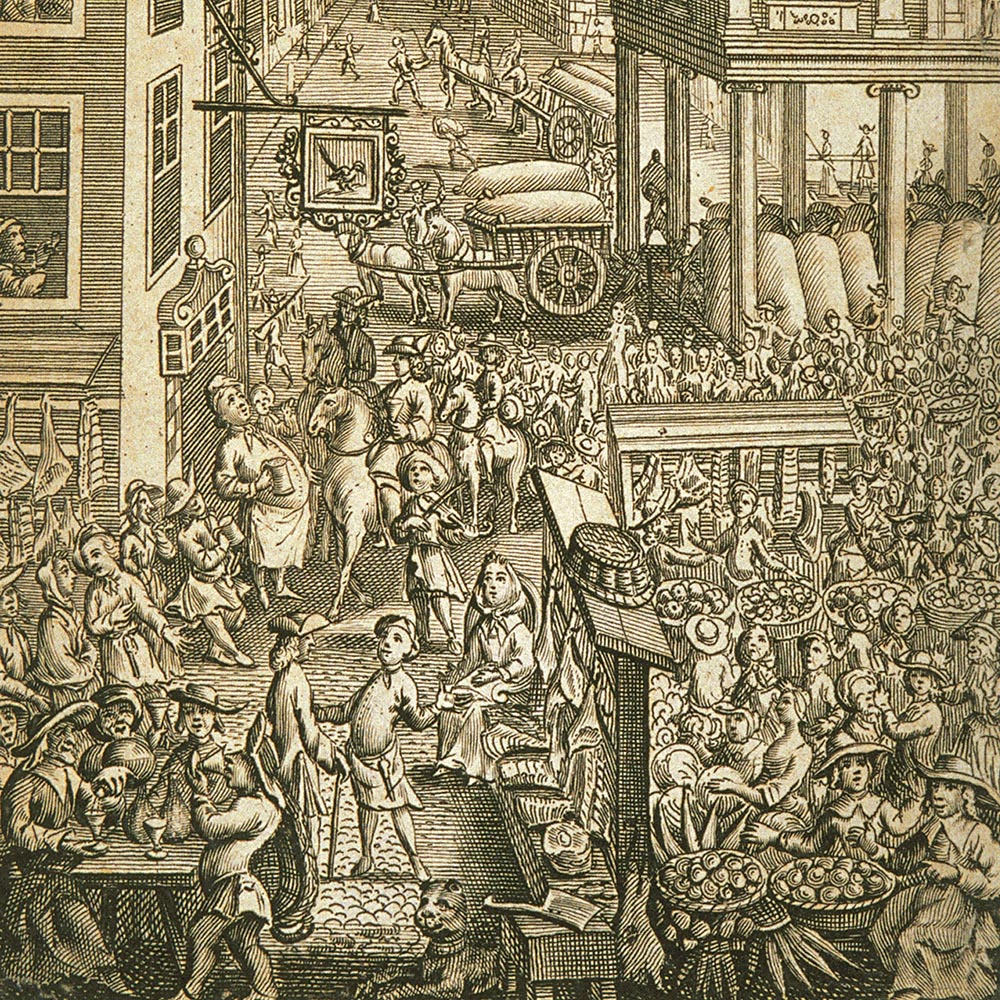
The authorities faced a constant battle to prevent the road from being completely blocked by sprawling stalls and wandering livestock. One set of rules from the 16th century required that traders set up their stalls in a fixed sequence, no more than a yard from the drainage channel running down the street, with the fishsellers closest to the bridge, followed by the butchers, the poulterers from the countryside, the oatmeal makers, the fruiterers and herb sellers, then finally the local bakers and poulterers. A further set of ordinances from 1624 proved similarly rigorous, but with the traders lined up in a different order and with the further proviso that fishwives be forced to stay on their feet – in the face of growing chaos, bureaucratic fiddling seemed to be the main weapon in the authorities’ arsenal.
Butchers were a particular source of drama. In the days before refrigeration, the best way of transporting and storing meat was in the form of a whole living animal, but a live ox or goat can cause considerably more mayhem than a French-trimmed rack of lamb. One of the 1624 ordinances attempted to force butchers to stop entering local shops or slaughter houses with oxen, bullocks or cows “that are so wild, that they will not enter but run away (as often it happeneth)”. In 1676, the churchwardens of St Saviour’s ordered the construction of a series of posts to keep out the wandering livestock.
Unlicensed trading was a huge problem for the sheriffs, with many a rogue trader selling bread or fish on the sly outside of the defined marketplaces. Pubs – of which there were a vast number – were some of the worst culprits, causing the City authorities to complain in 1522 that “almost every inn holder within the said Borough kepyth market”.
Death and rebirth
As London grew in size and importance and London Bridge became ever more critical as a trade route into the City, the semi-organised bedlam on Borough High Street began to arouse significant opposition within the corridors of power. The location of the market house right in the middle of the road certainly didn’t help – imagine a busy warehouse being constructed across the middle lanes of the M1 – and numerous representations were made to have it removed. In 1676 these were rendered irrelevant when a huge fire swept through the area, taking the market house with it.
This alone did little to ease congestion, and the City, while enjoying healthy revenues from the market, eventually decided that these were considerably outweighed by the dampening effect on business of having the only southern route into the centre completely blocked by bullocks. In 1754 a bill went before parliament declaring that as “the market obstructs much trade and commerce”, it would have to cease trading by 25th March 1756 and that thenceforth “no person shall use any stall, trussel, block, or other stand, or expose to sale upon such stands peas, beans, herbs, victuals or other commodities.”
At the same time, residents of Southwark were petitioning to be allowed to start a new market, independent of the City, away from the high street. A second act passed through parliament declaring that “for the convenience and accommodation of the public” the parishioners of St Saviour’s could acquire land away from the main road and set up a market of their own, and that this market would “be and remain an estate for the use and benefit of the said parish for ever”. Through its status as a charitable trust, it remains inexorably linked to the parish to this day.
The act also declared that “no provisions except hay or straw” could be sold within 1,000 yards of the new market. With this local monopoly in their favour, the parishioners quickly raised £6,000 by selling annuities to interested citizens – over £1 million in today’s money – and bought an area called The Triangle. Within two years, the parishioners returned to parliament for permission to raise a further £2,000 to enlarge the site and build a market house.
In February 1756 advertisements were placed stating that a “commodious place for a market is now preparing on the backside of Three Crown Court on the west side of the high street of the Borough and will be ready by the 25th March next for the reception of all country carriages and others bringing any kind of provisions to the said market”. Borough Market as we now know it was up and running.
The wholesale era
For a century or so, the all new Borough Market remained busy and popular but, set back from the road, it was essentially fairly parochial in character, selling a large range of everyday produce in relatively small quantities. It was during the 19th century that all this changed, with the Market rapidly expanding to become an institution of national significance, devoted solely to the fruit and vegetable wholesale trade. The main engines of this transformation were the urbanisation of south London and the arrival of the railway – as the population boomed, the growing demand for a wholesale market with excellent transport links meant that Borough Market was perfectly placed to benefit. As business flourished, the Market took over the land that forms the Green Market, then later bought and demolished the buildings on Winchester Walk to make way for what is now Jubilee Place.
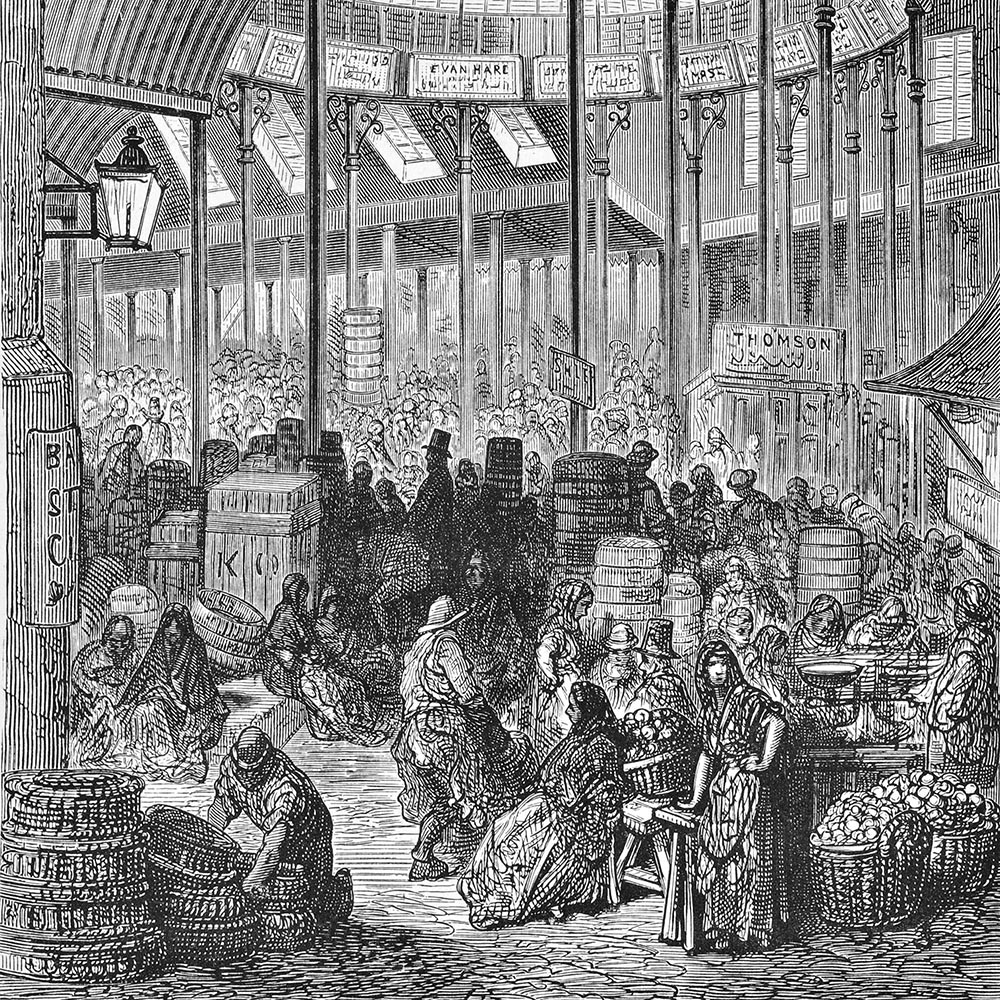
In 1862, as part of the South Eastern Railway company’s project to extend its lines from London Bridge to Cannon Street and Charing Cross, a railway viaduct was constructed through the middle of the market, bringing noise, soot and disruption, but adding to the accessibility of the Market. The need to widen the railway line in 1897 brought more disruption, as well as the sad demise of the Market’s magnificent but short-lived glass and iron domed roof, which had brought a touch of Crystal Palace glamour to Borough.
In 1906, the Market’s constitution was changed, placing its management in the hands of 21 voluntary trustees, drawn from the local community. The Market grew still further in the early 1930s, when the old Three Crown Square – a once prosperous residential piazza that had become a series of ramshackle warehouses – was demolished. The same development project, which cost £50,000, saw the creation of the Market’s famous art deco entrance and the construction of its office building.
At its peak, the wholesale market was a place of furious activity, responsible for feeding millions of people around the southeast. As one 1950s market guidebook put it, “one only has to pay an early morning visit to see what a veritable hive of industry such a concentrated area actually is, and what a highly important and essential service is given in order that a vast population served shall have its daily requirements so efficiently met.”
In 1933, it is estimated that 1,750,000 bushels of fruit and vegetables were sold at Borough. In the mid-1930s, 188 pitching stands were let to 81 different wholesale companies in the covered central area of the market, with a further 203 stands in the uncovered periphery manned by farmers from the Home Counties. Hundreds of porters were employed directly by the trustees to carry produce to and from the stalls, with trading taking place all through the night, and continuing long into the following day.
The renaissance
Borough Market’s days as a vital wholesale hub were ended in part by the construction of the huge New Covent Garden market in Vauxhall in the 1970s, but mainly by the relentless growth of the supermarkets which, by killing off independent greengrocers, destroyed the entire ecosystem in which fruit and vegetable wholesaling had thrived. The decline was swift and sad.
Borough Market’s current incarnation has its roots in the revival of interest in artisan foods which took shape in the 1990s. When the likes of Neal’s Yard Dairy and Brindisa – pioneering food businesses which had moved into the area’s empty warehouses – joined with fruit and veg wholesalers Turnips to host special retail events for the public at their respective premises and around the Market, their instant popularity presaged a new direction. Though initially reluctant, the Market’s trustees were eventually persuaded that a specialist retail market could offer a brighter future.
Thanks in part to the encouragement of these traders, Henrietta Green was asked to hold a three-day Food Lovers’ Fair at the Market in November 1998, which gathered together some of the best food producers in Britain as part of the annual Southwark Festival. The event, which was officially opened by the Two Fat Ladies, was a roaring success, with many traders selling out within hours.
This clear evidence of its potential led to a decision to hold a regular retail market at Borough on the third Saturday of every month, with British traders joined by those offering produce from around Europe and the world. This soon became a weekly affair, its popularity bolstered by the endorsement of just about every chef in the country. In what seemed like the blink of an eye, it was a genuine international institution – probably the most famous food market in the country. It is now open six days a week, and its activities have broadened considerably, but that sense of excitement has never dissipated. Many of the traders who started the Market’s modern boom are still here, still playing their part in its gradual evolution. The bridge that began it all is still there too, of course; still bringing customers over from the City – thankfully now unencumbered by fear of prosecution for the medieval crime of shopping in Southwark.
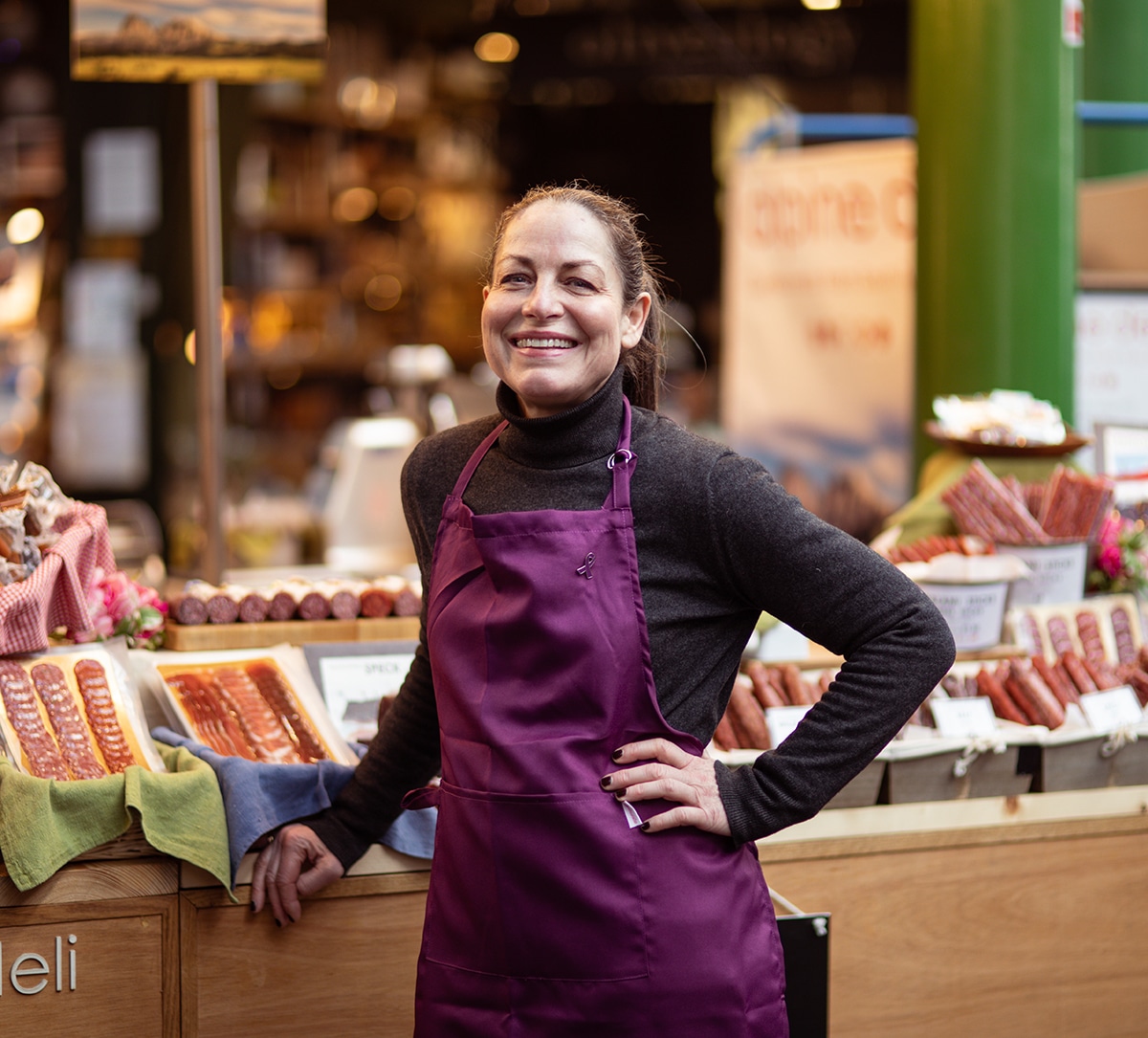
A view from the stalls: Mrs Sandhu
Ten insights into life at Borough Market from Mrs Sandhu of Temptings
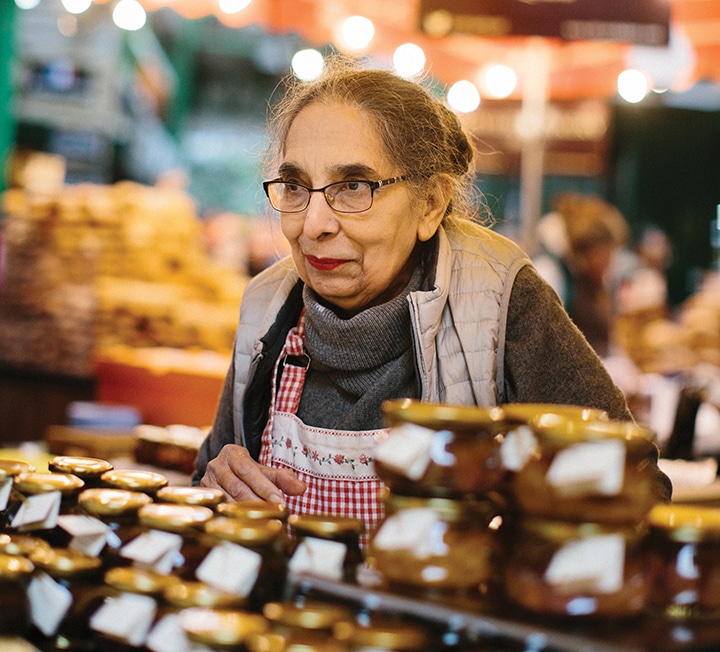
“SOME OF THESE RECIPES HAVE BEEN IN THE FAMILY FOR CLOSE TO 500 YEARS AND ARE STILL KEPT SECRET”
Interview: Viel Richardson / Image: Tom Bradley
1. My family has always made chutneys. I didn’t really make them as a child, but when I was a bit older I started making them for myself and for friends and work colleagues who liked them. The first time I made them for a wider audience was when I made canapés and snacks for the wedding of one of my daughters.
2. After the wedding, my new son-in-law Timothy said: “This food is amazing. You should be offering it to the wider public.” He used to come to Borough Market and brought me here to see the Market. He was the one who encouraged me to apply for a stall. That was in November 2000. Timothy is no longer with us, but we see the success of our stall, Temptings, as part of his legacy.
3. I was raised in the Punjab, and my family owned a lot of land. Hunting was a big part of life, and they would make meat pickles called ‘achar’ from wild boar, venison and chicken using old family recipes. Some of these have been in the family for close to 500 years and are still kept secret.
4. I use some spice blends that have been developed by my family and are not widely available. This is one of the things that make my pickles and chutneys unique. Another thing is the traditional methods I use.
5. On my first day here I had no idea what to expect, so I brought 11 jars of chicken achar. An Irish gentleman came to the stall and bought six of them after tasting a sample. I sold all the bottles in a couple of hours, so I spent the rest of the day just talking to customers. That gentleman still comes over from Ireland and buys things from the stall every Christmas.
6. From the beginning, the public reaction was extremely positive. I have to say it took me a little by surprise how quickly things grew. I never had to advertise, it was all word of mouth. I had to install a professional kitchen in my home to meet the demand. It was very hard, but I made everything myself. I still do today.
7. This is a real labour of love. For example, the meats achars will take me three days to make in batches of four bottles, so it is not large-scale production. There are always some chutneys or pickles in some stage of production at home. The whole process is very labour intensive. But I think it is worth it – the time and care I take is reflected in the tastes and textures.
8. I love experimenting and creating new chutneys. The achars are old family recipes, which I sometimes adapt a little, but the chutneys are my creations. The only chutney recipe I took from my grandmother was one using pomegranate. All the others I create myself.
9. In the Punjab there is a real mix of religions and cultures and each one has its own culinary identity. Even within each family, there are differences in the way we make a particular chutney, both in the spices and methods used. So the products we sell are really personal. You won’t find them anywhere else.
10. This is all about my connection with my customers – I love talking to them. I have several who have been buying from me since we started and many others who have been coming to the stall for years. You build wonderful relationships here. Temptings is a passion – that is the only way I can describe it. It is not about making money or paying the mortgage, it is about the ingredients, making the products and talking to my customers. I really do love all of it.
Mrs Sandhu no longer trades at Borough Market – after 25 incredible years, we finally said goodbye to Temptings in December 2025.
William Shakespeare, Borough Market shopper
Mark Riddaway, author of Borough Market: Edible Histories, on why we can confidently say that the Bard of Avon bought his groceries at Borough

“MUSIC MAY BE THE FOOD OF LOVE, BUT IT WON’T KEEP YOU GOING WHEN YOU’VE GOT A WORK OF GENIUS TO WRITE BEFORE FRIDAY”
Let’s start with a bold statement: William Shakespeare shopped at Borough Market. The greatest playwright ever to have penned a line in the English language, the writer of some of the most sublime poetry ever published, the most talented man ever spotted wearing a pair of tights, bought his bread and vegetables and a nice bit of mackerel right here in SE1.
Okay, so we have no actual evidence of this – no documents or diary entries or archaeological proof – but since when did an absence of proof stop anyone from speculating wildly about this most galactically famous yet frustratingly opaque of individuals? Despite his words being so embedded into our culture that we use his phrasing on a daily basis without even realising it, we actually know very little about the minutiae of Shakespeare’s life. Most of the documentary evidence we have has been painstakingly pieced together from tiny details in very boring official paperwork relating to taxes and contracts and legal cases – and none of it mentions where he shopped.
What we do know for certain is that around the turn of the 17th century, William Shakespeare moved to Bankside. And the reason we know is that he happened to be a tax dodger. On 6th October 1599, the Bard of Avon’s name appeared on a list of delinquents in the Lord Treasurer’s accounts, having failed to pay a ‘subsidy’ of 13s 4d levied on his holdings in Bishopsgate.
A note in the margin suggests that the playwright had moved to “Surrey”, the county of which Bankside was a part. Exactly a year later, a further set of accounts show the tax bill still outstanding, with a note stating “Episcopo Wintonensi” – the arrears had been passed to the Bishop of Winchester, the authority responsible for Bankside. As far as the taxman was concerned, Shakespeare was now a resident of Southwark.
This would certainly fit neatly with one of the other facts we know about him. In 1599, several members of the Lord Chamberlain’s theatre company, including Shakespeare, agreed a 31-year lease on a plot of land in Southwark upon which a brand new theatre would be quickly built – the Globe, the most famed of the many playhouses that sprang up in the area during this period. For the next few years Shakespeare would both live and work on Bankside, a period which encompassed perhaps the most extraordinary burst of creative accomplishment in British history. Hamlet, King Lear, Macbeth, Othello, Julius Caesar, Anthony and Cleopatra, Twelfth Night and Measure for Measure all flowed from his busy quill and were introduced to the world by the banks of the Thames.
As well as writing these immortal works, Shakespeare remained a jobbing actor for the theatre company, appearing in his own plays and those of other writers – in 1603 he was listed as the “Principal Tragedian” in Ben Jonson’s Sejanus: His Fall. He would also have taken much of the responsibility for the staging of his masterpieces – there was no such job as ‘director’ at the time – and the day to day running of the company, of which he was a senior partner.
He was, it’s fair to say, a busy man. And while music may be the food of love, it won’t keep you going when you’ve got lines to learn, actors to organise and a heart-breaking work of staggering genius to write before Friday. For that, you need actual food, and the place where the people of Bankside bought most of their food at the start of the 17th century was Borough Market.
In the early 1600s Borough Market wasn’t the well organised, nicely contained place we know today. Before it relocated to its current home in 1756, it sprawled along Borough High Street. Traders consisted mainly of farmers from Kent, Surrey and Sussex, who arrived from the countryside with grain, vegetables and livestock, and sold their wares alongside local bakers, poulterers and fishwives. This crowded, chaotic market, which ran four days a week, stretched for hundreds of metres down the highway – a regular carnival of noise and smell.
Butchers brought their meat to market both whole and very much alive, so irritable goats and wandering cattle were a constant menace. Not that Shakespeare would have been much of a beef eater. “Methinks sometimes I have no more wit than a Christian or an ordinary man has,” says Sir Andrew Aguecheek in Twelfth Night, “but I am a great eater of beef, and I believe that does harm to my wit.” He would, though, have shopped here. As a resident of Bankside, he had few other choices.
In truth we have very little idea precisely what Shakespeare ate to fuel his outpouring of genius – food crops up frequently in his work, but then so did pretty much everything, and it’s easy to read too much into his lines. We do know that he had a penchant for buying a little too much – in 1598 the playwright found himself in trouble with the authorities for hoarding 80 bushels of grain during a food shortage.
That original statement, then – William Shakespeare shopped at Borough Market – is about as detailed as it gets. Anything more would be silly speculation. Still, it’s not a bad celebrity endorsement, is it?
BOROUGH MARKET’S OTHER FAMOUS SHOPPERS
Geoffrey Chaucer
“If that I misspeke or say / wite it the ale of Southwark, I you pray.” So says the well-oiled miller in the Canterbury Tales. Or, in other words: if I can’t talk properly, blame the Borough beer. When Geoffrey Chaucer’s fictional pilgrims set off on the road from London to Canterbury, they started at the Tabard Inn, just off Borough High Street – a hostelry well known to the poet, who wrote at least part of his masterpiece while living across the bridge in Aldgate. Chaucer almost certainly shopped at the Market – and if the quantity of meat, fruit, pies and ale consumed en route is anything to go by, so too did his pilgrims, whose increasing levels of merriment seem to suggest some seriously heavy spending in the medieval equivalent of Utobeer.
Samuel Johnson
Given the fairly clockwork regularity with which he visited his friends the Thrales – a brewing family who lived next to Borough Market – it seems safe to assume that Samuel Johnson knew this place well. Those who doubt this should refer to the following quote from the author of the Complete English Dictionary, the Lives of English Poets and the first collected edition of Shakespeare’s plays: “Some people have a foolish way of not minding, or pretending not to mind, what they eat. For my part, I mind my belly very studiously, and very carefully; for I look upon it, that he who does not mind his belly, will hardly mind anything else.” You couldn’t get much more Borough Market than that!
John Keats
If only John Keats had stayed in Southwark! He lived for a year within sniffing distance of Borough Market while studying medicine at Guy’s Hospital on St Thomas Street, then after a brief interlude in Margate returned to the area to live on what is now Weston Street, before his poetic aspirations called him away to more exotic climes. Aged just 25, Keats died of consumption, brought on by malnutrition and disease. That’s what comes of moving away from the immediate vicinity of Borough Market. On the plus side, he left some pretty tasty poetry behind him and the best description on record of eating a nectarine.
Charles Dickens
From Dorrit Street and Copperfield Street to the eponymous primary school, Charles Dickens is quite literally inscribed into Southwark’s history. Yet his personal memories of the area were far from positive: he arrived here when his father was imprisoned in Marshalsea for an unpaid debt to a baker, and Charles was sent to a workhouse aged just 12. For Oliver Twist, Charles Dickens drew heavily on his experiences around Borough – though not, we hasten to add, for his food descriptions. Whatever the Market offered back then, we’re positive it wasn’t thin gruel.
King Charles III
With its emphasis on small-scale producers and a philosophy that promotes sustainable forms of food production, Borough Market sings from the same hymn sheet as the current monarch. Charles is a firm believer in the importance of traditional agricultural methods. He was, therefore, the perfect guest of honour when the Market celebrated the reopening of Three Crown Square in February 2013. The then Prince of Wales, accompanied by the Duchess of Cornwall, spent several hours walking around the Market, chatting with traders, tasting samples and generally giving the impression of being very much at home.
Blessed are the cheesemakers: Bermondsey Hard Pressed
Clare Finney tells the story behind an Alpine-style, Bermondsey-made cow’s milk cheese from Kappacasein
“TURKISH COFFEE TRADITIONALLY USES BEANS FROM ETHIOPIA AND YEMEN, WHICH WERE PART OF THE OTTOMAN EMPIRE”
Interview & illustration: Ed Smith
My wife Cimen is Turkish. Her family are established olive growers in northern Turkey. At The Turkish Deli, we specialise in Gemlik olives, which take the name of the area. They are brined and dried in various different styles, though all are rich in flavour. We also sell handmade Turkish delights and make our own meze and baklava. As well as all that we offer Turkish coffee, which is very different to western-style coffee.
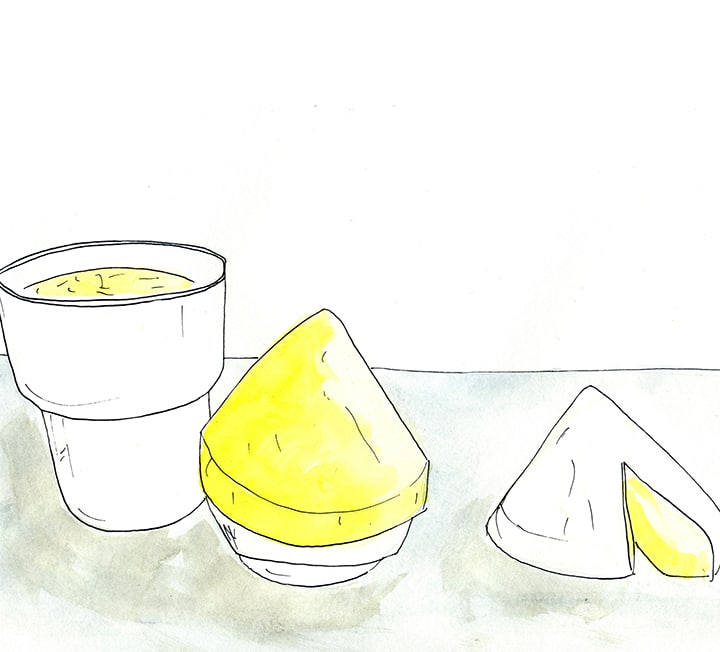
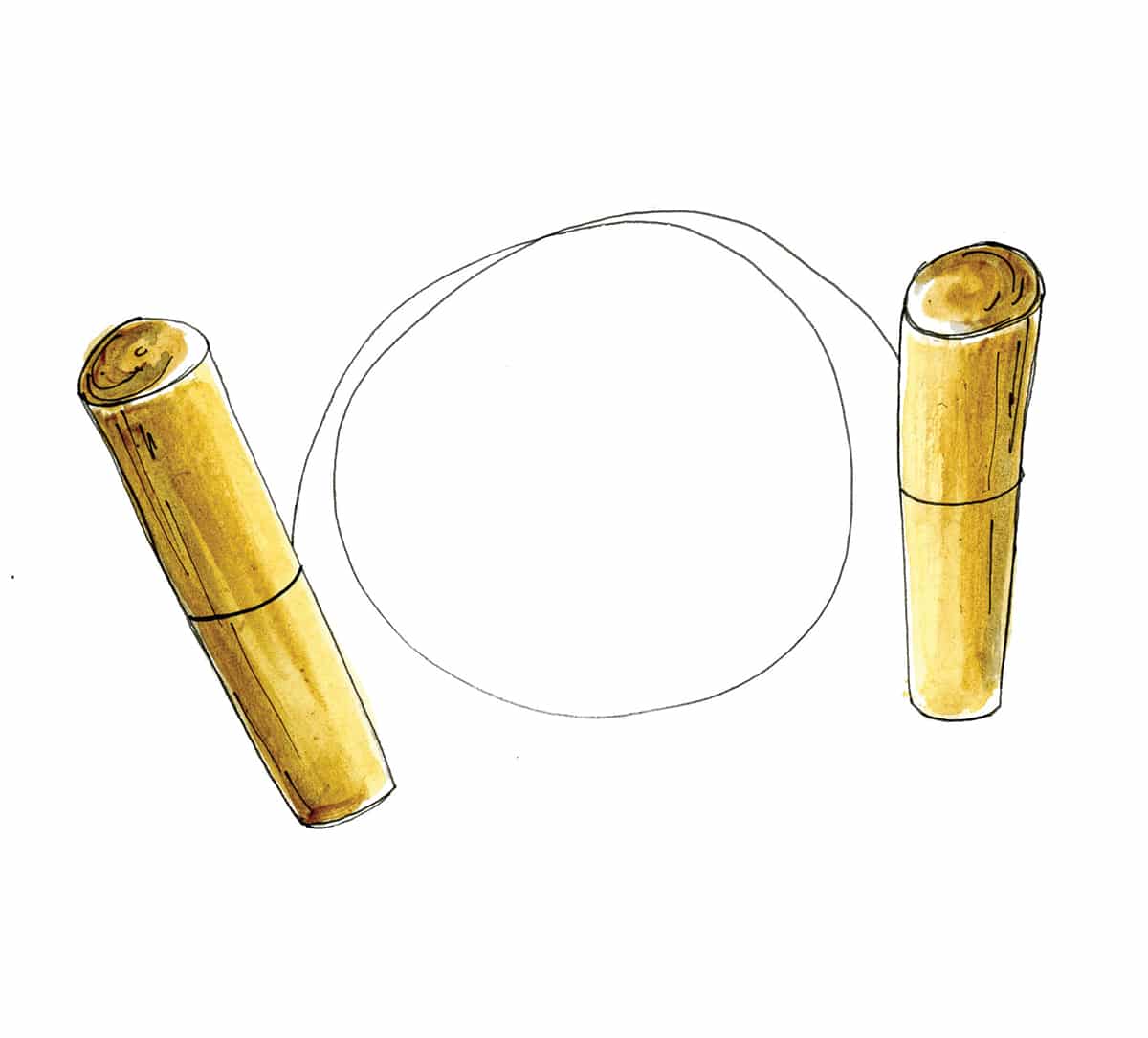
The methodology is so specific, it has UNESCO protection. Each coffee is brewed in a pot called a cezve, which is typically made from copper or brass. They are flat-bottomed, taper in the middle then open up again towards the top, and have a long handle, as originally they would have been used over an open fire.
The first step is to grind the coffee beans. Turkish coffee traditionally uses beans from Ethiopia and Yemen, which were part of the Ottoman Empire. I buy green Ethiopian beans (because of the war in Yemen we can’t import from there) and have a small hot air roaster in the shop, which can roast up to a kilogram at a time. We probably roast between two and six kilos a day. We have a special grinder to turn those beans into fine grinds – nearly like flour – which requires special plates and constant cleaning and calibration.
We then add a specific measure of cold water and coffee into the cezve – 100g water to eight grams of coffee – sugar, and sometimes a flavouring, according to the customer’s taste and custom, and then place it over a heat to warm slowly. There’s an initial stir to help blend the coffee, then the cezve is left for a bit before being stirred once more. You’re looking to achieve a crema on the coffee, and then to remove it from the heat just before it comes to the boil. At this point we take the cezve off the heat, give it a swirl, then decant into a cup in one continuous pour.
The customer has to wait for another two or three minutes for the coffee grinds to settle and sink to the bottom, then they can enjoy the drink while chatting, with a piece of Turkish delight or baklava on the side – it’s about companionship, friendship and socialising.
Blessed are the cheesemakers: Bermondsey Hard Pressed
Clare Finney tells the story behind an Alpine-style, Bermondsey-made cow’s milk cheese from Kappacasein
“I’D WAGER A CROCK OF SOUR CABBAGE THAT THE MAJORITY OF BRITS HARNESS BARELY 50 PER CENT OF A PICKLE’S POTENTIAL”
Image: Regula Ysewijn
Britain has long been a nation of pickles and picklers: of plum or apple chutney, of piccalilli and onion relish, of Opies walnuts and the ever dependable Branston. Moreover, through the 2010s we were repeatedly told that lacto-fermentation is now A Thing here, which surely means that for some it actually is? (well, at least in the keenest of foodie and lifestyle circles).
A hit of tart and sour with our food is well established, then. Yet I’d wager a crock of sour cabbage that the vast majority of Brits harness barely 50 per cent of a pickle’s potential, because we tend to deploy ours only in the context of a cold meal. Pickles go on the table when there’s a ploughman’s-style spread, they’re spooned next to pork pies and slices of ham, and they’re a key part of the best cheese sandwiches. But hot British food? Other than Lancashire hotpot with pickled cabbage, I can hardly think of an example. Which is in stark contrast to many other countries, where pickled or fermented vegetables are key condiments – or even ingredients – in their cuisine, whether the dish is served hot or cold.
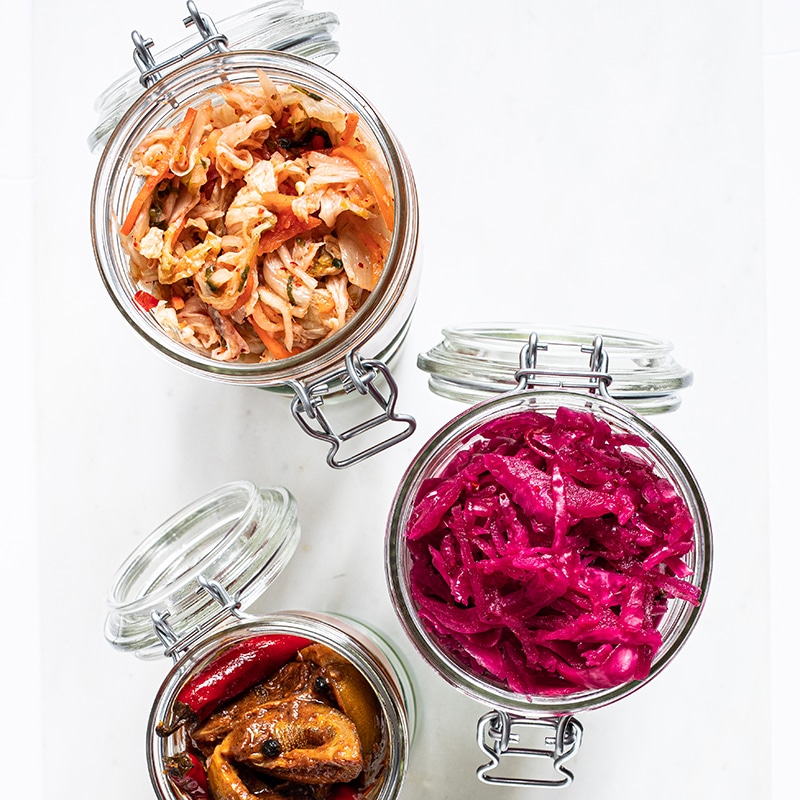
In German and eastern European cooking, finely shredded then fermented cabbage (sauerkraut) is ever-present. It might be warmed with onions and apples and served next to wurst or kielbasa, but is frequently even more integral. Look, for example, at the Polish dish bigos, which is a hearty and inherently warming hunter’s stew involving slow-cooked meats (venison, pork or boar) and smoked sausage – but mostly it’s braised sauerkraut. We should also admire dumplings such as Polish pierogi and Siberian pelmeni, whose fillings might include a smattering of sour cabbage alongside ground pork or mushrooms. More decadently, friend of the Market Alissa Timoshkina notes in her book Salt & Time: Recipes from a Russian Kitchen that a classic winter dish in her homeland would be goose or duck stuffed with braised sauerkraut and slow-cooked.
No doubt such dishes evolved because fermentation was essential to ensure vegetables were available all year round. But in our age of refrigeration and rapid freight travel, they appeal (to me at least) because of the marriage of sour with savoury; it’s a combination that ensures a plate of food will be layered and stimulating from the first bite to the last, vital if food is to be about joy as well as fuel. It has been suggested that central and eastern Europe’s fermenting culture stems from Asia, via the Mongol empire. Certainly, by opening our tastebuds to places even further east, we can learn more about the potential of matching sour foods to warm savoury ones.
In the southern part of the Asian continent, Indian pickles (achar) provide a vivid and enlivening counterpoint to rich and spiced foods. On a Saturday, you can do no better than visit Mrs Sandhu’s Temptings stall at the Market and try and buy her pickles and chutneys. They are a perfect match, obviously, for spiced dishes, but I think they make plainer meals fly too: a simple lamb chop, fillet of white fish, poached chicken, pretty much any vegetable that can be roasted or creamed. On that note, see also the burst of flavour that Borough Market Kitchen trader Mei Mei’s acar brings to a Malaysian poached chicken rice dish.
This brings me to the point of the piece, which is that while ‘authenticity’ is an appealing concept, there is also room, I think, for the fusion of ideas, techniques and flavours, purely on the basis that it can result in great tasting food. One very simple way of doing that would be to take ferments and pickles and use them, in the spirit of the global cuisines they derive from, to enliven British dishes and cooked ingredients. And you don’t need to do the pickling and fermenting yourself; superb sour condiments can be found around the Market. Your first stop should be Northfield Farm, where you can buy pickles from the London-based fermentation company Eaten Alive. Their kimchis suit Korean-style dishes of course – kimchi fried rice, seafood stews – and the pink smoked sauerkraut matches a German sausage marvellously. But beyond the obvious, try using them to add oomph to meat and two veg meals (bavette or onglet and chips, for example), whenever you have a fried egg or omelette, or (in particular) see how their incredible layered flavours quickly enhance broths and grain dishes.
Blessed are the cheesemakers: Bermondsey Hard Pressed
Clare Finney tells the story behind an Alpine-style, Bermondsey-made cow’s milk cheese from Kappacasein
“IF YOU BASE ANY DAY-TO-DAY DECISIONS AROUND CARING FOR THE ENVIRONMENT, WINE SHOULD BE AN EXTENSION OF THAT”
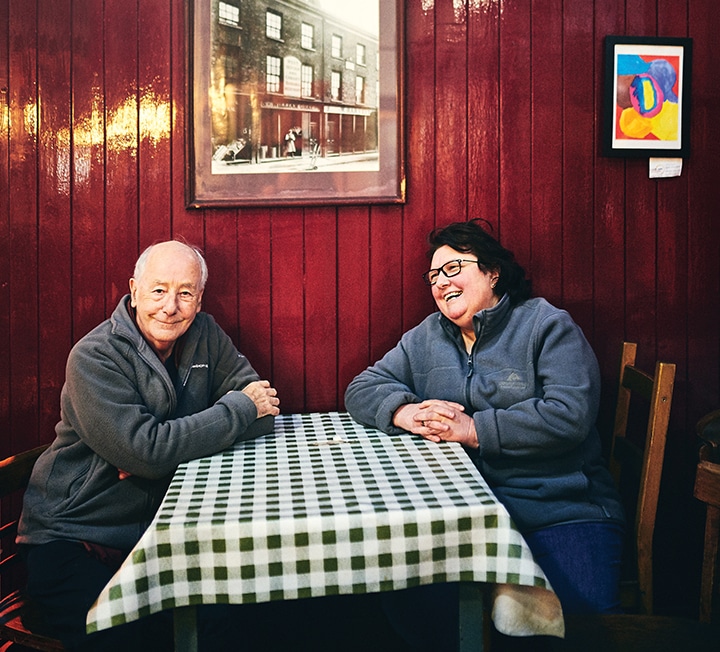
“We’re most interested in good wine,” says chef James Lowe. It seems a fairly obvious statement. But when James talks about good wine and its importance, he doesn’t just mean good to drink. He means good for the environment, for producers and – in moderation, of course – for his customers. “We looked for the same philosophy in our wine makers as we have in our farmers,” he continues. “One of the things that comes up more often than not is that they see themselves as farmers – farmers who are very much part of their landscape and terroir. They want to continue producing good wines and they understand that there’s a link between the health of the land and soil and the wine.”
“If you are basing your day-to-day decisions around caring for the environment, which I believe we all should, then wine should be an extension of that,” argues Isabelle Legron, the sommelier at Elliot’s. Elliot’s wine list is entirely natural, meaning it’s organically farmed and produced without additives or processing agents. Isabelle chooses it not just because she thinks that added yeasts and sulphites tend to mute a wine’s flavour, but because it’s better for the environment to grow grapes organically.
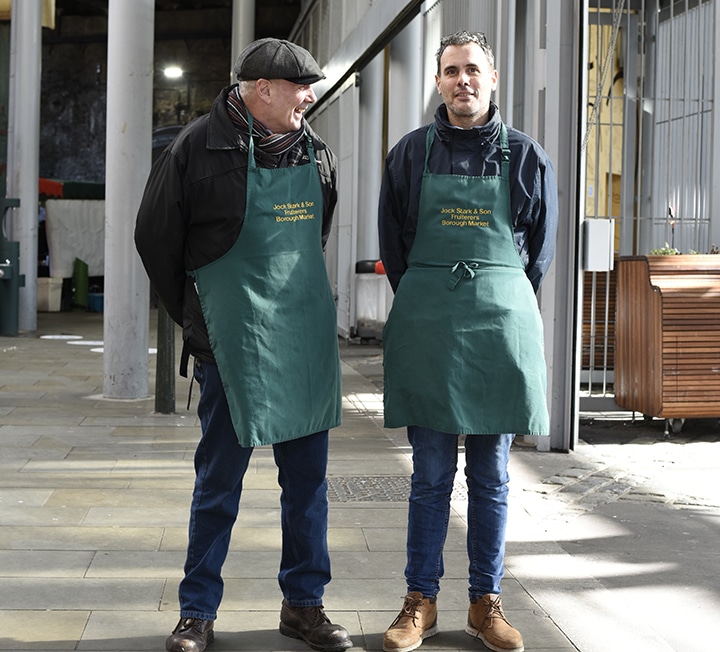
But wine can be organic without being ‘natural’, says Bedales of Borough wine manager Angelo: “Organic means the grapes are grown without chemical products – pesticides, fertilisers and so on – whereas natural means organic and low or no intervention in the winemaking process.” Whereas natural is about flavour and the principle of “making wine that expresses the land, not the winemaker”, organic is about “the impact on the environment and the soil”. Without pesticides and other chemicals, soil sustains millions of bacterial organisms, as well as insects, herbs and flowers, which in turn sustain bees and birds. To remove these is to imperil not just the area’s biodiversity, but the long-term sustainability of the vines themselves. “If you kill everything off you won’t have any more life – and if there’s no life you can’t grow vines,” says Angelo simply.
Bedales does stock some natural wines – such as the all-natural, slightly funky, red-fruited Catherine & Pierre Breton Grolleau Val de Loire – but the majority are simply organic, such as the Blaufrankisch Horitschoner, produced by Franz Reinhard, who has been cultivating under strictly organic management since 2006. “It’s a medium-bodied red, easy drinking, not too powerful. This malbec from Chateau du Cèdre in Cahors,” says Angelo, picking up another bottle, “is natural, and is perfect for summer: high acidity, fresh and, because it’s natural, a quite specific acidity that makes it particularly good slightly chilled.”
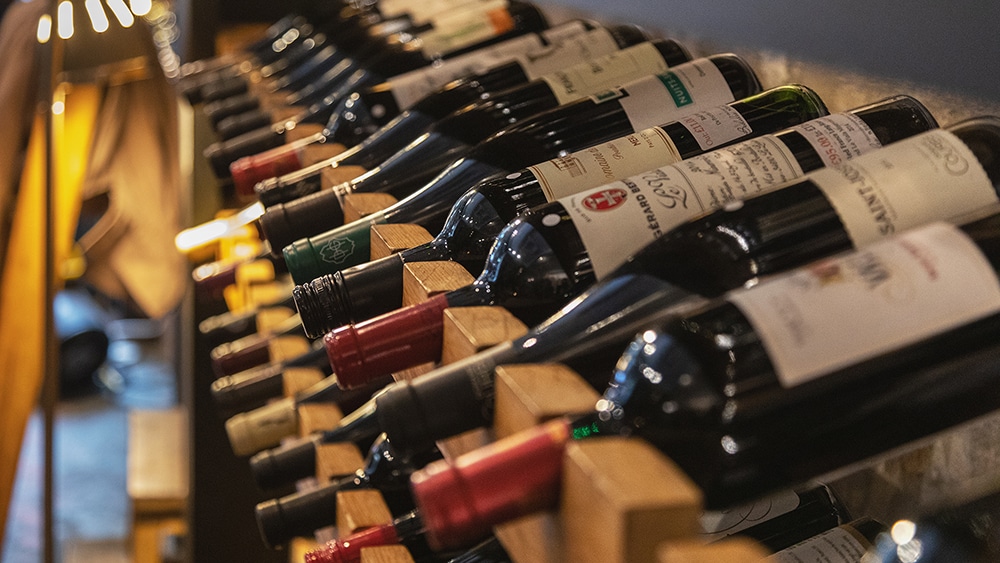
“We’re not producing stuff to feed the planet, so I don’t understand how we can let wine producers pollute the waters, reduce biodiversity and damage the natural landscape,” Isabelle exclaims. Elliot’s’ natural wines include a Rio Rocca spèrgle produced in Emilia-Romagna, Italy. It’s the colour of honey, but not too forceful, with notes of orchard fruit. Isabelle strongly believes the large-scale, industrial growing of vines has become a “social drain”, thanks to vast monocultures devastating biodiversity and the threats posed by chemical run off. If we’re concerned about buying organic meat and vegetables, she argues, why do we stop at wine?
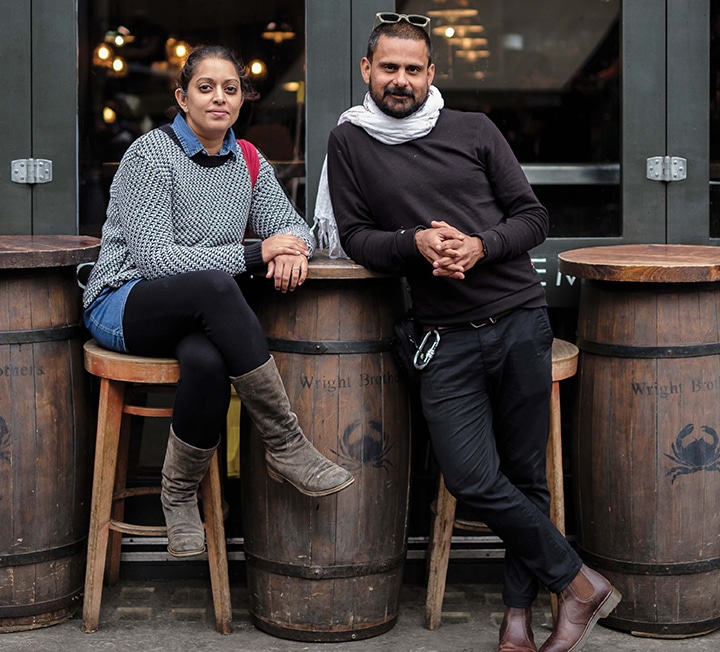
The culture of “working with the land and trusting it to repair itself” is a virtuous circle, says Toby Cartwright of Cartwright Brothers. “The less need there is for pesticides, the better the soil, the better the vine and grapes and the less need there is for intervention in the winemaking process.” The organic process has been used to rescue even old, diseased vineyards, says Toby, that “weren’t producing any grapes, and now they’re restored.” There’s not an abundance of fruit because the vines are old, but it is “excellent tasting”. Cartwright Brothers has a range of wines at a range of price points that fit the sustainability bill, from organic to full blown biodynamic and natural offerings. “A few years ago, a group of top sommeliers and masters of wine put taste to the test: they blind tasted 10 organic, biodynamic wines and 10 standard wines,” Toby smiles. “Nine of the 10 they chose as being the best were organic and biodynamic.”
Blessed are the cheesemakers: Bermondsey Hard Pressed
Clare Finney tells the story behind an Alpine-style, Bermondsey-made cow’s milk cheese from Kappacasein
“BEES HELP THE FARMERS BY POLLINATING PLANTS; TO ENCOURAGE THE BEES, FARMERS SET LAND ASIDE FOR REWILDING”
It’s been 25 years since The Lion King debuted on the big screen, burning the Circle of Life onto our brains and Mufasa’s death onto our retina. The latter I wish I could forget; the former is an earworm that rears its splendid, spine-tingling head every time I am reminded of sustainability and the natural world.
Of course, it’s been in my head all morning – because what are ecosystems but small, interlocking loops which together make up the path unwinding? Farmers rewilding parts of their land to encourage populations of pollinators and natural predators; gamekeepers managing moors to support populations of vulnerable ground nesting birds and other wildlife; foragers taking just enough to feed themselves or those restaurants and retailers they supply, leaving plenty for wildlife and birds. These things all find their place in the circle of life.
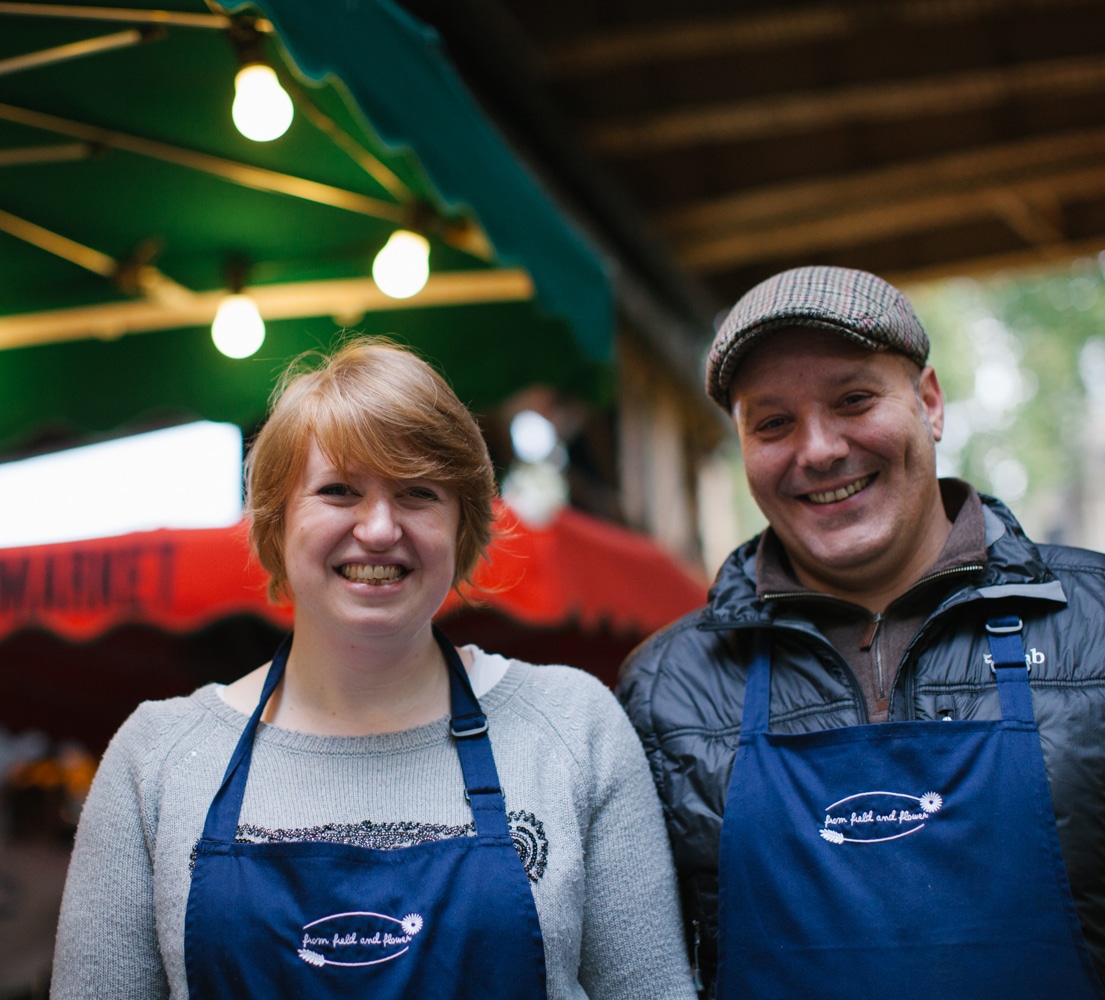
We’re part of it too – not just as fellow animals but in the choices we make regarding food and drink, which have such far-reaching consequences. Even something so seemingly simple as honey has the power to support the ecosystem, or to detract from it. “The role bees, in particular honeybees, play in the ecosystem in general is that they are great pollinators,” says Sam Wallis of From Field and Flower, “and when they can forage and pollinate wild species, that helps sustain the biodiversity of plants and trees.” Bees also help farmers of fruit and vegetables to produce naturally abundant crops, she continues, “so a lot of beekeepers keep hives on farmland and orchards – provided the crops are not treated with chemicals, which can mess up their senses and those of future generations.” Married with bees, the organic farmers who are trying to produce the best, seasonal produce can exist “in harmony with nature, rather than going against it.”
It is, quite literally, a virtuous circle. Bees help the farmers by pollinating the plants; the farmers, in an effort to encourage the bees, are setting land aside for rewilding. “Bees are busy, so they want to find the richest forage they can and mine it. A field of wildflowers will attract them” – generating biodiversity, a richer, more flavoursome honey for both bees and buyers, and more pollination for the farmer. It is, as a healthy ecosystem should be, a win-win. Problems arise when either the land or the bees themselves are exploited, either by monocropping or by the more “cynical” beekeepers, who harvest as much honey as they can and replace the bees’ natural, nutrient dense source of winter food with sugar syrup; a deeply unsustainable practice which affects the colony in the long run. “We have a producer who will not be able to supply us with heather honey this year because the rainy weather affected the heather flowering so badly, the bees have only just got enough for themselves this winter,” Sam laments. “It’s sad for us, because heather honey is delicious and popular, but it is the perfect example of how it should be – of beekeepers with a strong sense of values finding a balance with nature and putting the health of the hive first.”
The same principle of never taking more than nature needs to sustain itself is as true of foraging as it is beekeeping, Noel Fitzjohn of Fitz Fine Foods tells me. “With wild garlic, for example, which will be coming into season in the next couple of months, if I pick too large an area it will take a year to come back – sometimes more – whereas if I take a small amount in a big area, it will regenerate easily.” This is important not just for the plant itself, but for the health of the soil and the rest of the ecosystem. “When I pick rosehips and hedgerow berries, I never take more than 10 per cent of what’s there because they are so important for wildlife. It doesn’t sound like much, but it mounts up quickly when you consider how much each bush produces.” He too is grateful for the number of farmers rewilding and restoring and maintaining their hedgerows. Biodiversity benefits everyone and everything, including the farms themselves.
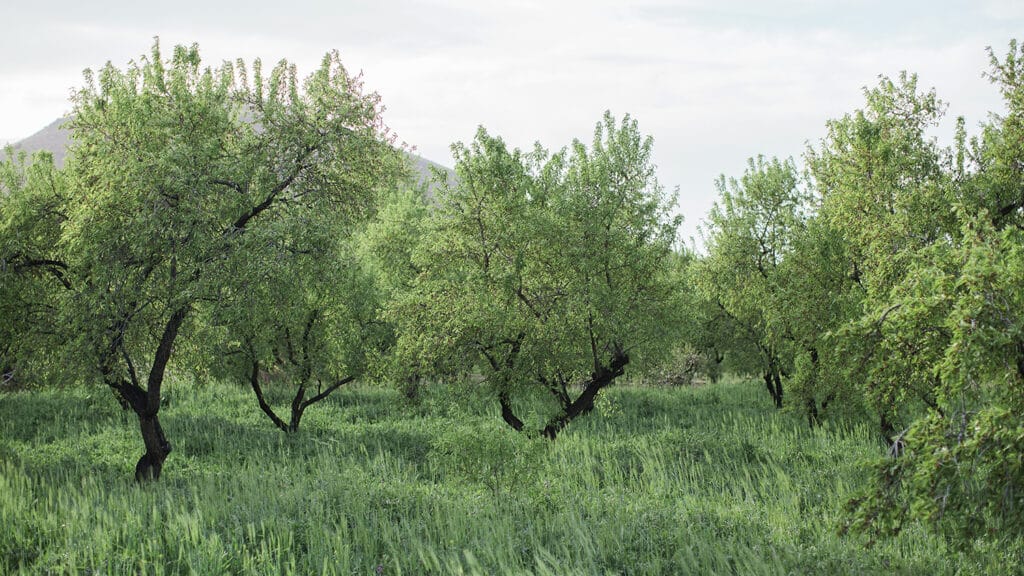
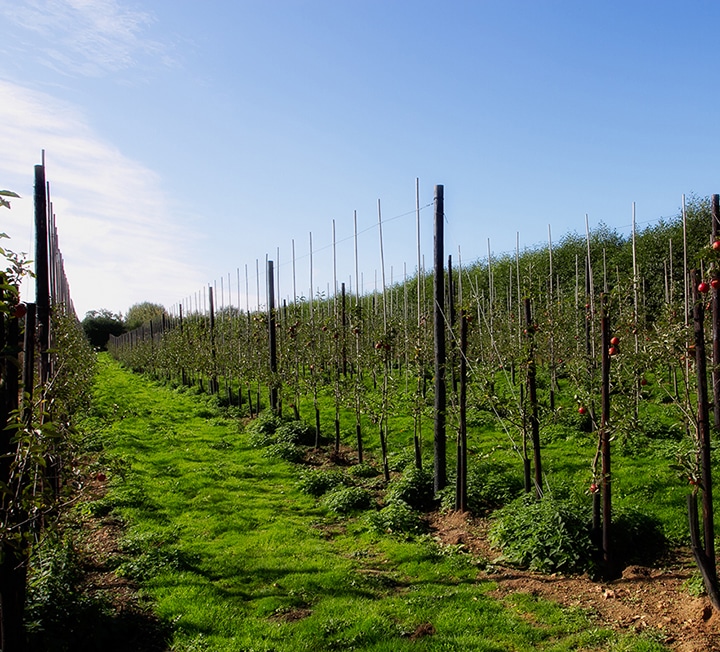
This is explicitly evident when it comes to agroforestry: the use of fruit trees in arable farming boost production, enriching and protecting the land in the process. “In East Anglia, where there are few hedges, farmers see it as normal for the topsoil to blow away periodically, but the trunks help decrease wind speed,” says Charles Tebbutt of Food & Forest. Meanwhile, the deep roots of the trees further reduce soil erosion, thereby retaining its stock of nutrients as well as adding to it via leaf litter come autumn. “Stephen Briggs, one of the leading proponents of agroforestry, talks a lot about the subsoil that cannot normally be accessed by arable crops,” he continues. “Because the tree roots go deeper, they suck up the phosphorous from the subsoil which is recycled when the leaves fall. This means the nutrients reach the topsoil without the need for excess fertiliser.” It’s good for the environment – less fertiliser is required, so there’s less run off and river pollution – as well as being conducive to larger yields.
The same message comes back time and again: producing food in harmony with nature is a win-win for everyone, while a mercenary, purely commercial approach to harvesting nature’s bounty will ultimately only ever be a lose-lose. “For us this is about working with small producers; family producers who see their work with bees as a partnership rather than something they just earn money from. Mass produced honey is adulterated – it’s easy to take for granted. But honey is precious,” Sam says passionately. For her, Noel, Charles and many other producers at the Market, the word bounty is key.
They take what’s in excess, so as not to disrupt – or in certain cases, to actively restore – the balance of nature. In contrast to the more faddish foragers, who can clear vast quantities of mushrooms, elderflower and the like, Noel is careful to ensure he leaves the lightest of footprints behind. Fungi in particular play an important ecological role, breaking down organic matter from plants and animals as well as serving as food for deer, rabbits, mice and insects. Knowing what to pick is perilously important, so this is inevitably the angle that gets the most attention. But knowing how much to pick – a knowledge borne of a long and initiate knowledge of nature, Noel explains – is important too.
For Noel and Sam, it’s about treading lightly. For Darren of Shellseekers Fish & Game, however, it’s about active management: culling those species which pose a genuine threat to the natural environment when in abundance and, through careful game keeping, ensuring that environment is maintained and secure. “We have a problem with deer in this country. There are no natural predators and while a lot of people stalk deer for sport, there aren’t enough doing it professionally.” What’s more, those in it for the thrill of the chase shoot stags rather than does, so the population can still easily explode. “If you have one stag and 40 females, you can have 80 more next year – and they are overrunning the place,” Darren explains, both in their own habitat and in ours. “Go into a woodland where there’s a deer problem and above head height it will be stripped completely. Eventually, there is no longer enough food to sustain the deer population, so they move onto farms and gardens.”
As if that wasn’t bad enough for both the woodland ecosystem and our farmers, in venturing into built up areas in search of food the deer will inevitably stray onto roads, posing a life-threatening risk to drivers and passengers. “We have a deer problem. Let’s eat our problems,” says Darren, who opposes bitterly the idea that any animal should be shot and then go to waste.
Natural ecosystems everywhere are under increasing threat. There is, in the words of Tim Rice, more to do than can ever be done in the way of sustaining them. But making sound, supportive decisions when it comes to our food choices seems an excellent way to start.
Blessed are the cheesemakers: Bermondsey Hard Pressed
Clare Finney tells the story behind an Alpine-style, Bermondsey-made cow’s milk cheese from Kappacasein
“TO ME, CORIANDER SCREAMS SOUTHEAST ASIA: THINK THAI GREEN CURRY, MALAYSIAN LAKSA OR VIETNAMESE PHO BROTH”
Image: Ed Smith
You’re either a lover or a hater. Of coriander, that is.
Most of us love the distinctive earthy, buttery, citrus, floral notes that are so synonymous with the foods of the Indian sub-continent and south-east Asia. But around 10-15 per cent of us are genetically predisposed to thinking it tastes like soap.
I’m afraid there’s very little I can do to improve things for those who think eating coriander (‘cilantro’) is like consciously swallowing fragrant bath water. Sorry about that. For everyone else, though, read on.
Storage
I’m sure we’ve all found ourselves with a bag of mostly unused coriander that’s turned in the blink of a fridge light, from meal lifting magic herb to brown, liquid mush. As always, I suggest you follow the wet towel approach to keep the herb fresh for as long as possible.
Perhaps more than any other herb, I’d say the best thing to do to get the most out of coriander is to use it liberally and often. To my mind, there’s little or nothing to be gained from trying to freeze or dry coriander. You could blitz it with olive oil to prolong the herb’s use, though that’ll turn black and unappealing soon enough.
Cooking tips
In most instances, it’s the leaves that you want; the stems are stringy and are not enjoyable to eat, though they do carry a lot of flavour (more on this below). If a recipe calls for fresh coriander, really you need to pick the leaves from the stems and then chop them or use whole as required, reserving the stems for another purpose.
Of course, your first thought at an instruction to ‘pick the leaves’ will, no doubt, be to ignore it, because life is too short. Yet unless you’re using huge quantities, it’s not really that time consuming, and is often quicker and more efficient than finding yourself picking through a tangle of stems later on (we’ve all been there).
Like basil, the leaves are delicate and don’t take direct heat very well, losing much of their impact when cooked, so you’ll find most recipes suggest adding the leaf at the end of the process/as a garnish.
As mentioned, though, the stems do have loads of flavour and are also happy in a hot pan. I tend to chop them finely and add to a stir fry or curry base at the same stage as onion, ginger, garlic and/or chilli. They’ll also provide depth to a chicken, beef or pork stock.
Classic uses
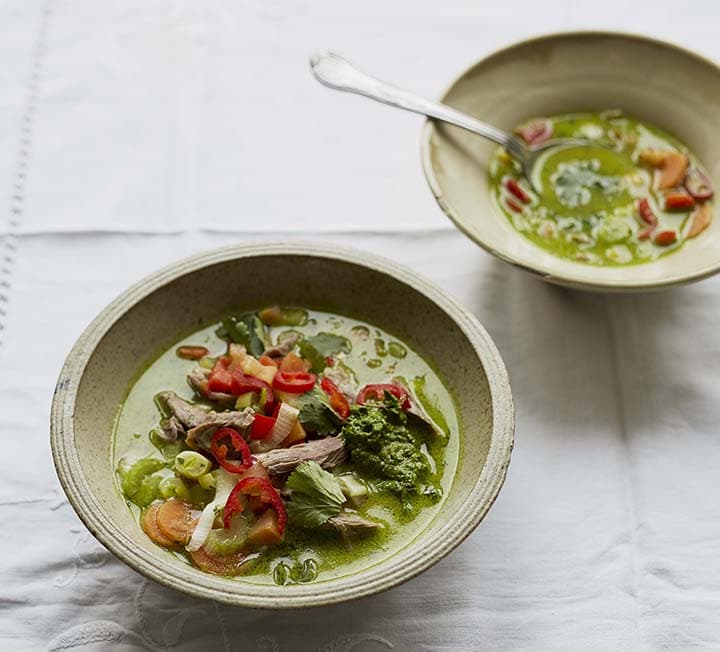
To me, coriander screams southeast Asia: think Thai green curry, which relies on this green herb, Malaysian laksa or Vietnamese pho broth, which makes use of the stems in the broth and the leaves as a vital garnish. In fact, think of pretty much anything Vietnamese: summer rolls, carrot and chicken salad, herby crepes and omelettes, banh mi baguettes. It’s an omnipresent, fresh, lifting staple.
You’ll also be familiar with coriander if you’ve travelled through central America. Mexican salsas often make the most of its floral presence, often (as in south-east Asia), matched with zesty, acidic lime juice.
While there’s great variety in the food of the Indian sub-continent, they’re often linked by the use of coriander through the cooking process and as a seasoning at the end. I can still taste a butter crab dish from a restaurant in Mumbai, to which just a sprinkle of coriander added the final, perfect, touch.
If you read the likes of Claudia Roden, Anissa Helou and Yotam Ottolenghi, you’ll know that coriander is a key ingredient in Middle Eastern cooking too. As with the cuisines mentioned above, that’s often as a garnish on a tagine, rice or grain-led dish. But it plays a major role, too, for example in schug, a hot pepper and coriander sauce from the Yemen.
On a similar theme, north African cooking relies on coriander for chermoula, a marinade used for fish, sea food and meat (most often: coriander, preserved lemon, garlic and paprika). Of course there are many more national dishes that take advantage of coriander, but the ones above stand out.
In terms of specific ingredient matches, how about carrots, quick fried pepper squid, crab, chicken and lemongrass, eggs, chorizo, chorizo and eggs, aubergine, yoghurt, lentils, avocado, lime, onions.
Coriander is, I think, the only herb of this series that I wouldn’t personally recommend in a dessert. Though I suspect there are some options out there (with mango?).
Market herb hero
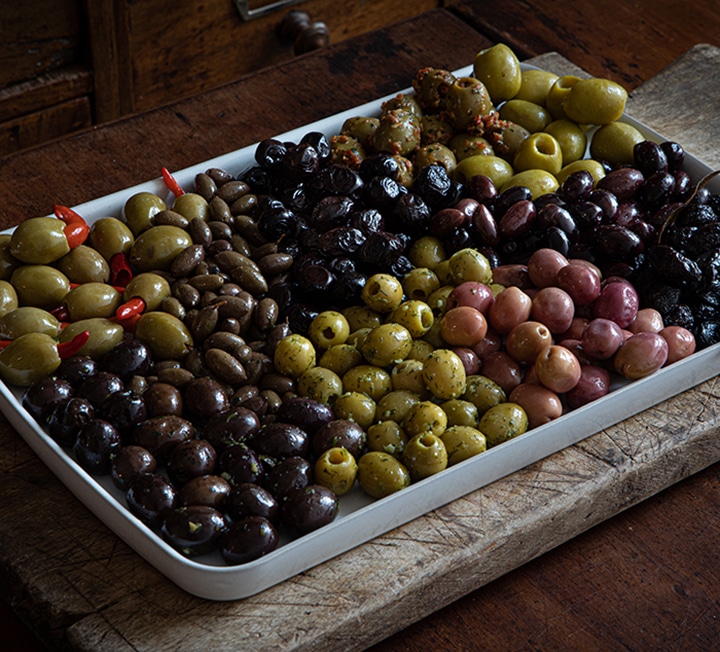
There are a number of options for Borough’s biggest users of fresh coriander, not least among the Borough Market Kitchen’s hot food vendors such as Horn OK Please and Gujarati Rasoi (and, of course, all the greengrocers). However, my hero on this occasion is Borough Olives, which uses coriander to great effect alongside a few wonderful olives.
A recipe suggestion
My winter slaw takes inspiration from the flavours of Vietnamese and Thai cooking (coriander, lime, chilli and fish sauce), and matches them with the great British cabbage. It’s vibrant and quite punchy (particularly if you can get your hands on a Japanese black radish). You could partner this slaw with many things – not least a buffet or as padding to a baguette – but definitely consider some crunchy on the outside, fatty and unctuous elsewhere, roast pork belly.
See Ed’s recipe for coriander cabbage slaw.