Soft power
Angela Clutton on how the soft, aromatic herbs of springtime bring with them a fresh burst of colour and flavour
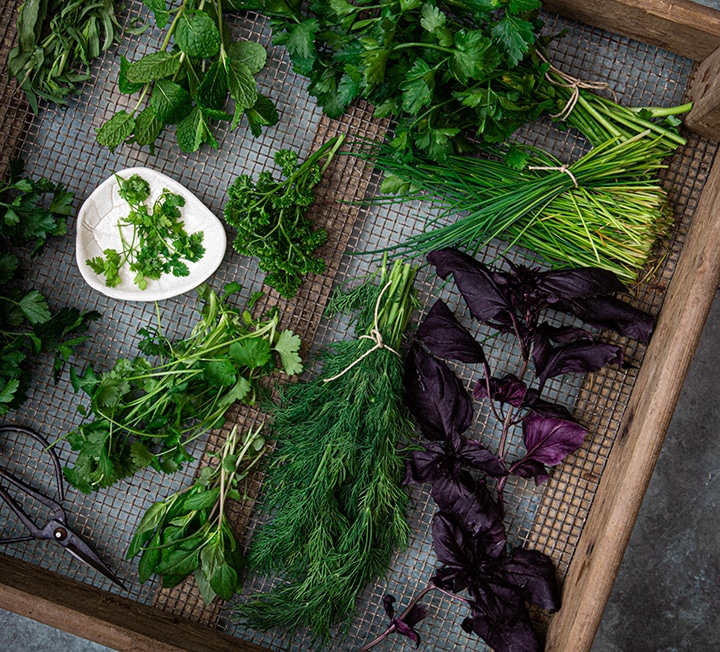
“SPRING IS WHEN THE FIRST DELICATE LEAVES OF MANY SOFT, AROMATIC HERBS BEGIN TO MAKE THEIR APPEARANCE”
Images: Regula Ysewijn
I think – I hope – that broadly speaking most of us have got our heads around the seasonality of our fruit and vegetables: strawberries in summer, pumpkins in winter, etcetera, etcetera. We’re starting to get a feeling for the seasonality of some meats, too. And, increasingly so, fish. But herbs? I wonder to what degree many of us even think of herbs as being seasonal – especially when we see the supermarkets selling those same slightly sad-looking plastic bags of basil, dill and the like all year round. Yet herbs really can be seasonal. Springtime is when the first delicate leaves of many soft, aromatic herbs begin to make their appearance. Much like the first sightings of crocuses or snowdrops, every year it seems to me a miracle that these dainty herbs have not just survived the harsh winter but are pushing through it, embracing the new light and bringing with them a lightness of flavour too.
They come to bring relief from the woody herbs of winter, such as rosemary and thyme, that have done such steadfast flavour service in hearty stews and more. As the arrival of spring brings a hankering for bright flavours, the new season’s herbs are well set to partner with all manner of other spring and summer produce.
The idea that we should make themost of various aspects of produce that come into season at the same time has rarely been highlighted better than by Thomas Tusser in 1557. A farmer, Tusser wrote A Hundred Good Points of Husbandry – a sort of ‘how-to’ for the farming year, in poem form. So popular was his poem that by the time it was republished in 1573 the 100 points had become 500, and the recommended herbs of fennel, parsley, tansy, thyme and “mints of all sorts” were amplified with 21 herbs for strewing, 22 for salads and sauces, and 28 for the “physic”. And that’s not even all of the herbs he mentions.
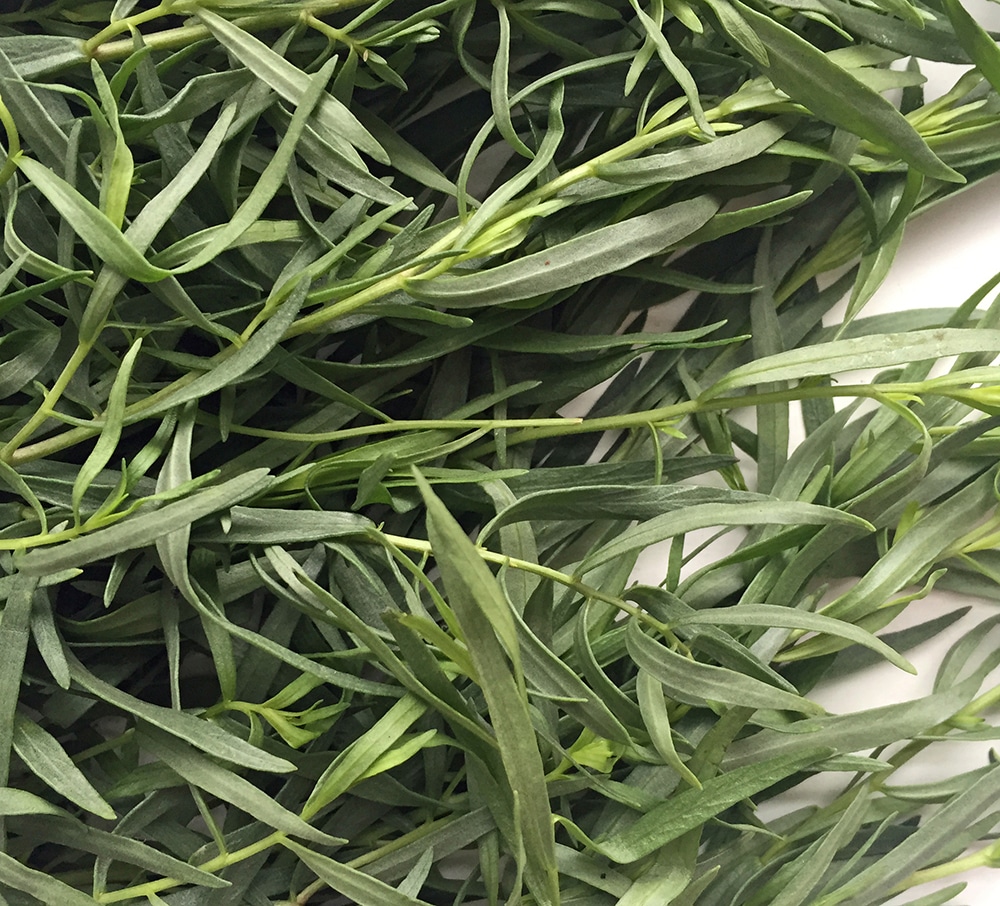
Tusser’s point – and it is mine too – was that we should enjoy all the land has to offer at the time that it does so. Take chicken – or, more specifically, spring chicken. I know, I know, we get chickens all year round now, but in heritage farming spring chickens were young chickens. (And once knowing that, the phrase about being a spring chicken makes rather more sense.) The meat of young chickens has a lighter flavour than older birds, perfect to be partnered with feathery dill, fennel or tarragon – three of spring’s most vibrant and useful herbs, each bringing its own distinctive note of aniseed flavour.
I like to chop up a bundle of those herbs, stir them through 150g or so of softened butter, season, and then gently push it under the skin of the chicken before roasting. The herb butter pervades the flesh, making it extra succulent and flavoursome. The butter is also exceptionally lovely for serving with young, sweet spring carrots that have been lightly braised but little more.
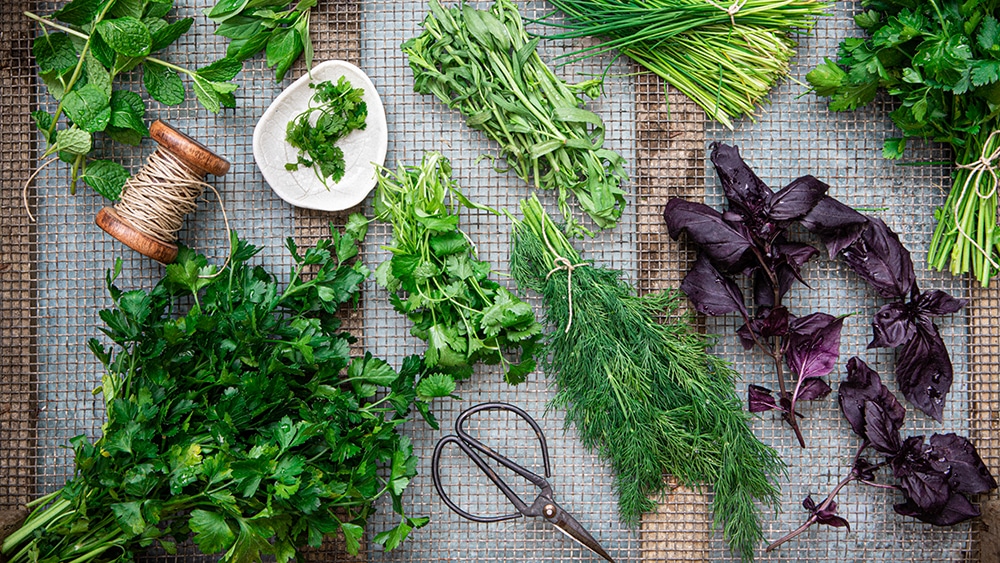
Other spring herb and produce partnerships? How about new-season oregano or any of the aforementioned aniseedy three with young goat’s cheeses? You could bake a tart of the cheese with some asparagus and spring onions, and throw some of the herbs in there too. Or whip yoghurt through with chervil or any other spring herbs to serve alongside a piece of baked fish (think plaice or sea trout). Or – and this is a bit of a personal fave – crab and some steamed-to-tender new potatoes mixed together into a salad with lemon, olive oil and chopped lovage.
I could go on and on with similar ideas – but in all of them so far the spring herbs are there merely as workers, doing a small but important job in among a host of other flavours, complementing and enhancing them. But these herbs are so joyous, so fresh tasting, that we should really take time to enjoy them as more of the main event too. Perhaps herb pies with lots – and I mean lots – of miscellaneous chopped spring herbs, mixed through with hard-boiled eggs and spring onions, before being baked in puff pastry. A true lunchbox treat, right there.
Or you could take inspiration from the Bavarian soup krautlsuppe that I came across in one of Elisabeth Luard’s books. She describes it as being typically served on the day before Good Friday, as, by tradition, bitter spring herbs are often eaten at Easter as a sign of penitence. The recipe calls for a simple base of onion and stock, with a mix of chervil, watercress, spinach and sorrel, and potato to thicken. If a bowl of that is meant to be a punishment, it’s one I’ll happily take.
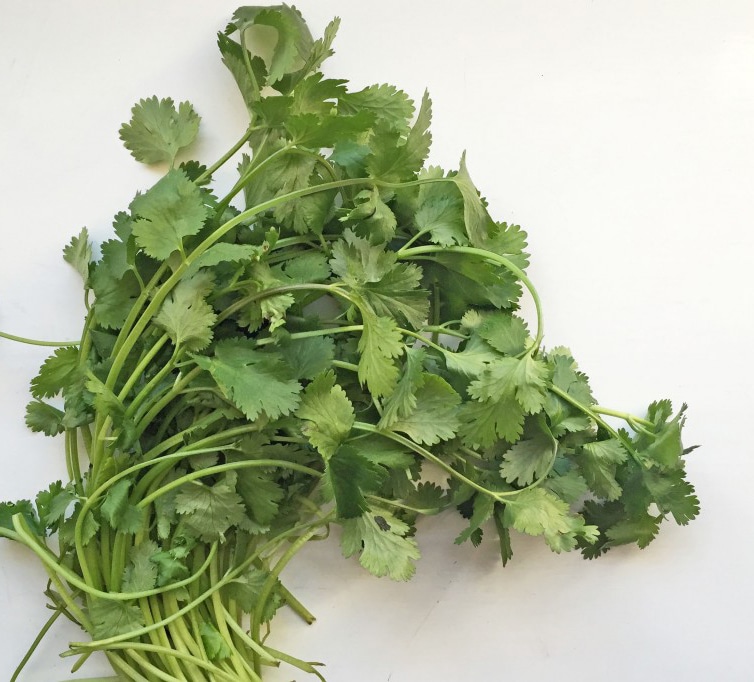
I’ve been thinking, too, of the Middle Eastern dish sabzi kordhan – a platter of herbs such as mint, fennel, dill, coriander or radish leaves that stays on the dining table throughout a meal. The herbs just sit there, ready to be reached for whenever a burst of freshness is needed. I love the idea of having the herbs ready as a refresher, but also how visually beautiful they must be.
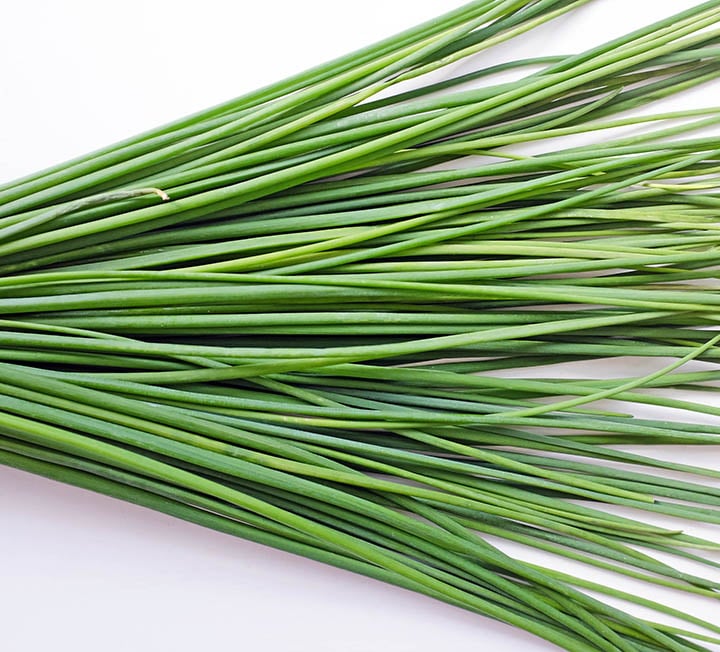
The beauty of fresh spring herbs is a large part of their charm. It is why they are so useful as a garnish. The elegant, delicate fronds of dill or chervil. Spears of tarragon. The green vibrancy of mint and chives. (Although there is little more likely to ruin for me a perfectly lovely brunch than an unexpected sprinkling of chopped chives on my poached eggs. But that’s just as personal thing). In an age where Instagram-able food is hotly pursued, herbs have the ability to turn the dullest-looking dish into a photogenic beauty. It is why parsley is so ubiquitous, but parsley is only the very tip of the possibilities.
I find it very hard not to get a little carried away and buy too many of these beautiful herbs at this time of year. Often too many to use, really. But it’s not that much of a problem. I know I’ll steep some in red wine vinegar or cider vinegar for an infusion that will be useful for months to come. I finely chop some into salts. And there’s usually a corner of my spring and summer freezer packed with little bundles of herb butters, like the one I mentioned earlier to go with the chicken. I make the butters with all sorts of mixes of herbs, with maybe a grating of lemon zest added too, roll them up in protective film, and freeze ready for slicing into all kinds of cooking.
It means I’m never short of the fresh burst of colour and flavour that these seasonal herbs can so easily provide.
Discover more
Blessed are the cheesemakers: feta
Clare Finney tells the story behind a tangy, sweet and salty cheese from Borough Cheese Company
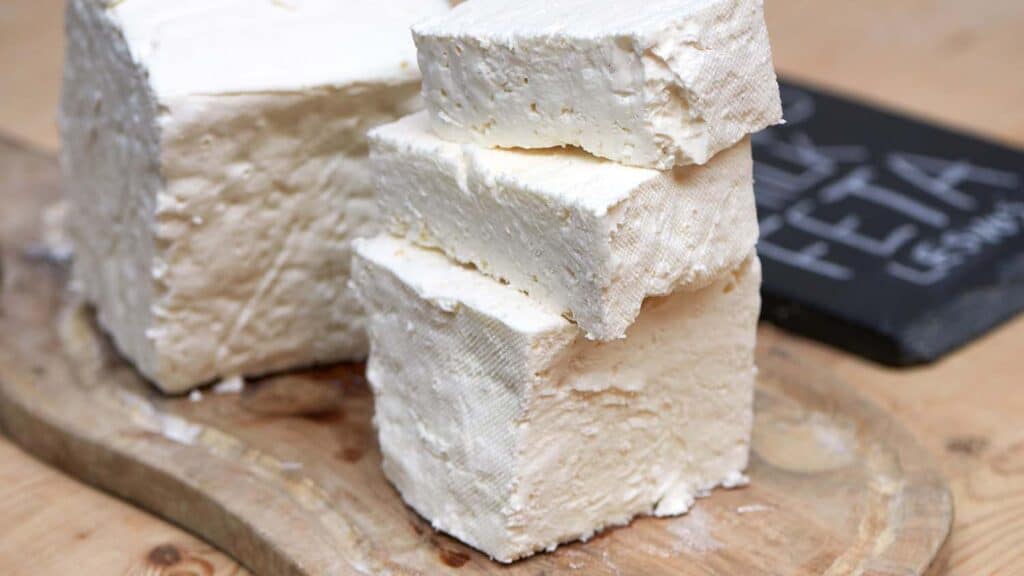
“THE GEOLOGY AND SEASHORE SETTING OF LESBOS CREATE THE PERFECT FOLIAGE FOR PRODUCING QUALITY MILK AND CHEESE”
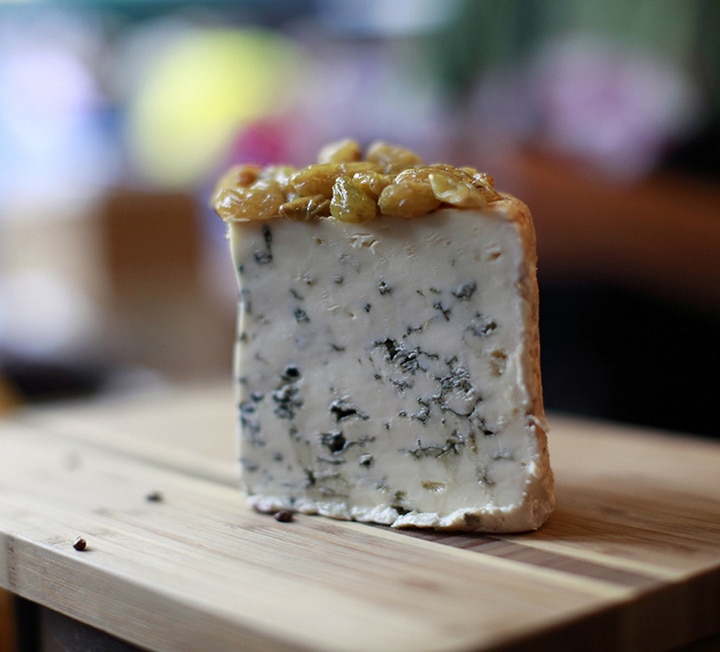
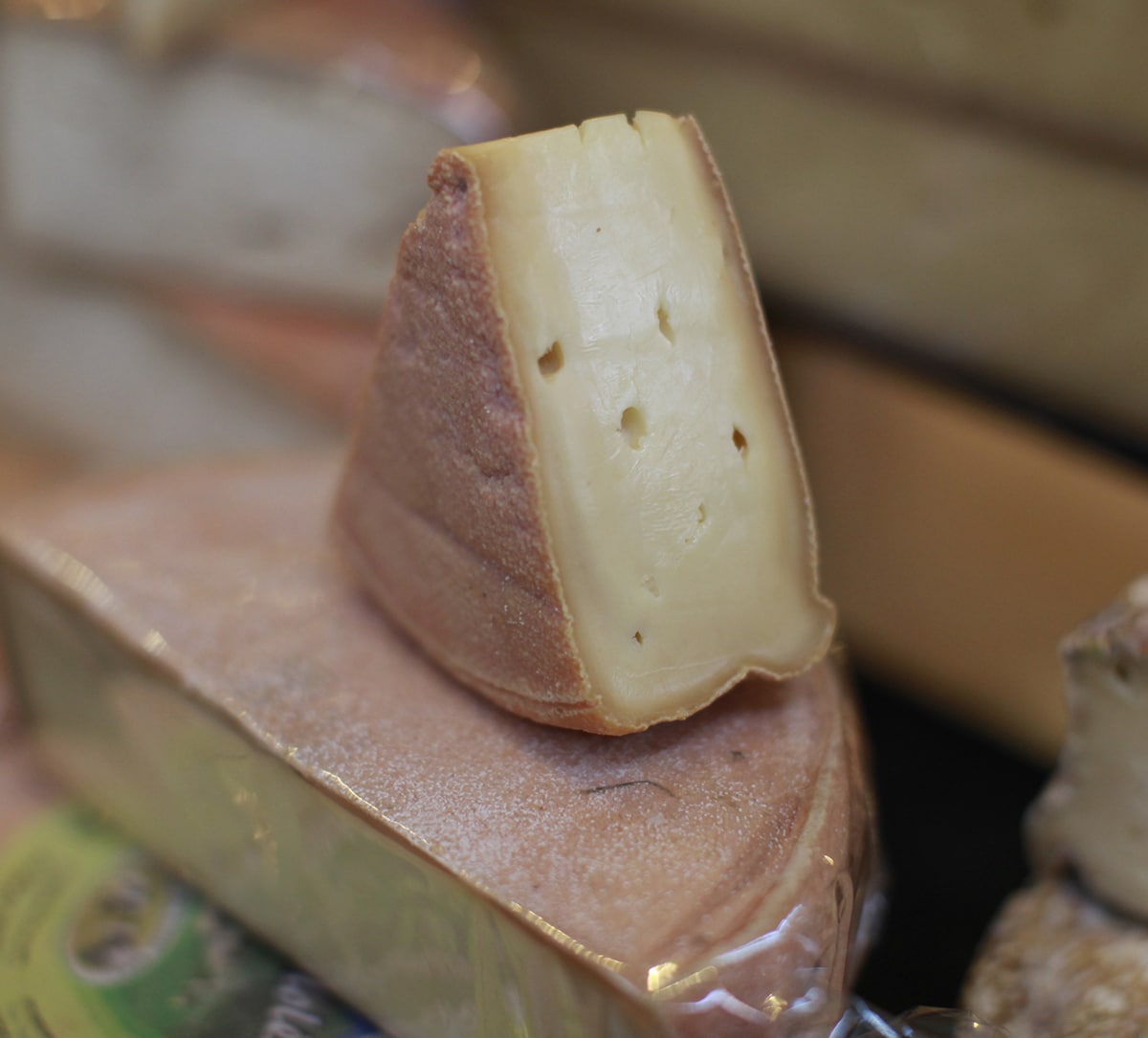
Should you ever be so lucky as to find yourself sailing around the Greek island of Lesbos, keep your eyes peeled for a boat full of sheep, manned by a shepherd. It shouldn’t be hard to miss. They’ll be heading to a small island of volcanic rock across the bay to supplement their diet with its unique varieties of mineral-rich herbs. The sheep are a hardy breed, native to the island, and they graze outside throughout the seasons – “not that winter is ever that bad here, but it can get cold in the mountains,” says Dominic Coyte of Borough Cheese Company. “In the summer months they have to find shelter during the heat of the day, and graze evenings and mornings.”
Being one of only a handful of Greek feta cheeses to hold protected designation of origin (PDO) status, the feta of Lesbos is invariably better and certainly more reliable than commercially produced iterations. The island’s geology – “the area producing feta sits on a caldera, which is essentially a volcano that has collapsed on itself” – and seashore setting makes for the perfect foliage for producing quality milk and cheese. “Much is made of the minerality of the Agra area, where our feta is produced, and the benefits to the herbage. There are no olive trees” – the roots of which make for quite bitter milk, if the sheep eat them – “and a real diversity of shrubs, herbs and wild flowers,” says Dominic.
Though best known for his mountain cheese, in recent years Dominic has been alternating mont d’Or, his venerable winter cheese, with this delicate, summery Greek number – its tangy, sweet and salty strains just crying out for fresh cucumber, black olives and tomatoes.
“Our feta is produced by the Tastanis family, who have been making cheese in this area for three generations,” says Dominic. They work with 15 shepherds and 1,500 sheep to produce feta from December to July. Three months ago, he went to visit them and was fed feta on every possible occasion. “We had about 20 courses and each had feta: with fish, wrapped in pastry, warm, cold… it just showed how versatile it is as an ingredient.” Though the majority of feta are a mix of sheep’s and goat’s milk, the Tastanis family make theirs with 100 per cent sheep’s – “so it has a very smooth texture, which is unusual in feta. What I like about the cheese is, that salty sharpness is not so obvious, so slightly fruity flavours can come out in the background.”
The sheep are milked twice a day. “It’s very impressive. Sixty per cent of the herd are milked by hand: I remember this guy sitting on an upturned bucket being jostled by sheep as he quickly milked each one.” The milk is taken to the dairy that morning and again in the evening, filtered, pasteurised and made into cheese. The Tastanis use their own yoghurt to culture the milk. “The most significant thing about feta is the use of salt: dry salting the curd and ageing it in brine,” Dominic explains. Feta varies hugely between regions and producers, but the method doesn’t vary much up until this point. What happens next – how long it matures for and whether that maturation takes place in metal or a wooden barrel – is at the discretion of the maker and seller. “Ours is six months, but it could go a little longer, over which time it will get slightly denser and saltier. I think if you capture it around the six to 10 months mark, it’s perfect,” he continues. “You have that creamy deliciousness. You have that blend of flavours.” You have a cheese savoury enough for a spanakopita, sweet enough for watermelon, rich enough for a salad and creamy enough for our personal favourite: a slice of sourdough toast and a drizzle of Oliveology’s Greek honey.
Shell shock
Thom Eagle on why the bold flavours of native brown crab mean that, rather than being treated with the delicacy afforded to lobster, it can provide the basis for a more adventurous style of cooking

“GET YOURSELF A FEW BOTTLES OF RIESLING AND SOME WHOLE CRABS AND MAKE A DAY OF IT”
Images: Regula Ysewijn
I lived for many years in Norfolk, mainly in Norwich, and particularly there and in the north of the county, all the way from Yarmouth to the Cromer sands, nothing heralds the start of the culinary summer so much as the arrival on the menu and market stalls of crab. In a world where few things still seem to be local and seasonal, where the great herring fisheries have long since moved on and where even Colman’s mustard, until recently the pride of Norwich, has relocated its factories, the Cromer crab is still very much a going concern, available during the season in every cafe and restaurant east of the Wash. Although the people of Cromer are right to be proud of their local crustaceans, really they are good all over the country, if often compared unfavourably with the apparently more glamorous lobster.
In defence of the crab, Hugh Fearnley-Whittingstall has made the remark that while lobsters cost twice as much as crab, they are not twice as delicious – which is true. Even this misses the point, though, which is that crab is in fact a very different eating experience to lobster, and not really to be compared at all. Bisques and ravioli notwithstanding, the somewhat ephemeral taste of lobster is to my mind best enjoyed as-is, halved and in the shell, with only a flavoured butter of some sort (garlic, usually) to adorn its sweetness – the kind of meal best seasoned by the close proximity of seawater. Crab, it’s true, is often served like this as well. Order a crab salad at, say, Cookie’s Crab Shop on the north Norfolk coast and you will get not a mixed affair but rather a selection of salad items alongside a whole dressed crab – a crab that has been boiled, cracked open, picked over and packed back into the shell.
While nice once in a while, I think this is in general simply too much crab to eat. To me, the strong flavours of both the sweet white meat and the murkier brown really come into their own when combined with other things.

The white meat, from the legs and the fat claws, is essentially the muscle meat of the animal (insofar as a crab can be said to have such a thing), while the brown, composed of not-yet-formed shell and the various organs inside the main body, is crab offal by another name, and the same sort of hierarchy between the two exists as in the meat of any other animals. When I was cooking at Little Duck, lacking the time and the space to really get to grips with a crab, we would buy tubs of either white or brown meat, the former being more than three times as expensive.
As, again, with the cheaper cuts of meat, this distinction is a blessing for those who like deeper flavours; less sweet and delicate, the brinier brown meat is doubly economical, as a little goes quite a long way. Just a tablespoon or two, loosened with a splash of the cooking water, seasoned with some garlic and chilli just-tempered in oil and brightened with a squeeze of lemon juice, makes a wonderful sauce for thick spaghetti; or stir the same amount through a risotto with fresh peas for something that feels like a Venetian spring. The classic treatment, of course, is just to mix it through some mayonnaise and spread it on toast.
Even the less pungent white meat can be happily stretched further with a little thought. A good option is to pair it with something similar in texture, sweetness, or both. At The Sportsman in Kent, Stephen Harris serves white crab meat with hollandaise sauce and a little shredded carrot, the texture of which exactly matches the just-cooked crab. Eating this was the first time crab really made sense to me, its flavour distinct and exact.
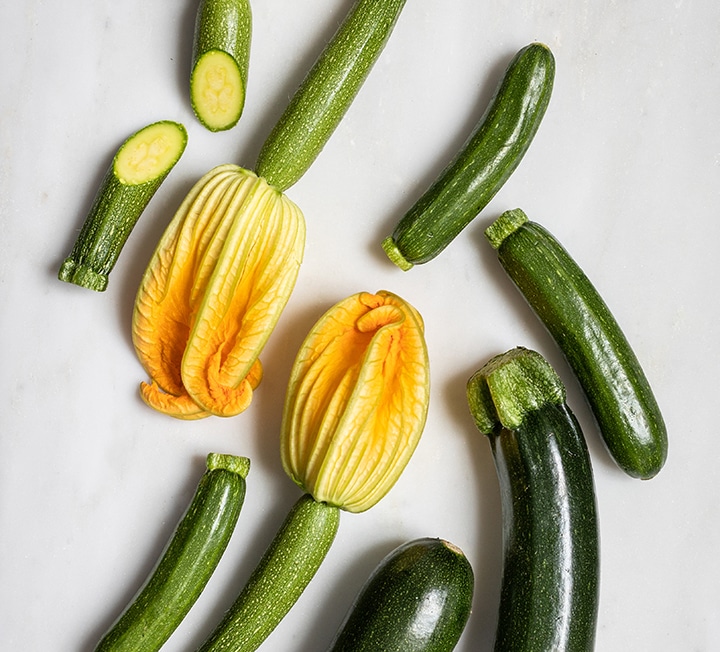
At the restaurant, we used to make a sort of crab soup with sweetcorn and fideos, the little lengths of angel-hair pasta. With brown meat as well as the white stirred through, it was hard to tell what was pasta and what was crab, and the result was a very satisfying plateful. More recently I have cooked firm green courgettes with red spring onions and a little garlic in olive oil and their own juices, sweated together until bright and glossy, but with a good bite still to them, and then mixed the result with mint, white crab meat, and sliced lemons preserved under oil, sweet and green and sunny.
These, like the neatly dressed shells sold by the fishmonger, are all very convenient things to do with a crab, but sometimes convenience is not what you are after. Sometimes (not often enough), lunch is something that takes a very long time, and results in a great deal of mess. If you find that this is to be the case, then absolutely the best thing you can do is to get yourself a few bottles of riesling and some whole crabs – one of each between two should be enough, at lunchtime – and make a day of it. Any good fishmonger or market stall, including those at Borough, will be able to supply you with whole crabs. In some cases, if you are adventurous, you might get them live, from which state they will need, for kindness’s sake, to be swiftly despatched, and then to be just as swiftly cooked as once dead, crab does not like to hang around. I won’t, in any case, go into the details here – you can look up the process elsewhere, if you feel up to it. Whether you buy your crabs alive or cooked, however, you will need the same accompaniments. Crab-crackers and picks if you have them, a couple of hammers and a pack of skewers if you don’t; a bowl of mayonnaise, another of lemon halves, and your best friends. You can clean up tomorrow.
Discover more

A walk through the reign
Across the seven decades of Elizabeth II’s reign, Britain’s food culture has been on an exhilarating ride. Angela Clutton takes a decade-by-decade tour of the nation’s attitudes towards cooking and eating, and shares a recipe inspired by the defining cookbook of each era
1950s
Try to imagine – although it’s pretty much impossible – what it might have felt like to make it through World War II, with all its deprivations, get to the hope a new decade brings, and then find that Britain’s food – much of it still rationed – was worse on the whole than it had been during the war years. That was the reality at the start of the 1950s for a nation struggling to get back on its feet.
What came next was a series of seismic changes to the way we feed ourselves. Kitchens slowly became more streamlined and electric – hello, fridges and electric cookers. Small local stores gave way to larger retailers, and the old routines of chatting with the shopkeeper were replaced with more impersonal transactions. Food production was increasingly industrialised, with a focus on standardisation and storability, causing the loss of many glorious varieties of apple, pig and so much more.
If you read that and sigh, it’s only because hindsight lets us see the negative impacts of all that change. The upside for those who lived through it was that food became cheaper and more accessible. Post-war austerity gave way to late-50s prosperity.
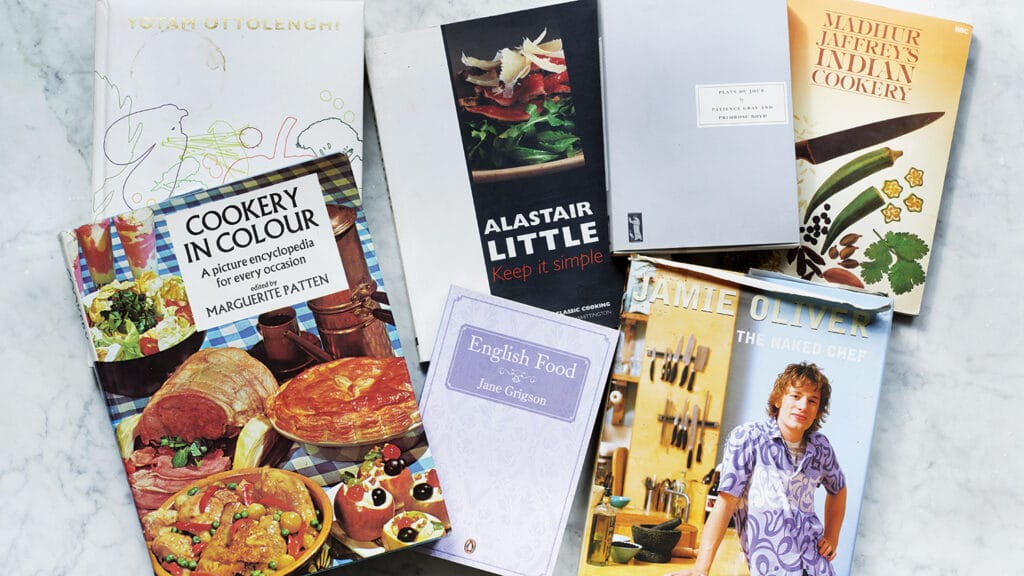
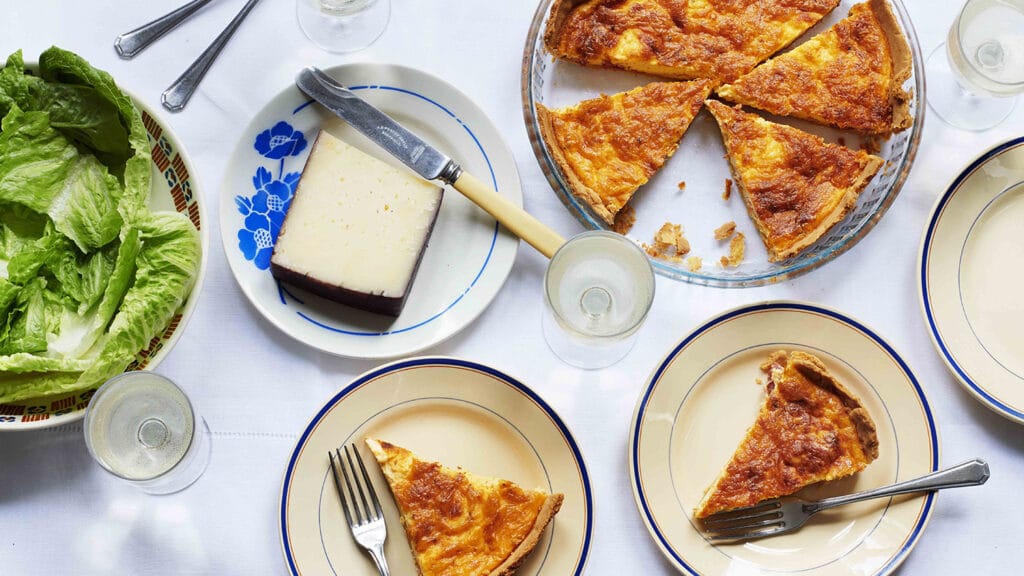
Food writer Patience Gray latched onto that hope of better times. In her bestselling 1957 book Plats du Jour (written with Primrose Boyd), she encouraged a store cupboard filled not with canned foods but with spices, herbs and oils. Her ideal meal was a main (the plat du jour) served with “green salad, respectable cheese, fruit in season and, where possible, a bottle of wine”.
Take heed of that for serving this quiche Lorraine – a dish that would become almost laughable, but in the 1950s could be enjoyed for its rustic, delicious simplicity. As Cary Grant says in the 1955 film To Catch a Thief: “It’s quiche Lorraine – I think you’ll like it.”
1960s
They say that if you remember the 1960s you weren’t really there. This possibly doesn’t hold true when it comes to the decade’s food, though – to have lived through that is surely to be marked forever by memories of rice moulds, piped mash potatoes, and meats and vegetables set in aspic.
Fancy some deep-friend chicken and banana (together, of course)? Or cubed lamb set in mint jelly? That’s what you might have been cooking if armed with Marguerite Patten’s era-defining 1961 cookbook Cookery in Colour. It sold millions of copies, feeling like a bright burst of something new after years of the same-old black and white cookbooks. Its timing couldn’t have been better: that same year, the Beatles made their debut at the Cavern Club, and the lights were being switched back on across so many areas of life – music, fashion, art.
This was the decade that colour came to TV too. Families would spend more and more time gathered around a screen, and ‘TV dinners’ were born. A whole chapter in Cookery in Colour is given over to those. As Marguerite puts it: “The advent of television has changed eating habits in many homes. Instead of an evening meal the family enjoy a substantial snack while watching their favourite programmes. Choose food that is easy to serve and eat on a tray.” The death-knell was being rung for families eating together around a dining table.
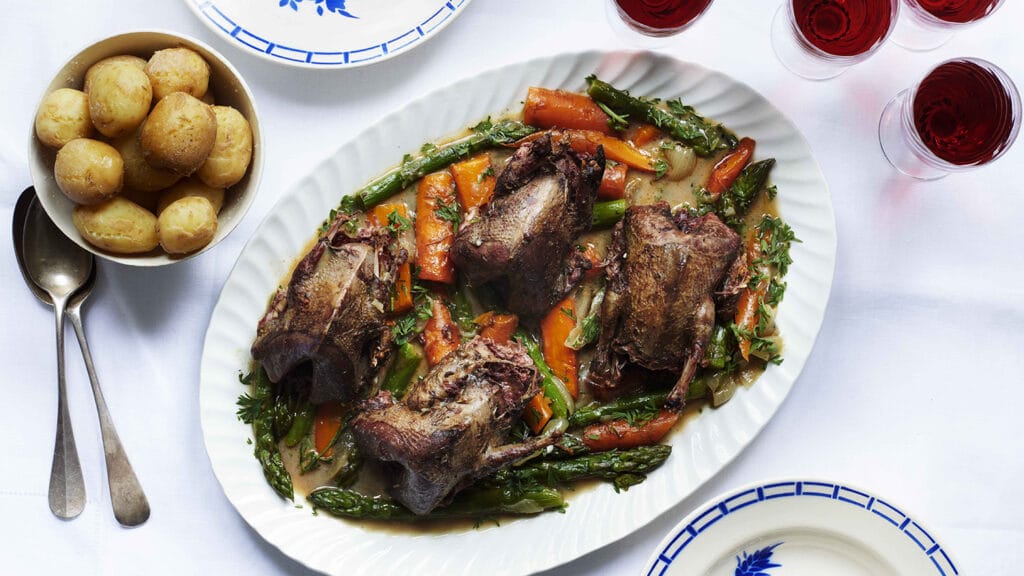
There was, however, still an appetite for good, simple cookery, featuring produce – like pigeon or rabbit – that was considered more everyday then than it is today. This recipe for braised pigeon is inspired by one from Cookery in Colour, but benefits from a few additional ingredients such as yoghurt and garlic that, from the 1960s onwards, began to be kitchen staples thanks to increased travel and immigration influencing the ingredients accessible to the home cook.
Braised pigeon with asparagus & carrots
Read Angela’s take on a 1960s recipe, inspired by Marguerite Patten
1970s
Ah, the 1970s. The decade of black forest gateau, prawn cocktail, and the raging heat of the 1976 summer heatwave. What do all those things have in common? Freezers.
The nation’s supermarkets through the 1970s became fixated by their freezer aisles. Without them the aforementioned classics just wouldn’t have taken hold at all. The prospect of having to do nothing more than defrost such fancy foods proved irresistible to all those in thrall to the decade’s move towards convenience.
These freezers were packed too with the ready meals that became increasingly popular as more and more women went out to work. Fridges and freezers meant mealtimes were distinctly quicker and easier to manage, and the food shopping needed to be done less regularly too.
Also changing was how people spent their leisure time. Eating out became more of a reality for more people, as did foreign travel. Spain was the decade’s favourite holiday spot, and holidaymakers brought back not just sombreros and sunburn but an interest in the flavours and ingredients they’d encountered. The door was opened for cooks like Claudia Roden to capitalise on that burgeoning interest in cosmopolitan culinary ideas. Her food often featured vegetables as the stars of the meal and (a real shocker this, to generations brought up on overcooked veg) were not always boiled but sometimes steamed, roasted or raw. It’s maybe no surprise that vegetarianism was also on the rise through the 1970s.
This is all sounding rather marvellous, isn’t it? A decade in which women were no longer shackled to frequent shopping and cooking, where there was more travel, more vegetarianism. But there was a flipside, too. The loser was seasonality. Freezing meant you could have anything, any time. We began to lose touch not just with cooking skills but with what was in season.
Legendary food writer Jane Grigson did her level best to ensure her 1970s audience didn’t lose sight of those things completely. Writing in The Observer and over many cookbooks, she was a voice for tradition and, well, actual cooking – not cooking fancy food, but cooking good food.
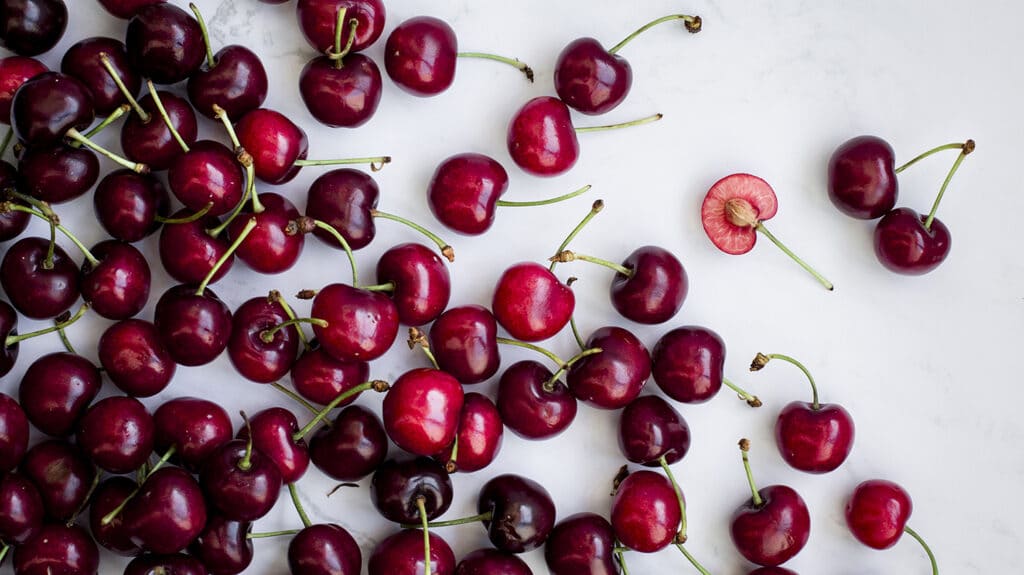
This recipe for cherry sorbet is based on one of hers, as is the accompanying cherry sauce. It’s up to you whether you do as Jane suggests and serve with a swirl of whipped cream – or even a grating of chocolate if you really want to evoke the flavours of black forest gateau. It’s just the kind of ice that many a home freezer in 1976 would have been thankful for, even if a wedge of Neapolitan ice-cream was more likely to be found in there!
Cherry sorbet with cherry sauce
Read Angela’s take on a 1970s recipe, inspired by Jane Grigson
1980s
Are you a foodie? Are your friends foodies? Do you hate the word ‘foodie’? If the answer to any of those is ‘yes’ you have the 1980s to thank for gifting us the word. ‘Foodie’ was first used right at the start of the decade in a New York magazine article, its birth testament to how food in the 80s was gaining cultural significance.
Or at least, restaurant food was. For this was the time of nouvelle cuisine – those teeny-tiny plates of food that left you somehow hungrier than when you started. But what about home cooking? By the 1980s Britain had got itself in a bit of a pickle on that front. The previous decade’s focus on frozen foods, convenience and ready meals meant that the 1980s home cook had become rather dissociated from actual cooking. Skills were under threat, and the basics seemed a mystery for many.
A saviour arrived in the form of Delia Smith – safe, reliable, relatable Delia, who showed a generation of homemakers how simple and satisfying home cooking could be. On the face of it there was nothing edgy about Delia’s food, and yet she nudged our national culinary sensibilities forward, gently embracing the foods of cultures such as Greece, France, Italy, China and Thailand.
Delia’s TV cooking show was joined by those of international chefs such Ken Hom (who made having a wok a British kitchen essential) and Madhur Jaffrey. Madhur took to cooking after she arrived in London to train as an actress, was appalled at the state of the food here, and asked her mother to send recipes so she might be able to cook the dishes she missed. Her shows and books brought colour, flavour, freshness and spice into kitchens across the country, while challenging perceptions of what Indian food might mean.
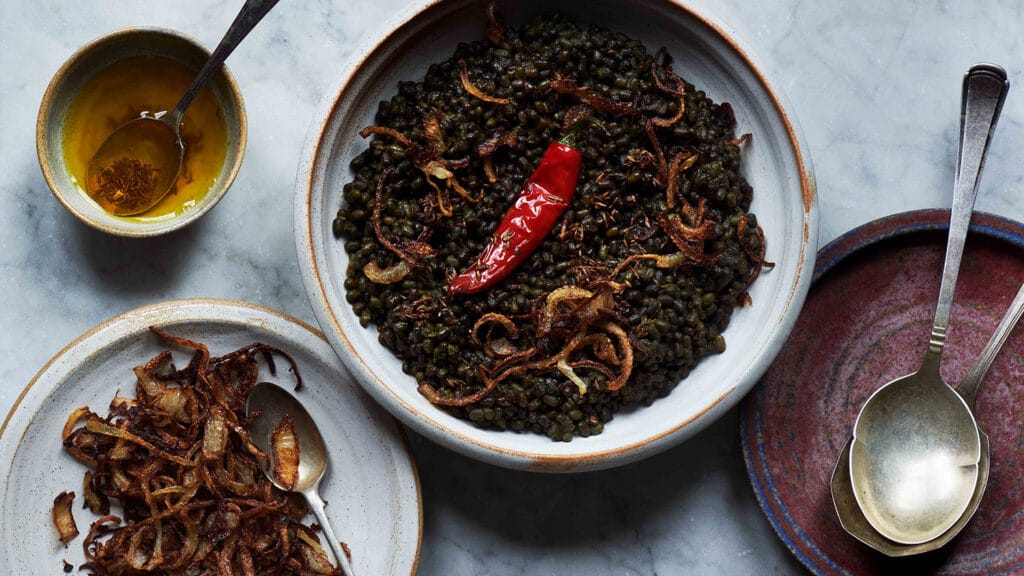
This recipe for dal with crisped onions is heavily based on ones featuring in her book Indian Cookery, which accompanied her 1980s TV series. I have swapped her moong dal for urid dal, but otherwise the flavours and techniques are all Madhur’s. Serve as part of a medley of Indian dishes or simply with an Indian bread.
Sookhi urid dal with crisped onions
Read Angela’s take on a 1980s recipe, inspired by Madhur Jaffrey
1990s
Was it even possible to eat out in the 1990s without having sun-dried tomatoes or balsamic vinegar? I’m not sure it was. And often they’d turn up in dishes they really had no place to be. Such was the allure of food fashion as the millennium approached, with shoppers becoming more interested in what they were buying, how it was made and where it was coming from.
Words like ‘organic’ were being used more. ‘Local’ started to mean something again. Farm shops opened to sell directly to the consumer, and farmers’ markets flourished. Borough Market was both a leader and a beneficiary of these shifts. Traders such as Neal’s Yard Dairy, Brindisa and Turnips – all still held dear by shoppers today – were among the first to open retail units in the Market’s empty warehouses. In 1998 some of the top food producers in the country gathered at Borough for a Food Lovers’ Fair. The rest is history.
That growth of interest in food was in part driven by a growing cultural fixation with high-end restaurants and chefs. As the 1990s came round, chefs became celebrities, courted by magazines and TV shows. If eating out was the new rock and roll, as so many journalists were so keen to write, many chefs were happy to take on the bad-boy mantle (they were, after all, mainly men). A few others took the opportunity to step out of the restaurant kitchen and into our homes as a way of spreading their love of good food. Alastair Little was one of those.
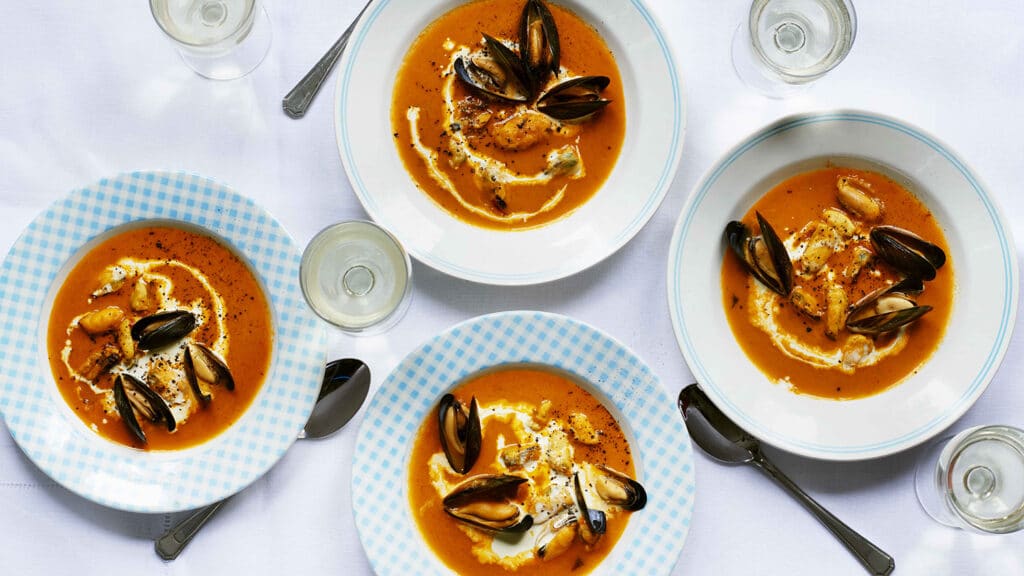
In the 1980s Alastair had made his name as head chef at L’Escargot, before opening his eponymous restaurant in Soho to huge acclaim. In the 90s, he published Keep it Simple, a cookbook aiming to be “a fresh look at classic cooking”. Typical of the time, its recipes are a little cheffy but also achievable for the ambitious home cook who wanted to have a go at the kind of techniques they’d read about chefs using. This mussel soup with saffron is based on one from that book.
2000s
How would our food culture rise to meet the hopes and expectations of a new millennium? What new voice would break through to epitomise the changing times? Who would guide us into the next stage of our culinary evolution? The answer would be found in the kitchens of the famous River Cafe, cooking away with a “bish, bash, bosh” attitude and a scruffy haircut.
I mean Jamie Oliver, of course. Who else? First spotted while a documentary was being made about the River Café, before weaving his moped through the heady days of late 90s laddism in The Naked Chef, Jamie went on to achieve huge success and make a genuine difference to how Britain eats.
His appeal was rooted in the accessibility of both his personality and his food. He’d grown up in pub restaurants, worked under Antonio Carluccio and Gennaro Contaldo before reaching River Cafe, and every step of his culinary heritage showed in the food. British classics were not so much re-invented as re-loved, with a fair dash of European influence thrown in too.
Jamie made it seem cool and aspirational to be on first-name terms with your fishmonger and greengrocer. Consumers who for decades had become increasingly disengaged from the provenance of food, were persuaded to care about the impact our food choices can have on animal welfare, our own health and the environment.
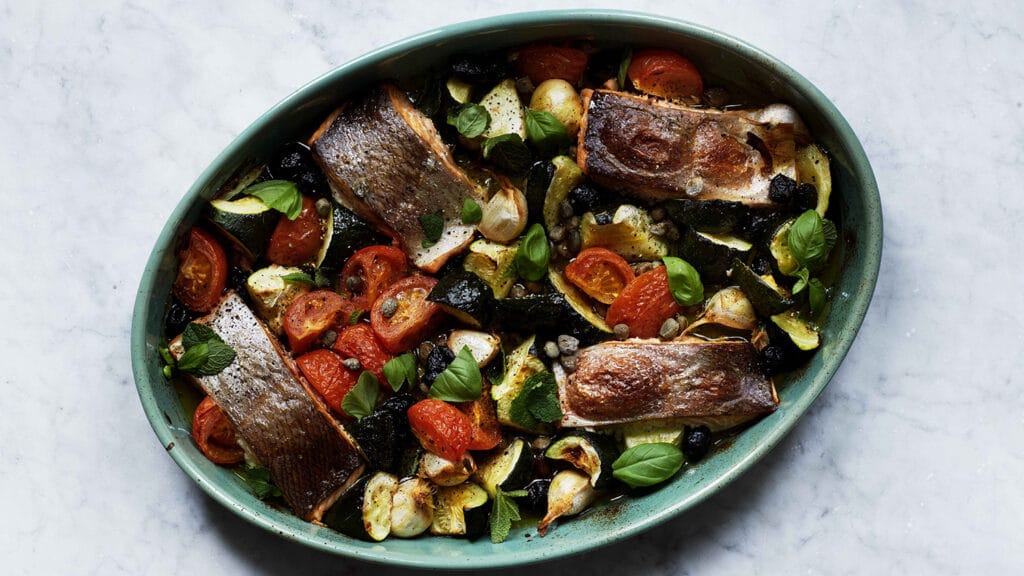
Jamie Oliver is the inspiration behind this traybake of salmon fillets with vegetables. Lovely jubbly – as the man himself might once have said.
Salmon & roasted veg tray-bake
Read Angela’s take on a 2000s recipe, inspired by Jamie Oliver
2010s
Who among us could have imagined the cultural impact of some amateur cooks gathering in a bunting-strewn tent for a baking competition? Certainly not me. You could have knocked me over with a Victoria sponge when The Great British Bake Off landed on our screens in 2010 and became a huge hit. I was surprised, pleasantly so, that something so simple and wholesome could be so popular.
The zeitgeist was well and truly hit. Bake Off offered comfort, something unchallenging to unwind to amid the very challenging economic picture faced by Britain in the wake of the 2008 global economic crash. It is often said that while people might watch a lot of TV cooking programmes, that doesn’t mean they necessarily get into the kitchen and actually cook. But there can be no doubting the impact of Bake Off – baking took off in a big way.
Perhaps that’s in part why the big blousy meringues piled up in a small shop window in Notting Hill so captivated London’s food trendsetters. They were helped along by the huge platters of beautiful vegetables and grains alongside that had been dressed into heavenly flavour balance with za’atar, sumac, rosewater, pomegranate molasses and more. I’m talking about Ottolenghi, if you haven’t already guessed – helmed by Yotam Ottolenghi and Sami Tamimi, and responsible for changing significantly how we cook and eat.
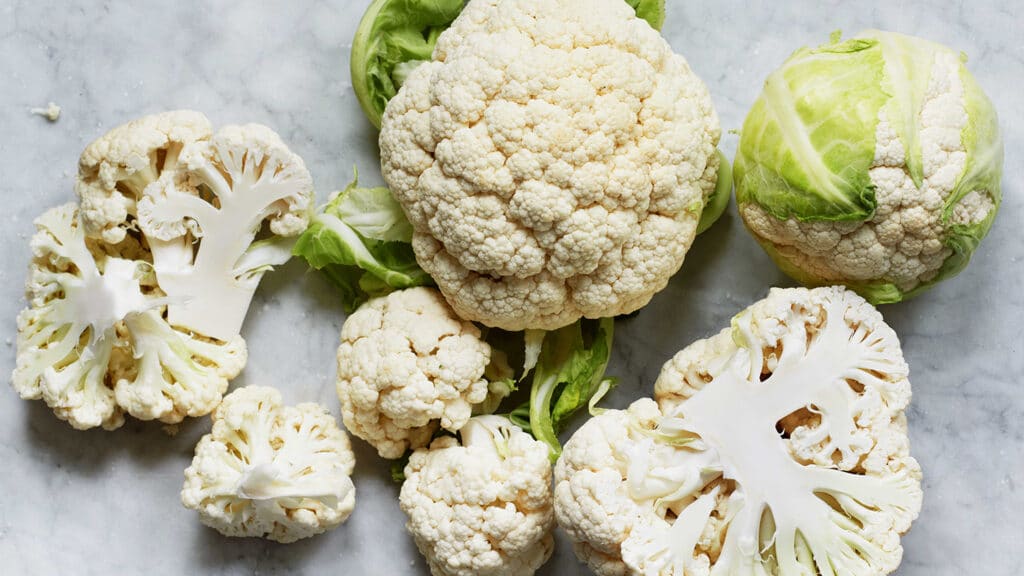
That is no throwaway exaggeration. I’ve already mentioned a few of the ingredients that Ottolenghi made mainstream. Perhaps the most 2010s of them all is tahini, a glorious sesame seed paste that became pretty much essential to have in the fridge. It could bring even the staidest of ingredients to life, and in the case of cauliflower it absolutely did.
Pre-Ottolenghi, British cauliflower was boiled into submission or baked with a cheese sauce, neither iteration covering us in much culinary glory. Post-Ottolenghi, cauliflowers were being roasted whole or as florets, with tahini and other Ottolenghi ingredients doing all they could to change hearts and minds upon this not-much-loved vegetable. It worked, of course. Where Ottolenghi goes we all follow.
Roasted cauliflower with spiced chickpeas & tahini
Read Angela’s take on a 2010s recipe, inspired by Yotam Ottolenghi
Edible histories: cider
Mark Riddaway, author of Borough Market: Edible Histories, tells the surprising story of one of Britain’s national drinks
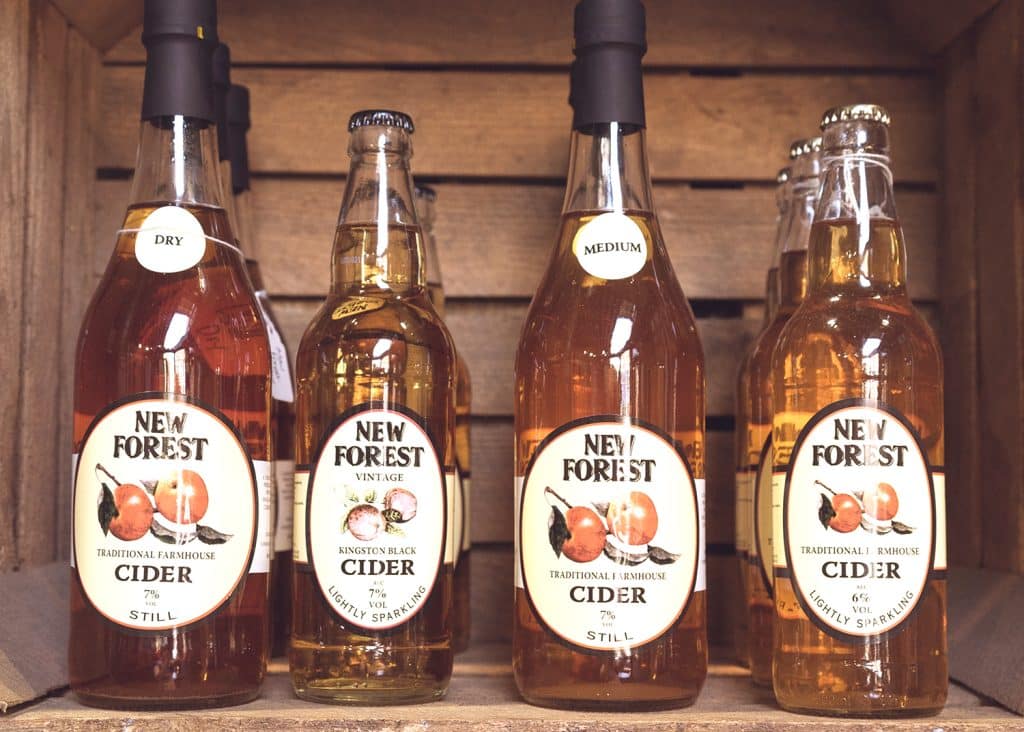
“ENGLISH CIDERMAKERS’ EXPERIMENTS WITH ENCOURAGING FIZZ WERE ADAPTED BY THE CREATORS OF CHAMPAGNE”
Such is its simplicity (being nothing more than pure apple juice, left to ferment), it is easy to presume of cider that it must be a remnant of our misty past – the refreshing draught a Neolithic Briton would have supped upon after a hard day erecting megaliths. The relative brevity of its story may be something of a surprise, then – until you think for a moment about the form of an apple: the tight skin, the sinewy core, the dense, tense web of cellulose and pectin that provides its signature crunch. This is not a fruit that surrenders its juice easily. Even the crushing or milling of an apple, itself a labour-intensive task, is only half the job, with the resulting pulp then requiring a hard and heavy pressing. No doubt, apples have at various times been bashed with crude tools in the pursuit of inebriation, but when it comes to getting the party started, nature offers some far less tiring options.
Certainly, if the ancients were routinely making cider, they left very little evidence. One of the earliest references to the drink came from the Roman writer Pliny the Elder, whose tone suggested it was of minimal importance to his contemporaries. In a chapter of The Natural History (77-79AD), he described 66 varieties of “artificial wine”, including drinks made “of the pods of the Syrian carob, of pears, and of all kinds of apples”. No further insight was offered into this apple wine – in fact, more of Pliny’s words were devoted to booze “made of the naphew turnip”.
It wasn’t until the early medieval period, in northern France, that cider visibly overtook turnip hooch in the pantheon of drinks. Compelling evidence of this came in De Villis, a management manual for the royal estates of Charlemagne, king of the Franks (768-814). This required that “siceratores” (makers of booze) be employed to create “pomatium” (cider), “pyratium” (perry) and other liquors. That Europe’s wealthiest monarch was making cider was telling: it was the development of the screw press that made its preparation viable (as well as transforming the speed of wine and olive oil production), but constructing a screw press was an expensive business. While the humblest of households could brew beer, only the rich could afford to make cider, and even then its production was usually a secondary pursuit: those abbeys and aristocratic estates that made wine in the summer used the same costly presses to juice apples in the winter.
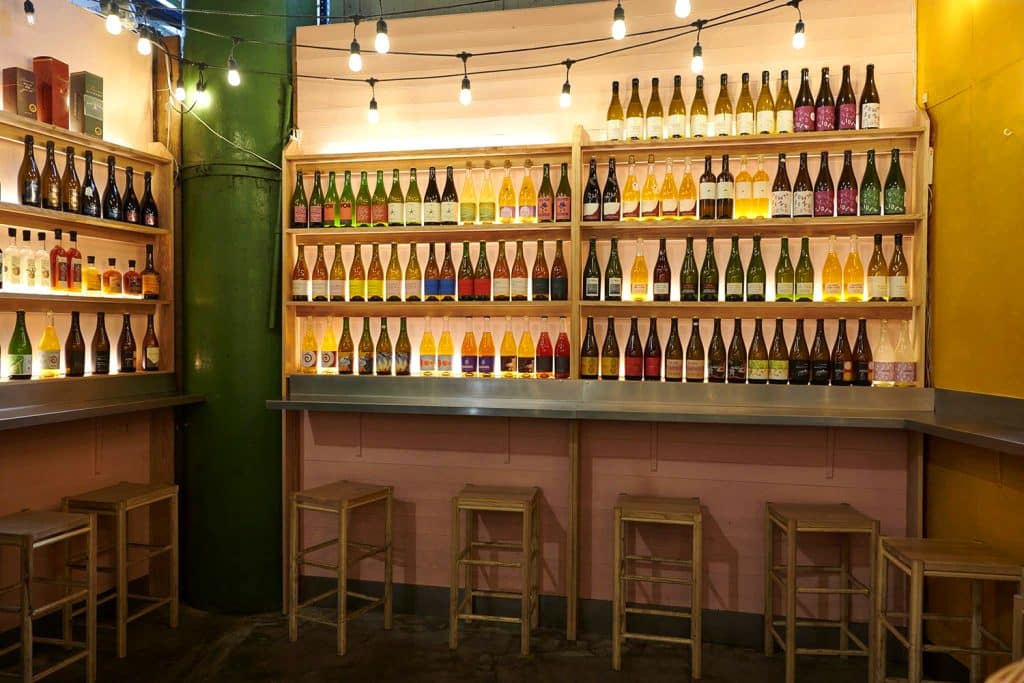
It is often said that the Norman conquest brought cider to England, but evidence of the drink being brewed here only really began to emerge in the 13th century. Over the two centuries that followed, occasional references to mills, presses and cider sales began appearing in estate records, but it was only after 1400 that the dam broke and the scrumpy began to flow. This move from the margins was closely linked to the progress of enclosure: the transformation of the English countryside from a system of vast, unfenced common fields, narrow strips of which were tended to by individual peasant families, to one dominated by larger farms. Orchards, which had no place in the old open field system, became a viable option for yeoman farmers, and hence, too, did the production of cider.
This was particularly true in the west of England. In the counties of the southeast, the flat landscapes and light soils lent themselves to intensive arable farming, but in the wet and rugged westerly regions, where cereals flourished less readily, apple trees and livestock offered a complementary combination: trees provided shelter, and the pomace from cider making – the mulch left behind after pressing – could be used as feed. As presses and mills became more readily available, Devon, Somerset, Gloucestershire and particularly Herefordshire became centres of English cider making. One of the major destinations for this cider was the region’s ports, to be used in sailor’s rations. John Parkinson wrote in 1629: “In the West Country of England great quantities, yea many hogsheads and tunnes full are made, especially to bee carried to the sea in long voyages.”
The 17th and 18th centuries were a golden age of English cider making, chronicled and partly inspired by a group of self-described ‘ciderists’: intellectuals who loved cider, believed that its quality could be improved by embracing a spirit of rational inquiry, and aimed to embed it as our national drink. Two ciderists, John Beale and John Evelyn, were founder-members of the Royal Society when it was established in 1662, making the link between scrumpy drinking and Enlightenment thinking much clearer than might be expected.
The ciderists’ ideas were set out in Pomona (1664) – part polemic, part practical guide – which was prefaced and compiled by Evelyn but built around the horticultural knowhow of Beale. Their hope was to “redeem” cider from the “opinions of those men who so much magnifie the juice of the grape above it,” wrote Evelyn, who argued that English tastes are “generally more for insipid, luscious, or gross diet, than for the spicy, poignant, oylie, and highly relish’d”, and that cider, unlike wine, was a natural fit for the native palate. As evidence, he told the story of a Mr Taylor, “a person well known in Herefordshire”, who had challenged a London vintner to put his best “Spanish or French wine” up against his county’s cider in a series of increasingly rigorous taste tests, every one of which ended in victory for the West Country draught.
As Pomona made clear, fundamental to the boom in English cider making was the cultivation of distinct local varieties of cider apple, known collectively as bittersweets and bittersharps. Beale’s cousin, Viscount Scudamore, was credited with propagating the most famous Herefordshire bittersweet, the redstreak. Cider made with its juice would, wrote Beale, “excel common cider, as the grape of frontignac, canary, or baccharach, excels the common French grape”. It had, according to Captain Sylas Taylor, another ciderist, “the flavour or perfume of excellent peaches, very grateful to the palate and stomach”. Other acclaimed varieties included the gennet moyle, which resulted in cider “of smaller body… yet very pleasant” and the summer fillet and winter fillet, which “passed for white wine” and when mingled with syrup of raspberries made “an excellent woman’s wine”.
Demand for good quality cider was inflated by a series of conflicts with France that led to French imports, including wine, being either scarce or embargoed (the ciderists’ aim was, in Beale’s word, to relieve “the want of wine, by a succedaneum of cider”). The best cider was made with the first runnings of the press, then racked from one cask to another (a process known as ‘keeving’) to inhibit yeast build-up and slow the fermentation, which improved its flavour. The sweetness (and strength) of the cider could also be increased by ‘tumping’ the apples – leaving them to age outdoors for several weeks – or, still better, keeping them in an indoor drying loft. Bottling the cider, a new notion, also added to its appeal. In 1615, when a timber shortage led to a ban on charcoal furnaces, glassmakers were forced to start using coal, which burns much hotter, and the glass that emerged was far sturdier than the delicate stuff of old – sturdy enough to withstand the pressure of a secondary fermentation, resulting in a lightly sparkling drink. It was English cidermakers who first experimented with encouraging effervescence in their bottles – innovations that would later be adapted by the creators of champagne.

Posh cider was far from the only game in town. Hugh Stafford, in his Treatise on Cyder-making (1753), made a distinction between fine cider and “rough” cider, with the production of the latter requiring far less time and care than the former, making it more widely affordable – it was this rough cider that became a staple of public houses around the country. At the bottom of the scale was “an agreeable liquor, for common use, call’d water-cyder”. Also known as ‘cider-kin’, this was made by soaking the pomace in water, then pressing it one last time, the ferment of which produced an insipid, lightly alcoholic drink. This was often fed to farmworkers in lieu of actual wages – a practice known as ‘truck’, which remained common in the cider regions until it was banned in the late 19th century. “This the peasants blithe / Will quaff, and whistle as thy tinkling team / They drive and sing of Fusca’s radiant eyes,” wrote the poet John Philips in his Cider: A Poem in Two Books (1708), an epic paean, written in the style of John Milton’s Paradise Lost.
Despite its ability to elicit raptures from poets, English cider was destined to be a victim of its own success. Increased demand led to the arrival in the marketplace of cider merchants whose nose for a profit led to all kinds of dilutions and adulterations. Its reputation was damaged further by the 18th century outbreak of ‘Devonshire colic’, an illness attributed to cider but later found to be lead poisoning. Mostly, though, it was killed by the rapid expansion of the beer industry, which quickly out-stripped the largely farmhouse-based world of cider in its range and sophistication. Cider making entered a death spiral, with reduced profits leading to farmers turning their orchards over to other uses. The most prized cider apples, the fabled redstreak included, gradually lost their disease resistance, but a stagnant industry failed to cultivate replacements. In 1785, the agricultural writer William Marshall decried how “all the old types that raised the fame of the liquors of this country, are so far in decline as to be deemed irrecoverable.”
It wasn’t until the late 19th century that a partial revival was triggered, inspired in part by developments in one of the drink’s other great heartlands: northern France. In the 1860s, when their grapevines were ravaged by the phylloxera louse, French authorities had been persuaded to finance a significant survey of and investment in the region’s cider making capacity. This sparked considerable interest among a group of Herefordshire naturalists who began experimenting with French apple grafts and working with some success to bring the county’s orchards back to life.
However, the real spark for the resurgence of cider was lit not in its western hub but in East Anglia, previously a relative backwater (one survey of Norfolk from 1796 had famously concluded: “Orchards very few, and much neglected, consequently no cider”). In 1870, William Gaymer, a Norfolk cidermaker, invested in a hydraulic press and began building a national brand, creating a system of cider making based around factories rather than barns. Gaymer helped break the link between grower and manufacturer by buying in apples from far and wide: in 1903, when the Norfolk apple crop failed, supplies were brought in from Devon. Others followed his lead: Percy Bulmer opened a factory in Hereford in 1887 and proved just as innovative in his embrace of industrial ideas.
Farmhouse cider, and the regional distinctiveness that came from the use of single varietals, became a niche drink as the big factories gradually took over. In the second half of the 20th century, cider became a pasteurised, filtered, carbonated, mass market product, largely made from anonymous apple concentrate, much of it imported. In recent decades, industry ‘innovation’ has seen the creation of white cider: a strong, colourless brew made by adding glucose or corn syrup to pomace – think of it as a weaponised version of cider-kin.
The idea of cider as a beautiful, simple, natural drink with a strong local character never entirely died out, though, as a visit to The London Cider House at Borough Market will make immediately clear. As John Philips would say, could he see the stall: “Thy choice Nectar, on which always waits / Laughter, and Sport, and care-beguiling Wit, / And Friendship, chief Delight of Human Life. What should we wish for more?”
Borough Market: Edible Histories by Mark Riddaway (Hodder & Stoughton) is available now from The Borough Market Store, in bookshops and online.


Bringing home the bacon
Two of Borough Market’s butchers share the secrets of producing, choosing and cooking the perfect bacon
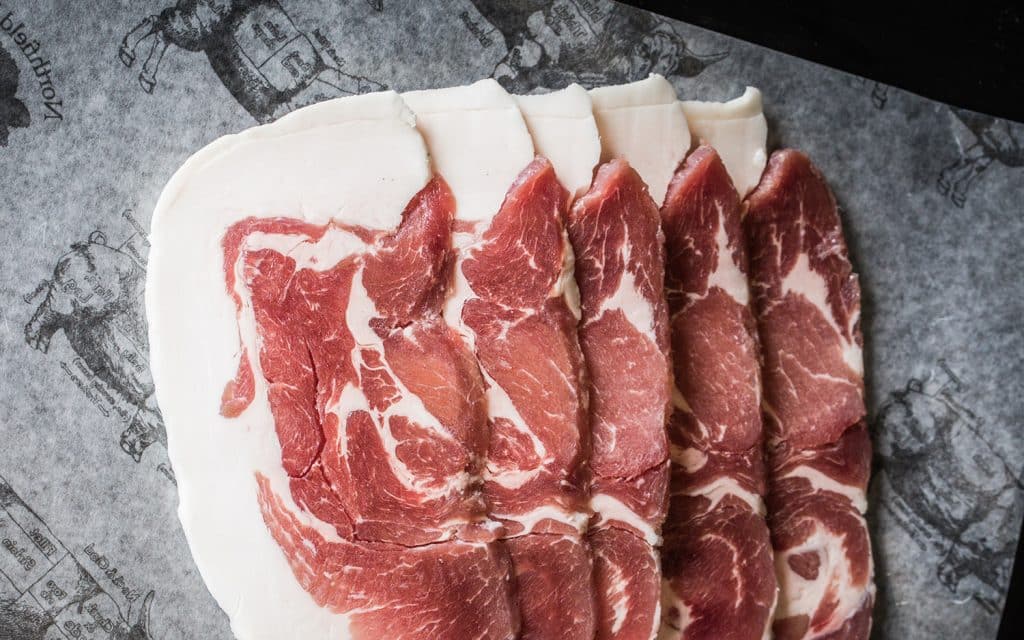
“COLLAR BACON, FROM THE SHOULDER OF THE PIG, IS THE VELVET UNDERGROUND OF BACON: IT HAS A CULT FOLLOWING”
Words: Ellie Costigan
It’s hard to find someone who eats meat who doesn’t love bacon – in fact, the same can be said for a fair few people who aspire to vegetarianism. There’s just something about the salty, savoury flavour and crunch of those crispy edges that hard to resist. Most of us will agree that bacon is one of the best things to come from the butcher but like many crafts, it has a simple process at its heart. “There are several different types of bacon: loin, belly, streaky and middle,” says Jozef at Ginger Pig. “Whatever the type, the most important thing is, you have to begin with really good quality pork – that is where the flavour comes from.”
The pork joints arrive fresh from the farm with the bone still in. Once deboned and ready for curing, the team apply a mix of dry curing salt and brown sugar. “We don’t use all that much cure – somewhere between two to three grams per kilo of pork. It’s there to enhance, not mask, the pork’s flavour. We rub this on the meat and then dry cure it for a week, turning the joints over every other day. When we’re happy with the level of cure, the salt mixture is washed off and the joint is then air dried for two weeks.”
At this point, some are sold as unsmoked bacon; the rest have a few more steps to undergo. Joints can be single, double or triple smoked, depending on the end flavour the team are looking for. They can also take things in different flavour directions, as with their treacle bacon. “For that, we start by using curing salt without sugar, then we rub black treacle over the joints and air dry for at least two weeks. It is delicious.”
When it comes to cooking, Jozef says, “if you use a great quality bacon made from high quality pork it does not really matter what you do with it.” His personal preference is to cook it in an oven on a low heat for 15 minutes, then whack the heat to high for the last two to three minutes. “That gives you crispy edges and lovely succulent meat.”
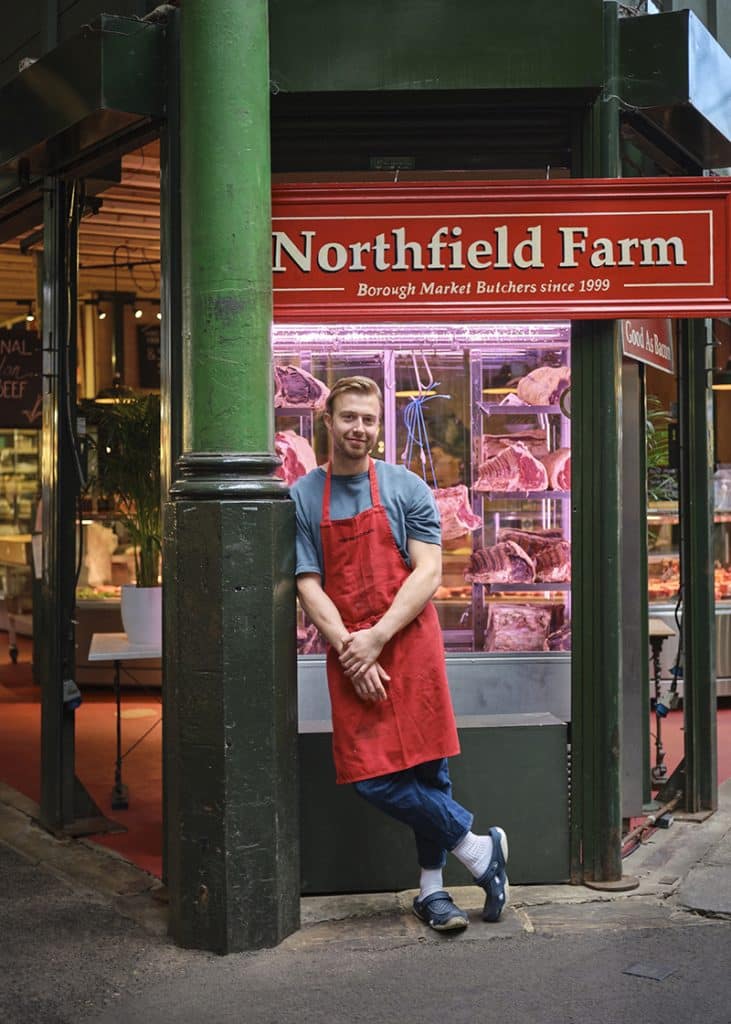
Dom from Northfield Farm – which sources mostly outdoor-bred British lop from neighbouring farmers up in Leicestershire – agrees. “If you start with really good bacon, you won’t go far wrong. The pork will do most of the work for you.” But he suggests breaking out of the habit of buying your favourite type of bacon all the time. “Firstly, the fact that different types of bacon come from different parts of the animal means the meat has different properties. Then there are different curing mixtures and methods. There are lots of different textures and flavours to explore.”
HIs favourite is collar bacon, “which comes from the shoulder of the pig and is one of the fattiest areas of the animal,” he explains. “Also, because it comes from a hard-working area, you get a rich meaty flavour – a bit more savoury than other bacon. It is densely marbled and does not really have an ‘eye’. That fat really helps bring out the flavour.” Northfield Farm has been selling it as long as they have been here at Borough Market. “I call it the Velvet Underground of bacon: it has a bit of a cult following,” he says with a laugh. “Not everyone knows about it, but those who do really love it.” When it comes to cooking, Dom favours a screaming hot frying pan. “That way you get nice crispy edges, succulent meat and you don’t render out all of that delicious fat.”
Discover more

Scoring points
Kathy Slack on the tricky art of growing asparagus
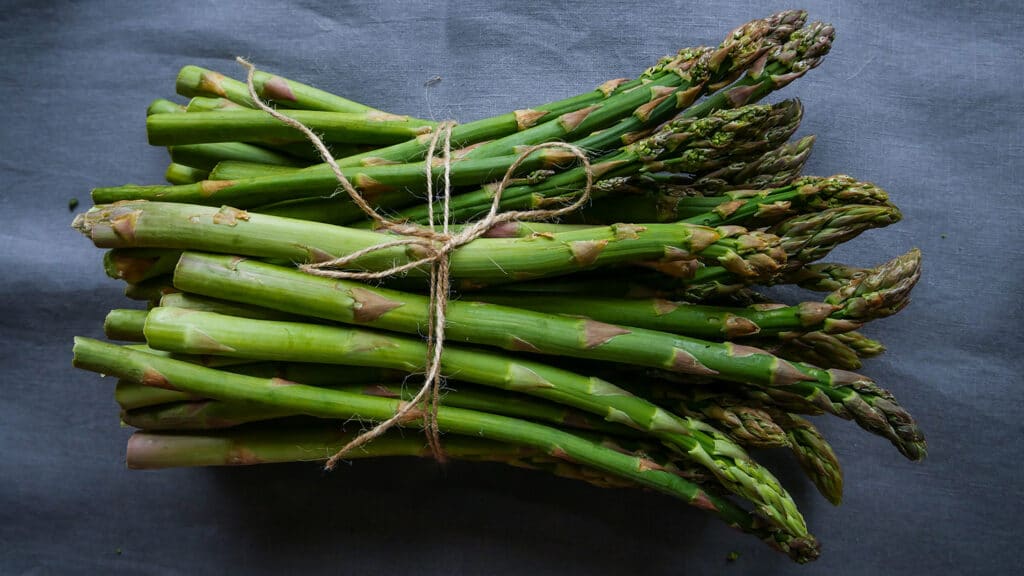
“GROWERS MUST EXERCISE SUPERHUMAN RESTRAINT AND STOP PICKING BY JULY TO SECURE NEXT YEAR’S HARVEST”
It’s a late May day in the 1980s. Two old ladies in tabard aprons sit, like wizened Italian nonnas, on plastic chairs in the lay-by of an Oxfordshire A-road. One holds a cash box in her lap, the other clutches a muddy turning knife. Behind them a sparse, sandy field is peppered with fronds of asparagus ferns, swaying nonchalantly in the breeze. Pull up here with your mother on the way home from school, and these gingham-clad keepers of the keys will waddle off into the field, joints creaking, and return with fistfuls of fresh, young asparagus for your supper.
This, for me, offered an early realisation of why some harvests are so prized and their season so fleeting. As a grown-up, encouraged by the memory of those halcyon days, I attempted to grow asparagus myself, but soon discovered that those old ladies were masters of a tricky art. Asparagus is technically possible to grow from seed, but most opt for planting dormant crowns, which must be left for two to three years before harvesting. It has to be picked by hand. And frequently – a spear can grow in less than a day. It needs plenty of space to grow, taking up acres of land, but hates weeds, so that expanse of bare soil must be weeded constantly, also by hand, asparagus roots being so shallow that a hoe would snap them.
And while the ferns will keep coming all summer, growers must exercise superhuman restraint and stop picking by July to allow the juvenile spears to grow into full ferns and secure next year’s harvest. As if all that wasn’t enough, they must then survive the winter without rotting in wet soil or being eaten by hungry wildlife keen to dig the dormant roots out of their shallow graves.
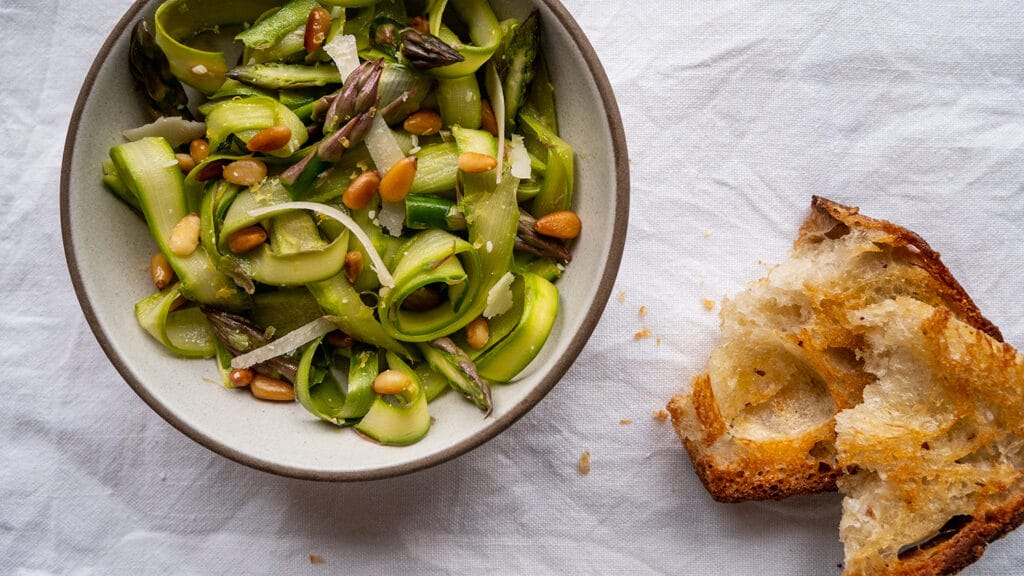
Unlike the growing, the eating of asparagus is best kept simple: steam and serve with butter or a soft-boiled egg. At most, wrap in prosciutto and roast for a few minutes. Or leave it raw, as in the recipe linked to below, to fully appreciate the juicy, crisp greenness of this hard-won harvest.
Asparagus, lemon & pine nut salad with garlic bruschetta
Read Kathy’s recipe, which brings to the fore the juicy, crisp greenness of English asparagus
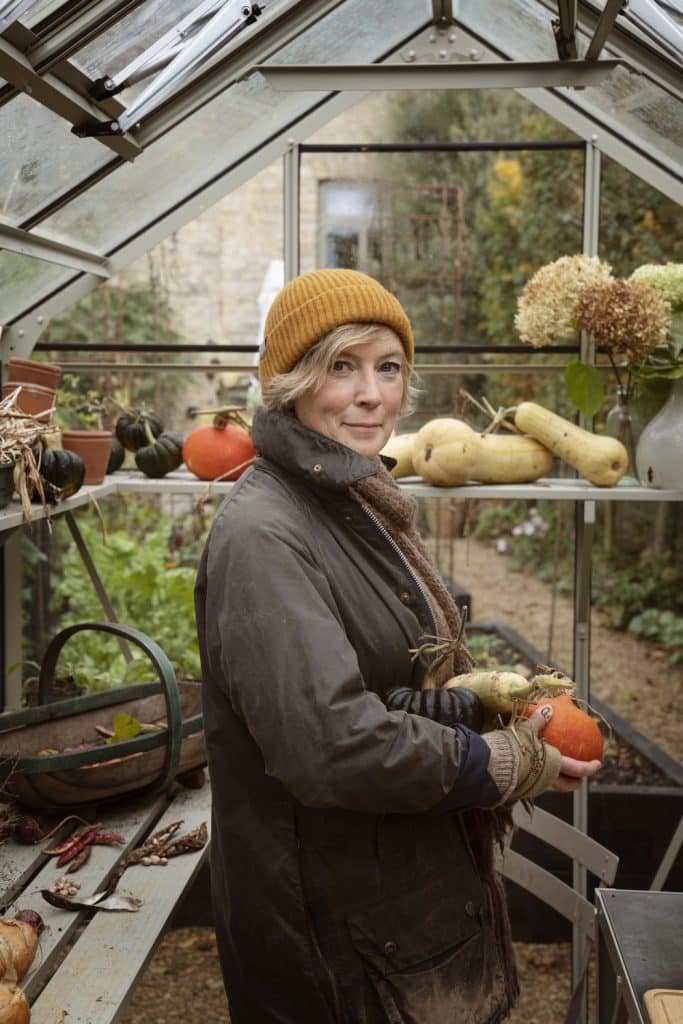
Kathy Slack
Kathy Slack is an award-winning food writer, cook and veg grower.
Author of Rough Patch and From the Veg Patch (shortlisted for the Guild of Food Writers Award), she writes for Delicious magazine, BBC Gardeners’ World and her bestselling Substack Tales From the Veg Patch.
Hot tips
Bee Wilson explores the life-changing revelation that, in defiance of the old consensus, asparagus can be cooked using methods other than boiling
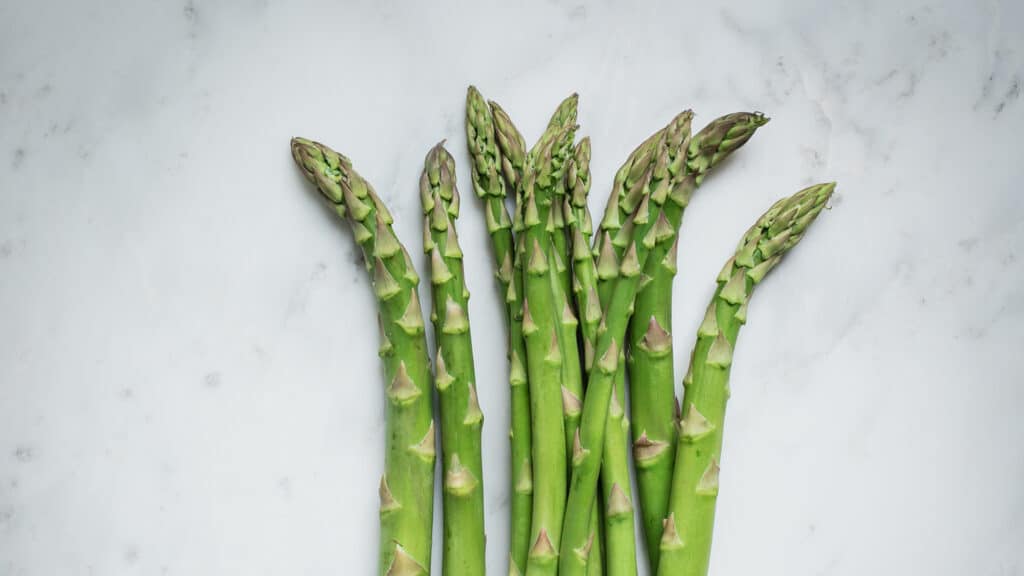
“OVER THE PAST DECADE, CHEFS AND COOKERY WRITERS HAVE THROWN OUT THE ASPARAGUS RULE BOOK”
Words: Bee Wilson / Images: Regula Ysewijn
“What if you do not possess an asparagus boiler?” asked Jane Grigson in her Vegetable Book. It is not a dilemma that troubles many cooks now. But back in 1978, when Grigson’s book was first published, everyone knew that there was only one way to cook asparagus: boiled, standing in a bundle. Not owning an asparagus boiler could make this tricky task even trickier.
An asparagus boiler – for the uninitiated – consists of a tall cylindrical lidded pan with an inner basket. The bundle of asparagus is put in the basket, stalks down, with a few inches of salted water. The idea is that in the time it takes every last bit of stringiness to be boiled out of the stalks at the bottom, the tips will steam to tender-crisp. To readers who did not possess this elaborate vessel, Grigson suggested improvising an equivalent using some other tall saucepan and a “wire blanching basket”. As for those who had no wire blanching basket, she recommended tying the asparagus in a bundle in a normal saucepan and improvising a domed lid of foil for the tips. The one thing Grigson did not suggest was cooking this sublime spring vegetable by any other method, because back then boiled asparagus was seemingly the only option.
Thinking about asparagus, it struck me that modern cooks express our love of ingredients very differently from cooks of yesteryear. In the past, asparagus-lovers worshipped this expensive vegetable by cooking it in one way only, which almost seemed to be demanded by the anatomy of the plant. To respect asparagus was to know that it needed to be kept in a bundle and boiled upright, with obsessive care for not overcooking the tips. By contrast, cooks now celebrate the all-too-brief season of these green vibrant spears by cooking them in as many different ways as possible. We griddle asparagus and we braise it; we shred it and eat it raw; we toss it with pasta and noodles; we use it to add spring freshness to green minestrone or risotto.
Cooks used to signal that an ingredient was special by cooking and serving it in one particular way and often in a single designated vessel. Turbot, for example, was poached in court-bouillon in its own special turbotiere. Hot salmon called for hollandaise and cold salmon for mayonnaise. And asparagus, prince of vegetables, demanded to be gently scraped to remove any tough outer stalks, then cooked in water.
There are 19 asparagus recipes in Haute Cuisine by Jean Conil, first published in 1953, and except for one recipe for green asparagus soufflé, all of the others consist of boiling it and serving hot or cold with a sauce. Many of these old haute cuisine ideas for boiled asparagus are in fact still lovely. Conil’s suggestions for asparagus sauces include ‘Maltaise’, a tangy hollandaise made with blood orange instead of lemon and a simple fresh cream sauce sprinkled with chopped chives and chervil. I am a big fan of Conil’s ‘asperges Espagnole’: hot asparagus served with poached eggs and vinaigrette.
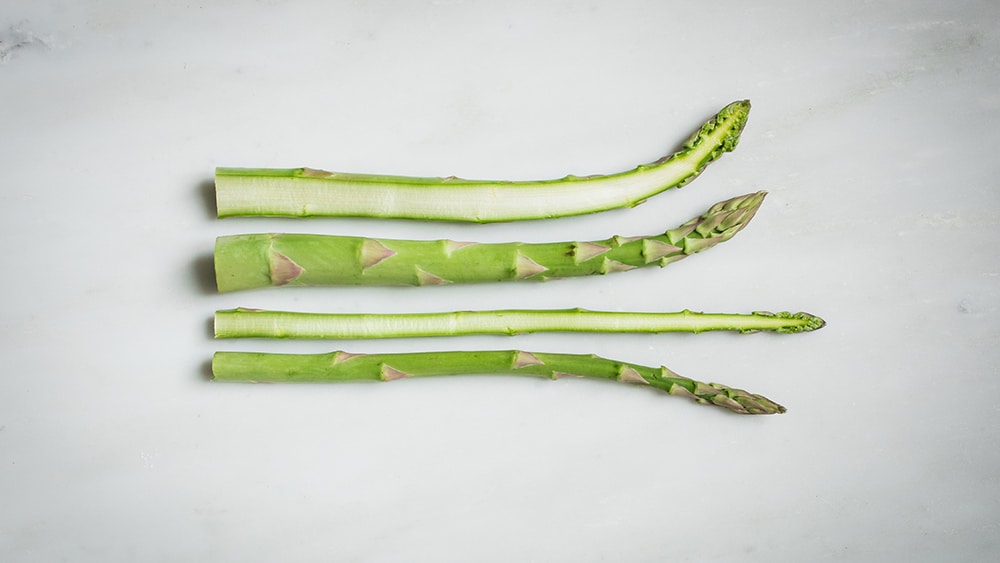
When I started cooking in the 1990s, I was firmly of the boiled asparagus school. Someone gave me an asparagus boiler for a wedding present and I was determined to master making proper bundles, like a Dutch still life. I knew that some recipe writers had started blackening asparagus on a char-grill, but the first few times I tried it this way, it tasted harsh and burned and half-raw, a waste of those expensive spears. So, I persevered with my asparagus boiler, even though I found the process frustratingly hit and miss. As Jane Grigson said, depending on the size and quality of the asparagus the timing could vary “from 15 minutes to 45”, which made it impossible to plan supper.
The recipe that changed the way I thought about asparagus was River Cafe penne with asparagus carbonara, which I first read about in 2000. This was a carbonara, but with spears of asparagus cut on the diagonal in place of the pancetta. The thing that startled me was the wondrous economy of the method. While the pasta boiled until al dente for nine minutes, you cooked the asparagus in a separate pan. The stalks were added first, then after two minutes, the tips, which cooked for a further four minutes. The blanched asparagus is tossed with pasta, egg yolks, parmesan, butter and thyme to make a richly spring-like dish: green and golden.
The first time I made it, I couldn’t believe that the asparagus had come out so perfectly with so little effort. I never used my asparagus boiler again, realising that I could boil the spears unbundled in a big pan for five minutes, with none of the fuss and better results.
Over the past decade, chefs and cookery writers have developed a much more experimental and playful approach to asparagus. We have thrown out the asparagus rule book. Take the controversial question of snapping versus slicing. Many cooks used to swear by the tradition of snapping each stalk to separate the edible top from the inedibly woody bottom. But in 2009, food writer Harold McGee experimented by snapping 130 spears and found that the snapping method was far less reliable than simply looking at the spears and cutting them at what seems to be the right point. Don’t discard the stalks. Much of the bottom part is still edible too, notes McGee, if you slice it very thinly and add it to a soup or stir-fry.
It was Yotam Ottolenghi who convinced me that chargrilled asparagus could make a welcome change from plain-boiled. Freshly harvested asparagus contains a lot of natural sugar and charring it accentuates both its sweetness and its umami flavours. Ottolenghi’s first cookbook contained a recipe for chargrilled asparagus, courgette and halloumi cheese salad. It was a bit of a palaver to make: the asparagus was blanched before it was charred with thin slices of courgette and anointed with garlicky basil oil. But the firm, bright spears took on a savoury depth that was a revelation. I have since discovered that I like charred asparagus even more if it is sliced up, tossed with salt and oil and browned for between five and 10 minutes under a very hot grill, with lemon zest added at the end.
If you don’t try different things out, you will never know what you’re missing. As J Kenji Lopez-Alt of The Food Lab writes, we should embrace asparagus “in all its forms from raw and crunchy to braised, olive-green and totally tender”. The best of all ways to cook asparagus, I am now convinced, is neither boiled nor grilled, but braised. By braising, I mean browning the asparagus in a single layer in a paella pan or similar before cooking with butter and a splash of water or stock until the liquid emulsifies to a glossy sauce, which takes less than 10 minutes. Braised asparagus offers both the browned intensity of charred asparagus and the delicacy of boiled.
With middle age, asparagus season has started making me feel wistful. It lasts such a short time, and who can say how many more asparagus seasons remain? This is yet another reason to expand your horizons beyond boiled asparagus. Not possessing an asparagus boiler is no loss. The real pity would be to miss out on squeezing every ounce of asparagus-joy from the season before it is gone.
Discover more
The herb guide: wild garlic
Ed Smith, author of The Borough Market Cookbook, looks in depth at the many fresh herbs available in the Market. This time: wild garlic
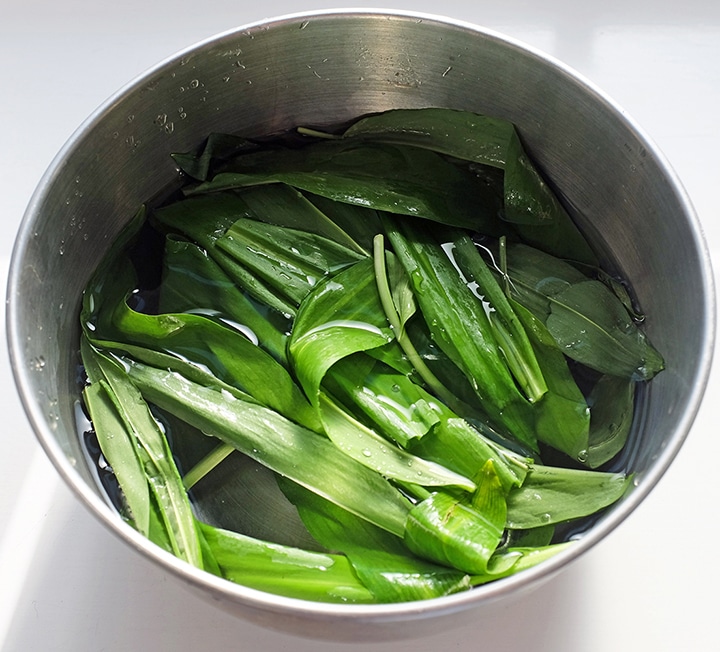
“USE RAW WILD GARLIC SPARINGLY – IT MIGHT LOOK MILD AND DELICATE, BUT BOY DOES IT PACK A PUNCH”
Image: Ed Smith
I recently realised that I’ve never really covered the question of what makes a herb a herb. That realisation struck when I was pondering whether wild garlic – or ramson, as it is otherwise known – qualifies for inclusion in this series.
As it happens, I determined well before getting too bogged down in detail that, regardless of the true definition of ‘herb’, these pungent allium leaves should be included on a matter of practicality: despite their ‘wild’ nature, we increasingly see these long, wide, pointed, vivid green leaves on the grocer shelves next to chives, coriander, mint and so on. They carry and impart an incredible flavour, and over the last few years have become an essential part of the British cook’s springtime larder.
In any event, after a spot of foraging through botanical guides and dictionaries, it’s clear that wild garlic fits technically too. A herb is defined as “any plant with leaves, seeds, or flowers used for flavouring, food, medicine, or perfume”; and “any seed-bearing plant which does not have a woody stem and dies down to the ground after flowering”. To my mind at least, wild garlic fits both of those.
Wild garlic grows in moist soil, usually under partial cover of deciduous but not yet leafy trees (often near to bluebells). The season runs from around March to May, depending where you are in the country. You’ll easily identify a patch of wild garlic as there’ll be more than a hint of garlic in the air – it’s a bit of a give-away. Moreover, towards the end of their season, a flurry of beautiful six-pronged white flowers highlights their presence.
Storage
Whether you’ve found and picked the leaves yourself, or bought them from a grocer, my advice on storage remains the same: use them as quickly as possible. Wild garlic leaves wilt in moderate heat and bruise easily too, so it’s best just to pick or buy a few of them, and in short order.
You should store the leaves in the paper or plastic bag or plastic box that you buy them in (or put them in something similar if you did the foraging). Then put them in the fridge.
I tend to then ‘refresh’ the leaves in a bowl of very cold water before using them. Or, if on the same day and I’ve space in the fridge / kitchen, I’ll cut out the middle storage process and just leave the leaves in the water until required.
Don’t bother trying to dry garlic leaves. You could, though, make an oil as per the chive oil in my previous post. Or beat into butter, roll in clingfilm and freeze until your wild garlic butter is required.
Cooking tips
There are three ways to use wild garlic in your cooking:
The first is raw as a chopped garnish. Slice finely with a knife and sprinkle is probably the best advice to give here. But use raw wild garlic sparingly – it might look mild and delicate, but boy does it pack a punch.
The second is to wilt the leaves in a little butter or oil, or very quickly blanch them. This quick application of heat mellows and rounds the flavour of the herb. It’s also my preferred way to use it – it’s so powerful when raw that you’d struggle to get through all of the garlic you’d picked or purchased if you only ate it in its fresh state.
Finally, many chefs will pickle wild garlic (called ‘ramps’ in the States), and add it as a punchy seasoning to numerous foods throughout the year.
Oh, one other thing: do use the flowers if you have them – they also carry a delightful garlicky flavour. Keep them raw and just sprinkle over your dish at the last minute; they’re not as harsh as the leaves, and they sure are pretty.
Classic uses
In terms of flavour pairings, it’s hard to say what ingredients you wouldn’t match wild garlic with (except sweet things). Basically, where normal garlic goes, wild garlic will too. That said, the likes of white fish, salmon, lamb, beef, eggs and wild mushrooms are particular fans.
It wouldn’t be correct to state that wild garlic has particular ‘classic uses’ in the same sense of many of the Mediterranean herbs covered in this series. However, well established uses and flavour combinations include:
— In a pesto, pistou or picada, obviously swapping normal garlic for the flavour in the raw leaves. You’ll see some recipes that completely substitute wild garlic for basil or parsley leaves too. But for me, this is too much. I’d keep a handful of either of those two herbs in the mix to mellow the effect of the garlic.
— As part of a sauce vierge (green sauce) mix alongside tarragon, parsley, capers, anchovy and a splash of red wine vinegar.
— Blanched at the last minute with asparagus.
— Beaten into a butter to melt over griddled beef steaks and lamb chops, or place within a wild garlic chicken kiev.
— Stirred through creamy risottos.
— Cooked in an omelette or with scrambled eggs.
Market herb hero
Any of the grocers stocking the herb – you’ll find it at Fitz Fine Foods and Turnips (and probably the other grocers too from time to time) – plus Neal’s Yard Dairy who, towards the end of the wild garlic season and then for a month or two after, may well have the wild garlic-wrapped version of Lynher Dairy’s Cornish yarg.
A recipe suggestion
Try my wild garlic & new potato frittata: because of its short shelf-life, I prefer to use as much of the wild garlic in my possession at the same time as possible, which usually means applying a bit of heat to mellow the flavour. One way to do that is to use a good bunch of the stuff in a frittata.
What it takes: foraging
Noel Fitzjohn of Fitz Fine Foods on location-spotting, constant vigilance and the menace of dogs

“LOCATION IS EVERYTHING. IF YOU WANT THE BEST PRODUCE, YOU NEED A LOCATION WITH THE IDEAL CONDITIONS FOR THE PLANT”
Interview: Viel Richardson
How did you come to be a professional forager?
When I started Fitz Fine Foods, foraging was never meant to be a major part of the business. We were making mostly pâtés and terrines, and I wanted to ensure that the ingredients we were using came from people whose methods were environmentally sensitive and sustainable. I had been foraging for myself for years, and some of that produce occasionally made it into my products. When I analysed what people were buying, the two most popular areas were our small selection of mustards and anything based on foraged plants. I decided to find a way to combine the two. That led to a range of flavoured mustards using foraged goods.
What is the key to being a successful forager?
Location is everything. If you want the best quality produce, you need to find a location with the ideal conditions for the plant. Plants can often gain a foothold in less than ideal places, but they will not be at their best, so you need to know and understand the environments in which they really flourish. Another big issue is dogs: if you forage in areas favoured by dog walkers, it is inevitable that your favourite patch will one day be used as a dog latrine. Essentially, any public land where dogs are common is off limits, so I mainly forage on private land.
Is that legal?
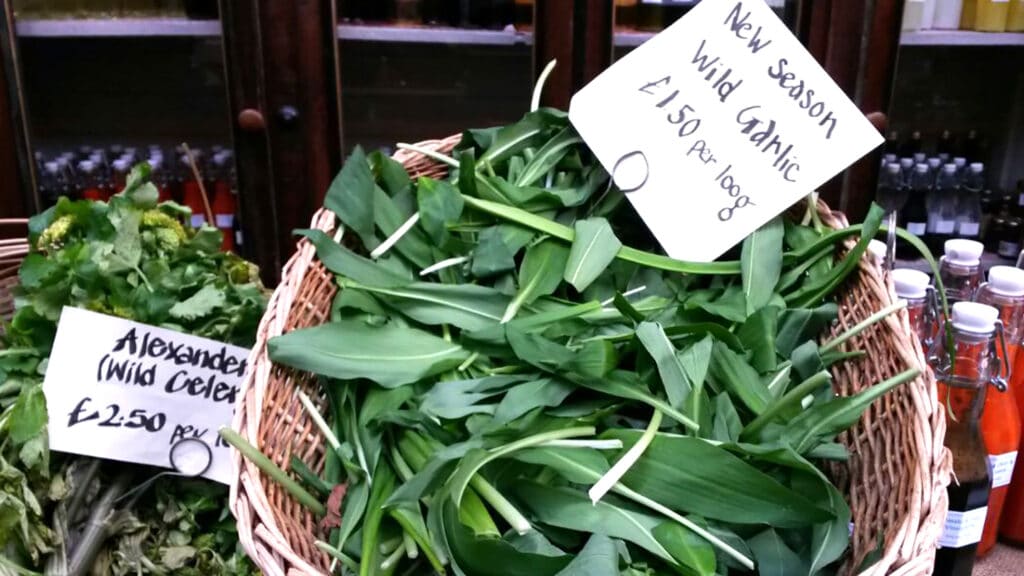
The laws around trespass and foraging have some grey areas, but from my perspective one thing is crystal clear: if you forage on private land for commercial purposes, you have to obtain the landowner’s permission. Tracking down the owner of a piece of land can be tricky, but it is absolutely essential. One place I go, which produces really wonderful wild garlic, is a private wood used for timber; the wild garlic plant is so out of control that it’s actually a real problem for the owner, so he lets me take as much as I need.
How laborious is foraging?
Anyone who has harvested plants commercially by hand will tell you it is hard work. If we take wild garlic as an example, I will gather for about three hours. That sounds a lot, but the idea is to never clear too large a patch. If you do, other plants like dog’s mercury and cuckoo-pint may colonise the area, crowding out everything else. I will clear a patch about two metres square and then move somewhere else – that way the wild garlic can recover. It is all about preserving the resource. You also have to be very observant and inspect the leaves as you harvest – while you’re not picking the leaves individually, you are glancing at each one.
What happens to the wild garlic once picked?
I wash the leaves in a large vat before inspecting them again. I then lay the leaves out to dry, before inspecting them a third time. I just want to make sure nothing else has crept in. After that, if I am going to make a mustard, I blanch the leaves like spinach; if it is for a pesto or for sale as leaves, it is left raw.
This all seems very time consuming.
Very much so. If you want to do it well, it has to be. That means that I cannot do all the foraging myself, so I do have to buy in produce from other foragers. If you’re going to stock produce that people want, you have to be able to offer it to them most of the time. They will forgive an occasional absence, but to build a stable customer base you have to offer some consistency. This is particularly relevant to me, as I make all the mustards myself, so I simply do not have the time to seek out locations, then forage and process everything I need.
How do you pick suppliers?
You do your research and assess the produce they offer. You really need to know how they operate. To give one example, some samphire pickers are paid by weight, while others are paid on quality. Lower quality, older samphire has wooden stalks in the centre, making it heavier – so if you’re paid by weight, there’s an incentive to pick the lower quality plant. You also need to make sure the suppliers are foraging sustainably. Luckily there are some very good companies out there. It is this mix of self-foraged and carefully bought produce that allows me to consistently offer high quality products.
Where do you get your recipes?
Most of them I create myself through experimentation – trial and error. To get the wild garlic pesto recipe nailed down took about three seasons of honing. There are some happy accidents. One day, some chopped-up wild garlic was left in a pot with some honey by mistake. I found it after a while, tasted it and thought it was quite nice, so tweaked the amounts and made some experimental batches – that is now a product. It turns out it takes quite some time to mature – the longer you leave it, the better it gets. If I had tried it straight away, it would have gone in the bin.
What foraged produce will be appearing as spring unfolds?
As you would expect, this is a time when a lot changes – and it can also be very unpredictable, depending on the vagaries of the weather. As our weather gets more unpredictable, you will often find things that the ‘books’ say are out of season. With the wild mushrooms, I’ll be harvesting St George’s, chicken of the woods and the scarlet elf cap, which is a really beautiful, bright red mushroom. Three cornered leeks should be making an appearance, as well as wild asparagus, marjoram and wild alexanders.