The Delia supremacy
As the Borough Market Cookbook Club comes together on 25th September to celebrate the 80th birthday of Delia Smith, Mark Riddaway pays tribute to her enduring influence on British cooking

“OTHER WRITERS DECORATED THE WALLS OF BRITAIN’S DOMESTIC CULINARY CULTURE. BUT DELIA BUILT ITS FOUNDATIONS”
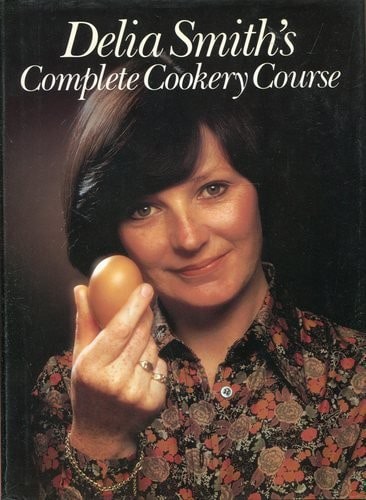
At the start of the 1980s, there were four cookbooks on my parents’ kitchen shelf: a battered family-heirloom edition of Mrs Beeton, and the three volumes of Delia Smith’s Cookery Course. I don’t think Mrs Beeton ever saw much action (hare soup and matelot of tench weren’t really the order of the day in the new towns of the M4 corridor), but those Delia books, crusted with flour and yellowed by spicy thumbprints, dictated absolutely everything that happened in that room.
Back then, Delia (whose level of fame rendered her surname completely redundant) bestrode British domestic cookery in a manner that today, in this multi-platform, multi-channel era of ours, seems completely implausible. Those three books alone – in their individual volumes, then later repackaged as a single edition – sold over six million copies. Her TV broadcasts drew audiences of a scale that today would be more representative of a World Cup semi-final or a royal death than a show about omelettes. A casual mention of an unusual ingredient or a specific item of cookware could cause an earthquake in Britain’s retail supply chains. There were, of course, others who wrote and talked about food, often much more brilliantly – the likes of Margaret Costa, Madhur Jaffrey, Claudia Roden – but while they played their part in decorating the walls of Britain’s domestic culinary culture, Delia built its foundations.
It was in 1969, as a cookery writer for the Mirror, that she began her ascent into the public consciousness. Her earliest appearances on TV came on Look East, a distinctly Partridgean regional magazine programme in East Anglia, after which, in 1973, she was offered her first solo BBC1 show, Family Fare. The Delia Supremacy began in 1978 when the first series of Delia Smith’s Cookery Course landed on BBC1 and it only really ended at the close of the millennium when Jamie Oliver began slugging olive oil around to the sounds of Toploader. Even as that new era of more kinetic TV cheffing knocked her from her pedestal, she still sold books by the bucketload – 2009’s Happy Christmas being a particularly gargantuan hit.
Her power was drawn from the convergence of several streams. Those early appearances on the screen coincided with the explosion in availability of colour televisions – as big a game-changer for TV cookery as it was for snooker. At the same time, the supermarkets, for all their many faults, were beginning to make available to the wider public wildly exotic ingredients such as pasta and chilli powder. And then there was Delia’s true genius: her realisation that, right then, an entire generation was crying out for basic instruction – and that she was exactly the right person to provide it.
People who were raising families in the 1970s had grown up in a post-war world in which food was scarce and cooking was functional. Butter was rationed until 1953, meat until 1954. Government intervention aimed at making food production efficient also made it narrow and cheerless. Imports were rare and costly. Britons of my parents’ age never really learnt to cook, because ‘cooking’ wasn’t really a thing. At school, children were taught ‘home economics’ – the single most depressing synonym imaginable, stripped of any vestige of pleasure. Bereft of choice or skill, you just ate what you had. If you had cheese, you made a sandwich. If you had vegetables, you boiled them.
Then along came Delia, with her colourful floral blouses and direct, school-teacherly manner, and slowly but surely things began to change. She presumed no foreknowledge, she judged nobody. In her generous, unpatronising tone, she offered instructions on how to poach an egg or soften a chopped onion. Then, as her audience’s confidence grew, she took on complex-sounding techniques with frightening French names, and thoroughly demystified them. And she did this not just on the telly, which rarely troubles the long-term memory, but in the books that accompanied them – a revolutionary multi-media concept.
Delia was never cool, never particularly charismatic or interesting. Serious food people often derided her utilitarian approach to cooking, her embrace of tinned vegetables, stock cubes and sliced bread. But the effect of her work was quietly radical. It was she who opened many people’s eyes to the possibilities that lay in foreign flavours, giving short shrift to the old idea that spices and garlic were disgusting and un-British. It was she who made large parts of the population aware of the very existence of bean sprouts, tahini and cranberries. Her ‘exotic’ food may have lacked for regional authenticity and cultural context, and I’m glad that I can now buy a Palestinian cookbook produced by two Palestinians and a guide to the food of the Caucasus written by a Caucasian (in the very narrowest sense of the word), but I also have no doubt that Delia’s repertoire of curries, chillies and goulashes played their part in shaping Britain’s current openness to the myriad flavours of the world. And while my mum’s chicken curry – Delia’s 1979 chicken curry, plus a few decades of subtle evolution – is no more Indian than my elbow, I still love eating it.
Looking at the front covers of those Cookery Course books, with their very of-its-time italic serif font and their strange inconsistency of cover images (a pepper grinder on part one, a pavlova on part three), gives me the strongest of Proustian rushes. It makes me think of licking a wooden spoon coated in raw cake mix, of the smell of browning meat, of my dad peeling spuds while Sports Report chuntered from the radio. It makes me think of the excitement of dinners that warranted a side of potatoes boulangere – a special Delia dish for special occasions. And it makes me grateful that, because of those books, I had the opportunity to grow up in a kitchen where cooking actually happened.
The Borough Market Cookbook Club’s Delia Smith at 80 takes place on 25th September, 10.30am – noon. Members will come together to talk about Delia ’s books and recipes, and indulge in a celebration of her work and influence.

The Delia supremacy
As the Borough Market Cookbook Club comes together on 25th September to celebrate the 80th birthday of Delia Smith, Mark Riddaway pays tribute to her enduring influence on British cooking
“SHAGGY CAP, LAWYER’S WIG, JELLY EAR, LION’S MANE: WE SHOULD APPRECIATE HOW EVOCATIVE THESE NAMES ARE”
Image: Regula Ysewijn
“Pan-fry in plenty of butter.” Are those the sweetest words in recipe writing? They just might be. They also go a long way towards explaining why mushrooms turn up in my kitchen so very often. Mushrooms, with their sponge-like qualities, enjoy little more than soaking up the glory of a melted pool of top-notch butter and, to be honest, I totally get where they’re coming from.
It’s usually in autumn that I get to thinking about mushrooms. Perhaps there’s something about kicking fallen leaves that evokes the woodiness of flavour so many mushrooms share. Perhaps it’s something not nearly so romantic and is just that autumn is when we’re used to seeing them on sale. But waiting until October – or even September – means missing out on months of fabulous fungi from the varieties that begin to appear through the summer and lend themselves just as much to the cooking of that season too. And the only foraging skills required to enjoy them are those you bring to the market stall.
Chanterelles are among the most glorious of summer-blooming mushrooms. You know the ones: a gorgeous yellow colour with a hint of apricot aroma and flavour, shaped like a trumpet, or an umbrella that has blown inside out in the summer breeze. They’re sometimes known by their French name, girolles (confusingly, in France the name ‘chanterelle’ is used for a different species of fungus), and while they are prolific growers in French woods, they also enjoy the Scottish climate and grow plentifully in the woods there too. They grow right by the trees, sharing minerals – and therefore flavour – with the tree roots. A chanterelle growing in the shadow of, say, a chestnut tree is going to take on its chestnut flavour, which means that when you come to cook it you’re going to be releasing those same chestnut notes into your food too. It’s a give and take that is fundamental to how useful mushrooms are in the kitchen.
While taking care not to toughen your chanterelles by overcooking, you might like to sauté them for omelettes or scrambled eggs; they’re great with anything in the rabbit / chicken line of things, and with shellfish too. Simplest – and summeriest – of all, try them raw, the slices tossed in a vinaigrette of walnut oil, sherry vinegar and herbs, then served with a goat’s or blue cheese.
There’s an elegance to chanterelles which I find entrancing. But I would be failing in my mushroom duty not to ’fess up that some summer mushrooms are a little bit less on the elegant side and closer instead to one of the more visually unusual characters in Dr Who – many of whom, as Dr Who fans will know, are the good guys. And so it is with these more characterful mushrooms, like the puffball.
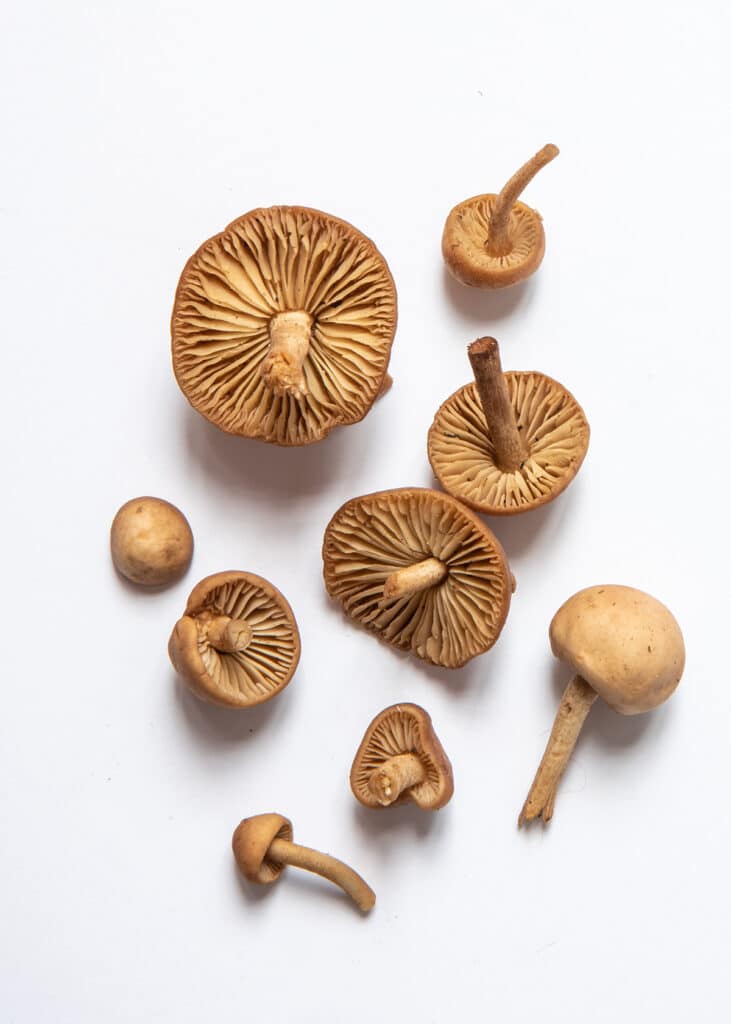
as mousserons
The name echoes the 1980s skirt-fashion I was just too young to enjoy at the time and haven’t had the guts to try since. I’m not sure I’d have the guts to try a puffball mushroom, either, if I came across one without knowing of their wonderful flavour. Round or pear shaped, growing on a short stem and covered with tiny soft spines which sometimes grow to look like little pointed warts (I did warn you), they’re best when young, firm and bright white. Ideally no bigger than 25cm or so in diameter, which is still pretty bloomin’ big. There are different varieties – some without a stem and others with a long one, some maturing into a skin that cracks into scales and flakes. And they’re all completely delicious.
Try your puffball peeled, cut into thick slices, dipped into beaten egg and breadcrumbs, then fried in butter. Griddle them like a steak. The larger ones can even be stuffed with whatever mix you fancy of cooked rice, loads of herbs, some lemon, maybe some dried fruit and spices, then wrapped in foil and baked.
Parasol mushrooms come late in the summer and look pretty much exactly as you’d imagine from the name, with a long, thin stem (which you don’t eat) topped by a broad shallow cap that opens up like, well, a parasol. The cap is covered in brown scales and according to Jane Grigson, who knew a thing or two about mushrooms, is “one of the most delicious mushrooms to eat”. Like the puffball, they can be sliced, dipped, fried, stuffed, or else cooked with bacon for the best of breakfasts.
There are still more summer mushrooms to talk about here, but let’s pause first to revel in their names. Puffball and parasol we’ve covered. Space is going to run out before I can get to shaggy cap, lawyer’s wig, jelly ear and lion’s mane, but we should appreciate how brilliantly evocative each of them is. As is the fairy ring, also known as the mousseron, which is very likely the French linguistic root of our English word mushroom. Mousserons are at the other end of the size scale to puffballs, barely 2-5cm across their cap and standing about as tall. Fairy size indeed, but not lacking in flavour whatever their stature – these are wonderful mushrooms for soups, stews, or adding into a mixed mushroom tart.
I mentioned right at the beginning that mushrooms have a sponge-like quality. It means they yearn to absorb the moisture around them and in so doing will take on flavour. Butter, yes, but also garlic, fresh herbs, wines, vermouth or marsala, vinegars: all are good for the simplest, most impactful cooking of mushrooms.
What you might notice, though, is that mushrooms can also give away a lot of moisture when they’re cooked. Sometimes too much to simply bubble off without over-cooking the mushrooms. If that happens, simply drain off the liquid – be sure, though, to reserve it for cooking with elsewhere. It will be packed with richly umami-laden flavour.
Those umami qualities are why drying mushrooms is such a good idea. It’s as easy as anything, especially with the mousserons. Just leave them on a tray overnight in a low oven and then store until you’re ready to rehydrate and bring their flavour to all manner of other dishes.
I’d always rather do that with a perhaps over-plentiful supply of good mushrooms than try to store them for too long. Mushrooms tend not to like hanging around. Somewhere cool and dry is best. In the fridge can be tricky as they are keen to absorb other smells, but if you need to then go for it using a paper bag that’s left open at the top. Never in plastic (as if you would…) as the mushrooms will sweat unpleasantly.
Really the best thing to do with mushrooms is enjoy them as soon as you have them. Throw then into simple pasta dishes. Use to stuff summer’s courgettes. Bake them into a tart or pie. Or, of course, pan-fry them in plenty of butter and pile them up on toast. You simply can’t go wrong.
Market Life issue 50
The brand-new edition of Market Life includes an interview with Elizabeth Haigh of Mei Mei, recipes from Ed Smith and Kathy Slack, a guide to the art of ham carving, a piece on the new generation of Borough Market traders, and a celebration of our award-winning magazine’s half century.
Discover more
All or nothing
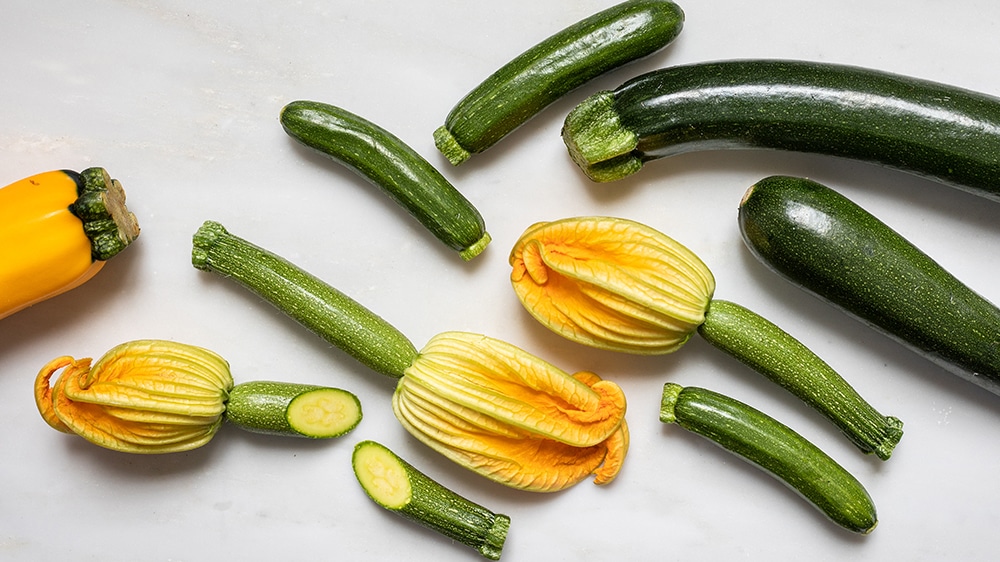
Thom Eagle on why the best approach to courgettes is to either cook them into total submission, or else leave them alone
“I THINK THAT THIS APPROACH – TO COOK VERY THOROUGHLY, IF YOU ARE GOING TO AT ALL – IS BEST FOR MOST VEGETABLES”
Images: Regula Ysewijn
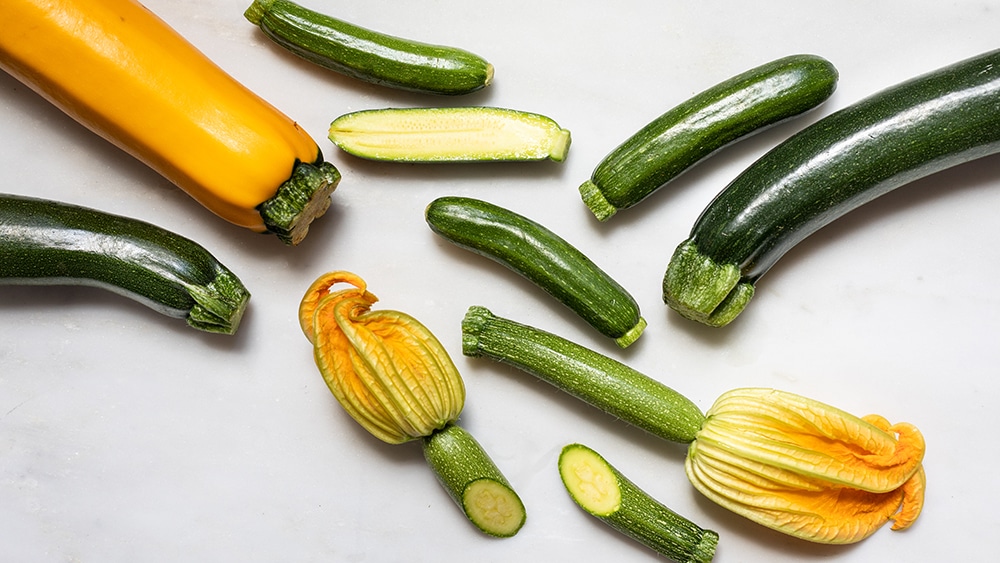
That until relatively recently this country favoured the thick-skinned bulk of the marrow over the courgette, whether in its flowering immaturity, its firm sweetness or through its juicy peak, has always struck me as peculiarly and doggedly British.
The apparent efficiency of allowing the vegetable to grow to its maximum volume, which really makes sense only when preparing for a competition at a traditional country show, is made a nonsense of when you consider that anyone who grows courgettes has, at the height of the summer season, far more than they know what to do with, and that many of the most successful recipes for them involve reducing their volume as far as possible, in an often vain attempt to make some dent in the glut. It is remarkable, if you are not used to it, how quickly vegetables grow, with the weather on their side – only a handful of days separate the fruit from the flower.
At the restaurant the other day I made a pasta sauce from romane courgettes, ridged and slightly stubbly, a couple of kilos of them grated and cooked over a high heat with olive oil and garlic in a slightly-too-small pan so they steamed more than they coloured, stirred the whole time as they gained in intensity what they lost in mass; those couple of kilos made only enough sauce to coat six people’s pasta, but the colour was bright lime and its flavour the essence of courgette.
My father makes a dish that is nothing more than thickly sliced courgettes, thinly sliced tomatoes and some form of grated cheese, all layered up together, and the tomatoes bleed their rich umami into the juices as they all braise their way into softness. Sometimes the best thing to do with vegetables is to cook them right down into total submission, and marvel at the depth of flavour – although sometimes the best thing to do is to leave them alone, at least as far as cooking goes.
If you have a lot of quite small courgettes – perhaps the bright yellow ones, but at any rate thin-skinned and very fresh – shave them all on a mandolin or with a vegetable peeler into Rizla-thin collapsing ribbons. Your boxful is now a bowlful, into which you can massage coarse salt, lemon juice, mild red pepper flakes, olive oil and mint, in that order, and leave to sit happily for an hour or so while they merge into a whole somewhere between a salad and a relish. It will sit happily alongside a very plainly roasted chicken or a fresh white cheese for a lunch or outdoor dinner that tastes of a brisk summer’s day.
On the whole, I think that this approach – to cook very thoroughly, if you are going to at all – is best for most vegetables, from the gnarled roots of winter to summer’s snappy fruits. It stems as much from the traditional British approach to greenery as it does from the more recently (for me) acquired Italian taste for braised and stewed vegetables of all kinds, preferably eased along with plenty of oil or pork fat, and perked up with anchovies, capers, olives, or just a sharp dose of lemon or vinegar – a good one, as sweet as it is sour.
It is the braising and the dressing, of course, that makes the overcooking worthwhile, allowing all the flavours to penetrate the softened flesh of your bobby bean, your aubergine, your chicory, your courgette or even your marrow; if you are going to plainly boil a vegetable it is best to err on the side of crunch, and allow texture and colour to make up for any deficiencies in flavour.

In some restaurants, summer is all about the somewhat frenetic practice of blanching and shocking green vegetables – cooking them briefly in briskly boiling salted water and then bathing them in ice to immediately stop the cooking. This is fine in the professional context of high volumes, or if there is something else you intend to do to your green beans, say, on their way to the plate, but I must admit I shudder slightly when I read articles advising cooks to do so at home.
Few things have their flavour improved by a dip in iced water, and in any case the logistics of doing so in a small kitchen – of gathering enough ice, suitably large containers, utensils to retrieve and to stir and to strain, and so on – seem to outweigh the efficiency of the operation, at least in my experience. I like my home cooking to be a little more relaxed, so I scoop my just-underdone green beans straight from the water and into the frying pan, to nestle in the garlicky oil while little twists of pasta cook in the same water; I would, in any case, never boil a courgette.
If I was disparaging earlier about the marrow, it is perhaps in memory of boiled cubes of the vegetable, overgrown, overcooked and under-seasoned, leaking the remains of their flavour into the edges of my school dinner, and the same treatment serves its younger cousin no better, even with salt and cooking time more carefully regulated; the water simply brings out its watery nature.
If you must cook your courgettes al dente then it is better to do so as near as possible to fire (though preferably not on a skewer with button mushrooms and chunks of sweet red peppers), and to let the heat and the smoke fill in the flavours that long cooking might otherwise provide. You don’t need to barbecue; I still have somewhere an old cast-iron griddle pan I acquired from my first professional kitchen on which countless slices of courgette have been striped with black, softened but still with a slight crunch, before being left to linger in lemon and oil to a warm room temperature.
A thick-bottomed pan of any kind will do the job, though, if you cut your courgettes into decent chunks – perhaps on see-sawing diagonals for a maximum of exposed flesh to caramelise and almost burn – and then coat them lightly with oil and heavily with seasoning to roll around the hot pan, kept for a minute on each cut side until they start to colour and smoke. You could pick the pieces straight out of the pan and toss them from hand to hand until cool enough to grasp between thumb and two fingers and dredge firmly through, say, taramasalata, seasoned yoghurt, or any of the pounded mixtures of nuts, spices and vegetables popular from Syria to Spain.
If you have a little more self-restraint, then tip the contents of the pan into a waiting bath, whether of vinaigrette, anchovy and tomato, or perhaps masses of thinly sliced onion, cooked gently with honey and vinegar. In any case, the point of a courgette is abundance, the expression on a plate of the generously trailing plant, so cook them in piles, and gather friends, and eat the heat of the summer.
Discover more
Cut & dried: French charcuterie
Ed Smith explores the nature of French charcuterie and explains what distinguishes this country’s cured meats from other classic European traditions
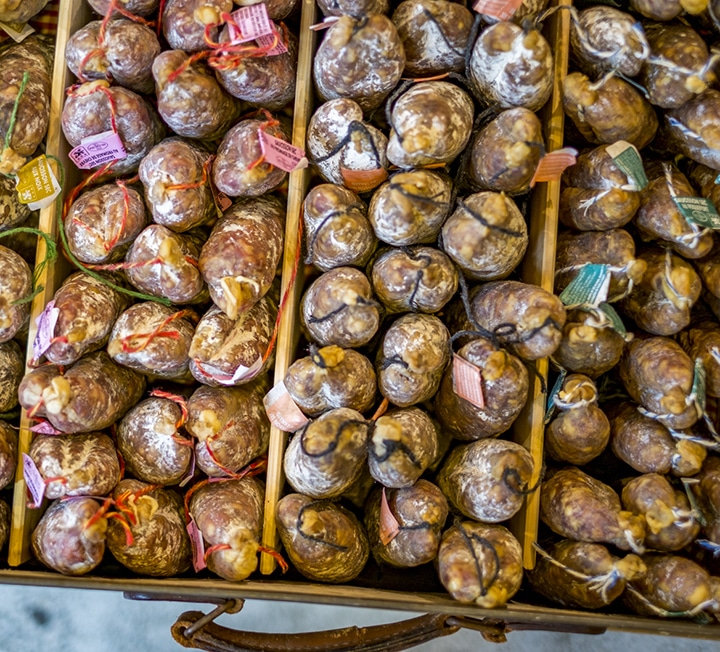
“CRUCIALLY, FRENCH CHARCUTERIE IS ABOUT PRESERVING MEAT AS A COOKED ITEM, AS WELL AS AIR-DRYING AND SMOKING”
Words: Ed Smith / Image: John Holdship
Having covered Italian salumi in some detail (see Italian salumi parts one and two), you might well ask what more there is to write on the subject, even in the context of other European countries. Whether it’s called salumi, charcuterie (French, Spanish and English), wurstwaren (German) or something else, isn’t cured meat all the same – just pork, beef or venison, salt, maybe some flavourings, and time? Answer: non.
We could, of course, go into great detail about different breeds of pigs – for example, the qualities of Iberian black pig that becomes jamon Iberico de bellota versus that of the Basque pig that’s used to make jesus du pays Basque. We might also consider the impact of climactic conditions on resulting meat products, for example areas with a warm sea breeze (such as that which is harnessed by the makers of prosciutto di San Daniele) versus cold and wet environments in Alpine regions, which tend to foster smoked rather than simply air-dried meats.
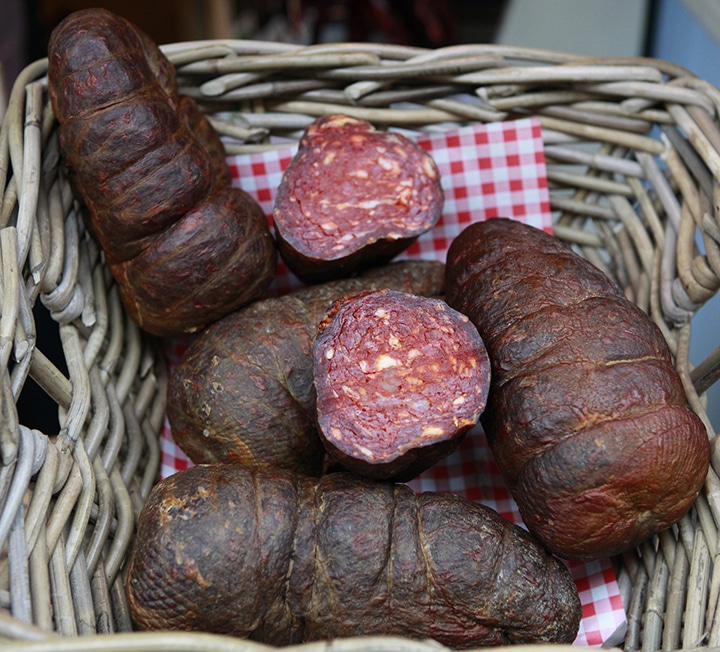
But perhaps it’s useful to take a more simplistic, bird’s-eye view. Literally: imagine walking round a French town or market, compiling a charcuterie platter, then using your phone to take a ‘flat lay’ image for Instagram. How would it look? What’s discernibly ‘French’ about it? How does it differ from something you might put together in Tuscany, southern Spain or Germany? To my mind, the thing that makes a French platter stand out is that it’s not simply a selection of air-dried meats (though saucisson and sliced muscle meats are important): in France, there’s more variety to the genre. On a French board, there’ll be some ‘soft’ charcuterie too, a pâté or terrine, maybe a big clump of rillettes.
Crucially, French charcuterie is about preserving meat as a cooked item, as well as by way of air-drying and smoking. In fact, the word charcuterie derives from ‘chair cuit’, meaning ‘cooked meat’. Long before they were licensed to sell raw sausages and smoked and air-dried meats, charcutiers were first and foremost purveyors of cooked meat products, and this tradition still impacts what the charcutiers and butchers in French villages and towns offer now.
It’s interesting that Jane Grigson’s seminal Charcuterie and French Pork Cookery barely touches on saucisson sec, let alone air-dried hams. Those items do of course exist, but it does emphasise the fact that, if you want to serve an authentic French meat board, you need to begin with the soft stuff.
Soft charcuterie at the Market
Grigson notes that the words ‘pâté’ and ‘terrine’ are used relatively interchangeably, and she tends towards suggesting that pâté is the general term to cover all types of forced or minced meats that are gently cooked, with plenty of fat and gelatinous stock, so that they last in a mould for a good few days. It’s sometimes the case that terrines are made in straight-sided, rectangular moulds, and are often relatively coarse; pâtés are smoother, sometimes mousse-like in form. But then, technically, the filling of a hand-raised pie (whether a round pork pie or something more decorative) is a pâté.
In short, don’t get too caught up in semantics. Do, instead, sample and buy some of the many pâtés on offer at The French Comte. These are coarse country pâtés, some involving apricots, based mostly on venison or boar rather than pork. Pâté seasonings and peculiarities are almost infinite and generally follow regional preferences and ingredients – one of The French Comte’s pâtés is seasoned with pine needles, reflecting the Alpine fauna of the Jura region.
A rillette is more easily defined as cooked, pulled and potted fatty meat. It tends to be pork belly sat in its own fat (or the fat of a duck or goose), though it can also apply to potted goose, duck or rabbit (also plus goose or pork fat). Le Marché du Quartier is an excellent place to head for rillettes, as is The French Comte.
Smoked and air-dried charcuterie at the Market
It’s not clear whether the French created the smallish, air-dried and sometimes smoked saucisson, but they’re both prolific and very good at making them. Any French market will have buckets of these small, often quite hard cured and dried sausages. They’re typically flavoured with black peppercorns or rosemary, or perhaps they’re quite plain. At Borough Market, Une Normande a Londres has a wondrous selection of them. Use a knife to cut discs somewhere between the thickness of a 50p and £1 coin.
Air-dried meats from the Jura
Perhaps saucissons are so prevalent in France because like the UK, before modern curing technology existed, the climactic conditions across much of the country were not particularly well suited to curing and drying large muscle meats. A small sausage could be left to dry out without going mouldy. Large hams, not so much.
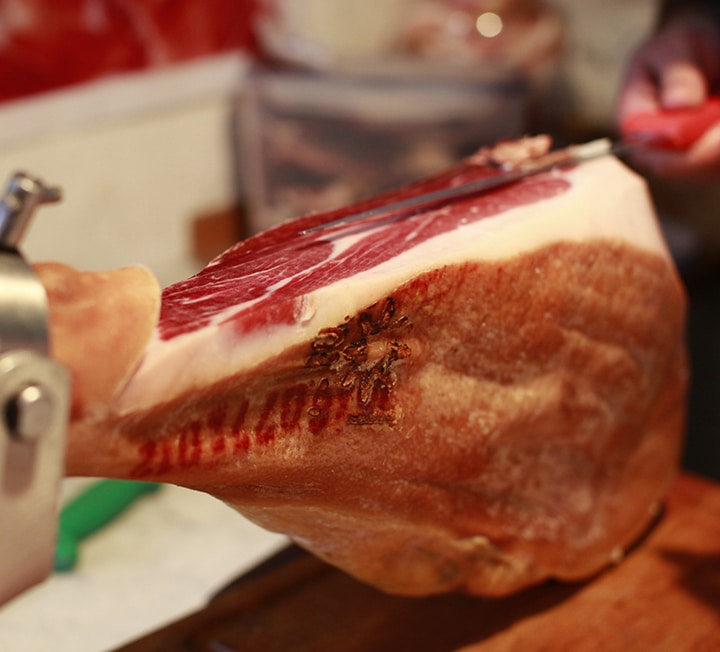
That said, there are still areas in France with a tradition of cured and air-dried meats – in particular, plenty of stellar hams such as bone-in Bayonne ham from the town of the same name in the Basque region (similar to a prosciutto); jambon de Savoie (cured with the bone-out – like a speck, although not salted); jambon de l’Ardèche and jambon de Lacaune from south-west France. Each use heritage breed pigs from specific regions and have minimum periods of maturation (usually between nine and 12 months). Those four hams are from relatively mountainous regions – again indicating that geography and climactic conditions are important in establishing curing traditions.
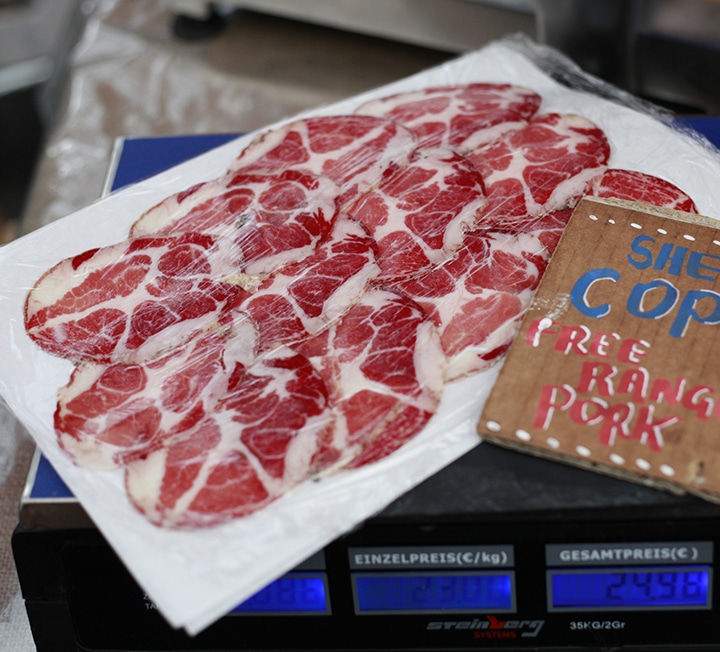
The Jura region is another environment that appears to be suited to curing, as The French Comte’s meat counter suggests. Here you can sample and buy a number of different meats, many of which are smoked, as is the region’s style. Consider, in particular, walking away with wafer thin slices of their whole hams, the smoked noix de jambon (the central muscle of a ham); some beef fillet marinated in plum brandy before being cured and dried (known as ‘tavaillon’); or dry-cured duck magret (breast), which is outstanding sliced thinly and mixed among bitter frisee lettuce leaves.
The ultimate French charcuterie board
It’s tempting to buy everything. I would suggest, however, that when it comes to putting together a charcuterie board, less is more. Select appropriate quantities (about 35-50g per person) of three different meats: one soft, one saucisson, one muscle meat. You can always come back on another occasion and put different meats into the same formation. But do always include a pile of cornichons from Borough Olives and / or turn the charcuterie board into a meal with the addition of a baguette or pain rustique from Olivier’s Bakery.
See Ed’s recipe for carottes râpées & celeriac remoulade: perfect accompaniments for French charcuterie.
The Delia supremacy
As the Borough Market Cookbook Club comes together on 25th September to celebrate the 80th birthday of Delia Smith, Mark Riddaway pays tribute to her enduring influence on British cooking
“IT IS A BEAUTIFUL THING TO SEE THE BEGINNINGS OF A CONNECTION WITH THE IRAQI PEOPLE”
Interview: Viel Richardson / Image: Adrian Pope
1. There is a definite mix in my family, with Iraqi, English and Irish in my background. Food was always a big part of growing up. I was always passionate about it, but more from the perspective of eating rather than making. I was not sat on my grandmother’s knee, soaking in her culinary knowledge.
2. The food that was cooked by my father, aunties and rest of the family was nowhere to be found outside our homes. I worked in the Square Mile before doing this and when I took leftover dolma and biryani to work, my workmates loved it. I knew that the cuisine was incredible, but to get that kind of recognition from people who were so new to it was exciting. At the time, London was going through a street food explosion and while I was out there enjoying the food, the thought that Iraqi food must have a place here was always at the back of my mind. I decided to do something about it and hosted my first supper club in 2012.
3. It was my father, who was born in Mosul, northern Iraq, who taught me to cook Iraqi food. He gave me the family recipes for dolma, stuffed onions, stuffed vine leaves and stuffed vegetables. When I tried them and they turned out really well, something just clicked. From that point on, I drove my dad mad pestering him for knowledge and recipes. He is a real “Stay out of the kitchen when I’m cooking!” cook and can have a short fuse, so having me constantly asking questions drove him crazy. But I needed to know. He came to realise that he could either give in or keep on shouting. He taught me the spice blends and the cooking techniques – the baharat blend I use is unique to our family.
4. Kubba is a real staple of Maslawi food – the food of my father’s region. It can best be described as like a filled dumpling or a croquette. They come in a variety of tastes and textures and can be boiled, fried or baked.
5. I chose kubba to be a theme of KUBBA because it is such an undeniably Iraqi food. You mention kubba to someone from Iraq and they instantly know what you are talking about. The challenge is to introduce this to people who do not know about the cuisine. I get a lot of joy and pride from explaining the dishes to new people.
6. If you say to an Iraqi someone is Maslawi, they will say, “Okay, they know how to cook.” Mosul is known within the country as a place where the food is excellent, using very delicate and intricate spicing.
7. If I were to describe the flavours of this cuisine, I would say, think Turkish or Persian but with Indian spices. We use things like black pepper, cloves, rose, cardamom, cinnamon, cumin, coriander. These are familiar spices, but it is the way they are combined and the techniques we use that give the food its unique style.
8. Juma Kitchen is quite meat-heavy, as is the custom with this food. Beef is predominant and lamb is very popular, but on the stall we have innovation as well as tradition, so I designed a mushroom kubba. It has turned out to be wonderful – even the meat lovers are asking for it sometimes.
9. Making kubba is a labour of love. Everything is handmade. There is a lot of craftsmanship and technique involved, and I want to honour that. I tell all my staff about the amount of respect we must give to each one as we make them.
10. Getting the phone call to say that I had been accepted here in the Borough Market Kitchen was wonderful. I’ll never forget that moment. It was very emotional. It is validation not just of me but of Iraq as a country. It is a beautiful thing to watch people walk away after trying our food and to see, in a very real sense, the beginnings of a connection with the Iraqi people.


The Delia supremacy
As the Borough Market Cookbook Club comes together on 25th September to celebrate the 80th birthday of Delia Smith, Mark Riddaway pays tribute to her enduring influence on British cooking
“IN THIS COUNTRY WE HAVE SOME OF THE BEST MILK IN THE WORLD – CREAMIER THAN ITALIAN MILK AND PACKED FULL OF FLAVOUR”
In many ways, making ice cream at home is tricky. It’s time-consuming and laborious, it can be more expensive than the stuff you buy from the shop, and is certainly much more difficult than dropping by the nearest gelateria. Especially if you make it without a machine.
And yet earlier this month, that is exactly what I set out to do with the help of two of Borough Market’s most respected – and patient – ice cream experts: Craig Allen, co-founder of Greedy Goat, which specialises in ice cream made using British goat’s milk, and John Marco of 3BIS Gelateria, who serves-up award-winning gelato based on a 30-year-old family recipe from Rimini.
I have to confess – it didn’t start well.
“I’m sorry, but it’s just not possible to make proper gelato or ice cream at home, unless you have an ice cream maker,” warned John. “Would I ever attempt to make ice cream at home? No, sorry, I just wouldn’t. In fact, the only tip I can give you is to avoid it altogether.” Craig wasn’t exactly brimming with enthusiasm either: “It’s so much easier with an ice cream maker – you just pour in the ingredients and it’s done in like 20 minutes.”
The technique

Fortunately, after some gentle persuasion the duo agreed to help me, inspired – I like to think – by a rant of mine bemoaning the cost of such machines and celebrating the virtues of good old elbow grease. “Okay,” said John, with a small sigh. “Let’s start with the milk and cream – both should have a decent amount of fat content, so I would always suggest whole milk and double cream. And they should always be British. In this country we have some of the best milk in the world – it’s creamier than Italian milk and is packed full of flavour, as most of the cows are grass-fed.”
Craig agreed, although his preference, unsurprisingly, was for goat’s milk. “It contains less lactose than cow’s milk, which means it can be enjoyed by many of those who are lactose intolerant,” he said. “It’s also easier to digest than cow’s milk, because the fat particles are smaller. And finally, it’s lighter and cleaner tasting, meaning you’re not left with a fatty film coating your mouth.”
If you were to freeze the milk and cream at this stage then you’d end up not with a tub of deliciously creamy ice cream but with a giant milky ice cube, which is why the second most important ingredients are eggs and sugar. The former acts as a natural emulsifier, preventing the water and fat molecules from separating, while the latter not only provides the all-important sweetness but also lowers the freezing point of the mix, ensuring it doesn’t freeze solid.
The flavourings
As for flavourings, I’ve met foodies who argue that the best ice creams are served pure and unadorned, with no need for extravagant additions – not even the faintest suggestion of vanilla. It’s an honourable idea but not one I’m willing to endorse. How can you, when faced with so many possibilities? The Greedy Goat, for example, serves more than 25 flavours on rotation, ranging from rhubarb and custard to cherry bakewell, while 3BIS offers gelato made with everything from mascarpone and figs to peanut butter and liquorice.
“Our bestseller is pistachio and this also happens to be my favourite,” said John. “But ultimately, it doesn’t matter what the flavour is – this is just personal preference. The key is sourcing the very best ingredients you can get your hands on. For example, we use pistachios from Sicily, hazelnuts from Piedmont, coconut from Sri Lanka, mango from India and strawberries from England.”
In the end I opted for Craig’s preference, earl grey tea and lemon zest. The ingredients are cheap and readily available, and this zingy flavour combination perfectly suits what is shaping-up to be one of the hottest summers in living memory.
The freeze
The initial stages of making the ice cream were surprisingly straightforward: I created a custard of milk, double cream, sugar, egg yolks and tea, which was pasteurised before being cooled and infused with fresh lemon zest. So far, so easy. The hard part, unexpectedly, was the freezing. While most recipes call for just a few hours in the freezer, my initial attempts still had the consistency of unpleasant milkshake some two days later. Not the result I was looking for.
The problem? I was using too much sugar, which was preventing the ice cream from forming large enough ice crystals. More still, the volume of ice cream I was attempting to freeze was too large, especially with a freezer struggling to hold its own in such balmy conditions. The solution was easy: in my next test batch I decreased the sugar and split the mixture between two bowls. A day later and voila, I was rewarded with a rich and velvety-smooth ice cream brimming with flavours of lemon and bergamot.
Sure, a machine might have saved me time, but what could be more important than an afternoon spent making ice cream?
Earl grey tea & lemon zest ice cream
Whisk six egg yolks vigorously in a bowl for around 5 mins and set aside. Place 250ml whole cow’s or goat’s milk, 90g icing sugar, 400ml double cream and six earl grey teabags in a heavy saucepan and heat to just before boiling point, stirring occasionally. When the milk and cream mixture reaches 80C, remove the tea bags and set them aside.
Allow the mixture to cool to room temperature before slowly stirring it into the egg yolks. Whisk until it forms a thickened custard. Add this mixture back to the pan and bring up to almost boiling point (around 80C), stirring regularly until it reaches coating consistency (thick enough to coat the back of a spoon).
Transfer the mixture into a large bowl and leave to come down to room temperature. Add the zest of a lemon and the tea bags, cover with clingfilm, and place in the fridge overnight. In the morning, remove the tea bags and decant the mixture into two shallow bowls before placing them in the freezer.
Remove the bowls from the freezer every half an hour, using a fork to whisk around the sides. This needs to be done repeatedly for the next 3 hours, or until you achieve a smooth consistency. Leave in the freezer undisturbed for at least 24 hours before serving.

The Delia supremacy
As the Borough Market Cookbook Club comes together on 25th September to celebrate the 80th birthday of Delia Smith, Mark Riddaway pays tribute to her enduring influence on British cooking
“BOROUGH MARKET ITSELF IS A WHOLE FAMILY – I’VE REALLY SEEN THAT IN ACTION”
Interviews: Clare Finney / Images: Lucy Young, Christopher L Proctor, Alice Mann
Esther Crouch on Philip Crouch, The Parma Ham and Mozzarella Stand (pictured above)
I’ve been doing the odd shift with The Parma Ham and Mozzarella Stand since I was 15 but when I was first working for my dad, I just treated him like my dad. I would be mean and snappy if I felt like it. It was only when I went and worked for someone else in a bar in Tooting that I learned to be more professional with him while at work. It was good to learn how to be in a work environment, because I think when you’re with family there is a tendency to just be how you usually are with them.
It was at the bar that I learned I can bring a really happy energy to work. My old boss told me they noticed that no matter what happened, I remained positive, which was great. I’ve since brought that to The Parma Ham and Mozzarella Stand. Dad said over the last year it’s been a saving grace that I’ve brought that attitude, while from him I have learned how to run the shop and manage people in such a way that they don’t feel like they are being managed. You don’t really realise he is telling you to do something because his approach is so natural, and he doesn’t bring his stress about margins and so on to the shop floor. I try to be like that and remember that at work, you can choose how to present yourself.
Since I’ve been here, Dad and I and my brother Jonathan, who also works in the business, have developed a good, balanced working relationship. My respect for my dad has also grown. I’ve seen how traders come to him for advice and heard how they talk about him. The Market itself is a whole family – I’ve really seen that in action.
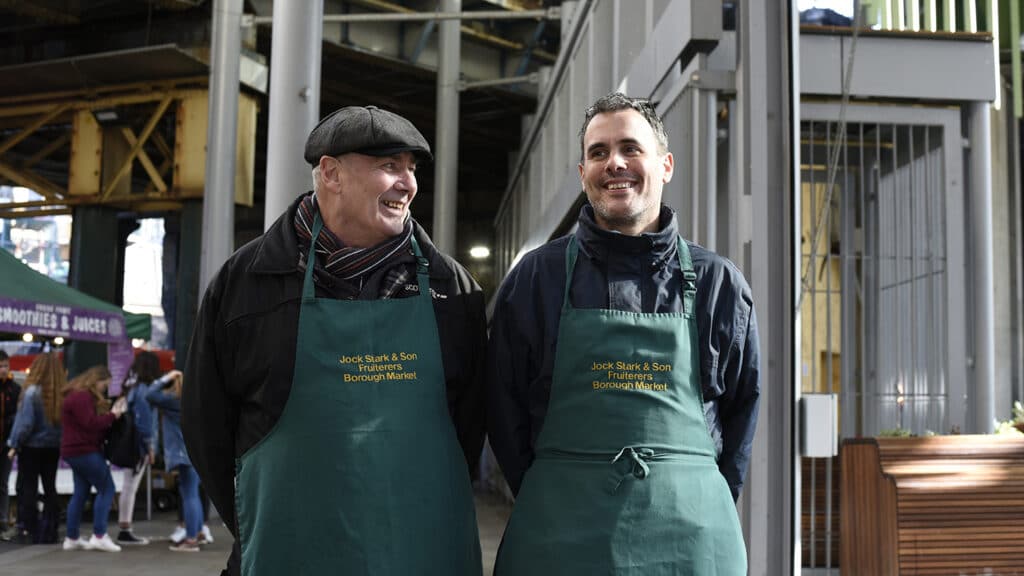
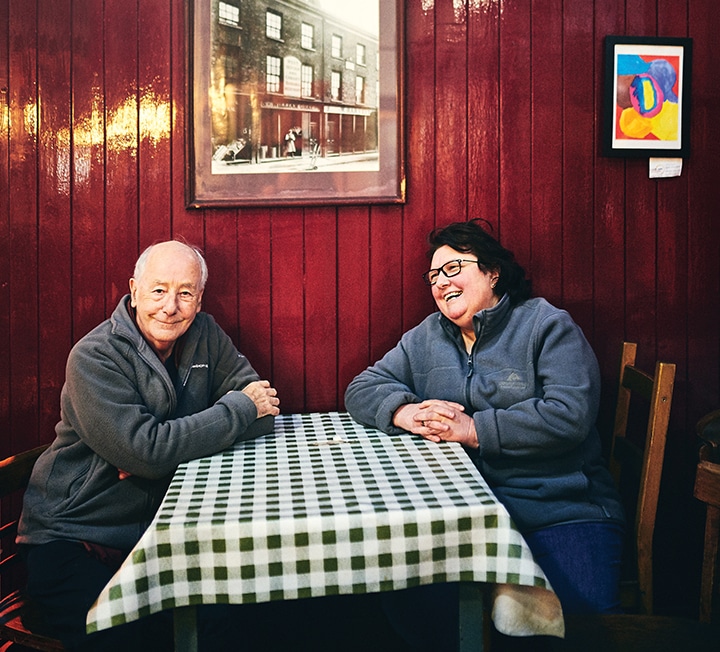
Richard Stark (right) on Jock Stark (left), Stark’s Fruiterers
My dad has had shops for as long as I can remember. I worked with him part-time all during school and then for four years after sixth form. Then I trained as a joiner and went into the building game but after 15 years, I was tired of going into the City with a big bag of tools every day. That was six days a week, this was three and I enjoyed it, so when he asked me to come and work with him full-time, it was a no-brainer. We worked together for four years, then I took over Stark’s Fruiterers when he retired.
We had our moments when we were working together – because you do, when you’re under each other’s feet all day long. Sometimes we couldn’t stand each other. I’d drive home and think, I can’t do this anymore – but we were always absolutely fine the following morning and we get on really well now that he’s retired!
The way we buy and sell is slightly different. He was more conscious of price. He’d buy a class two lemon, for example, whereas I know people love a quality Sicilian lemon and are happy to pay for it. I’ve also introduced more vegetables and did home deliveries during lockdowns. Dad was worried I wouldn’t be able to pull through this last year, but I’ve just about managed to do it.
I have to admit I have taken a lot of leaves out of his book when it comes to selling. The way dad talks to customers, talks about the produce – he doesn’t talk in order to sell but it helps, naturally. Like him, I never try to force a sale on someone. If I talk about some asparagus, it’s because it’s really nice produce and I want you to eat it and enjoy it. I’ve definitely learned from him – though when people say, “you’re just like your dad”, that really annoys me!

Dominic McCourt (right) on Jan McCourt (left), Northfield Farm
I’ve got a brother, Leo, who handles the farming side of the business. He has been orientated toward farming and meat since he came out of the womb. Leo’s first word was tractor – but I was not like that. I just kind of fell into it. I was drifting along after college, unsure what to do with myself, and dad suggested I come down to London and give butchery and selling a go.
I loved it as soon as I started. It’s been really positive, working with dad, and I’m grateful he’s given me this career. It has also been good having some independence; being based here rather than under his watchful eye at the farm! In the last few years, as he’s given me more autonomy to make decisions at the stall, we’ve undergone a transition from him being my boss to me being more like his boss. My brother and I drive the business, and we look to him for advice when we need it – mostly when we’re doing something new, like the restaurant pop-up we’ve just launched, or on financial matters. We’re good at handling product and service but he is more financially minded, so when it comes to that we look to him.
Leo and I have changed a lot over the past few years. We’ve rebranded and changed the structure of the Northfield Farm shop – but we’ve maintained dad’s principal values, the ones he started out with. Rare and traditional breeds grown slowly, that is the heartbeat of the business that dad set in motion. We are driving forward.


The Delia supremacy
As the Borough Market Cookbook Club comes together on 25th September to celebrate the 80th birthday of Delia Smith, Mark Riddaway pays tribute to her enduring influence on British cooking
“FOR THE FIRST TWO TO THREE WEEKS, THE SALTED LEMONS WILL HAVE BEEN LEFT SOMEWHERE WARM TO GENTLY FERMENT”
Images: Regula Ysewijn
When life gives us lemons, we should make lemonade. But what if those lemons have been salted?
Preserved lemons have become a relatively common sight in British cupboards and fridges as our exposure to and interest in north African food has increased. Let’s call it the Roden-Henry-Ottolenghi-Ghayour effect. That said, I bet for many of us the common sight is of a mostly full jar, untouched for several months since being unsealed for a specific recipe, and another unopened jar in the cupboard, purchased because you forgot about the open one in the fridge.
This ingredient is exactly what the name says: the result of a centuries-old process of preserving lemons through salting, for the dual benefit of avoiding the wastage of a glut and harnessing a flavour until long after the harvest is over.
They’re not simply salty, though. For the first two to three weeks after being packed into a jar, the salted lemons will have been left somewhere warm to gently ferment. In addition to making the fruit less hospitable to spoiling bacteria, this process breaks down the sugars, starches and citric acid, which is why the resulting flavour characteristics are floral and, well, lemony, as opposed to being intensely acidic and sweetly tart as fresh lemons are. Over time they also seem to develop umami – ‘the fifth taste’ – which is why preserved lemons are often described as adding ‘depth’ to recipes.
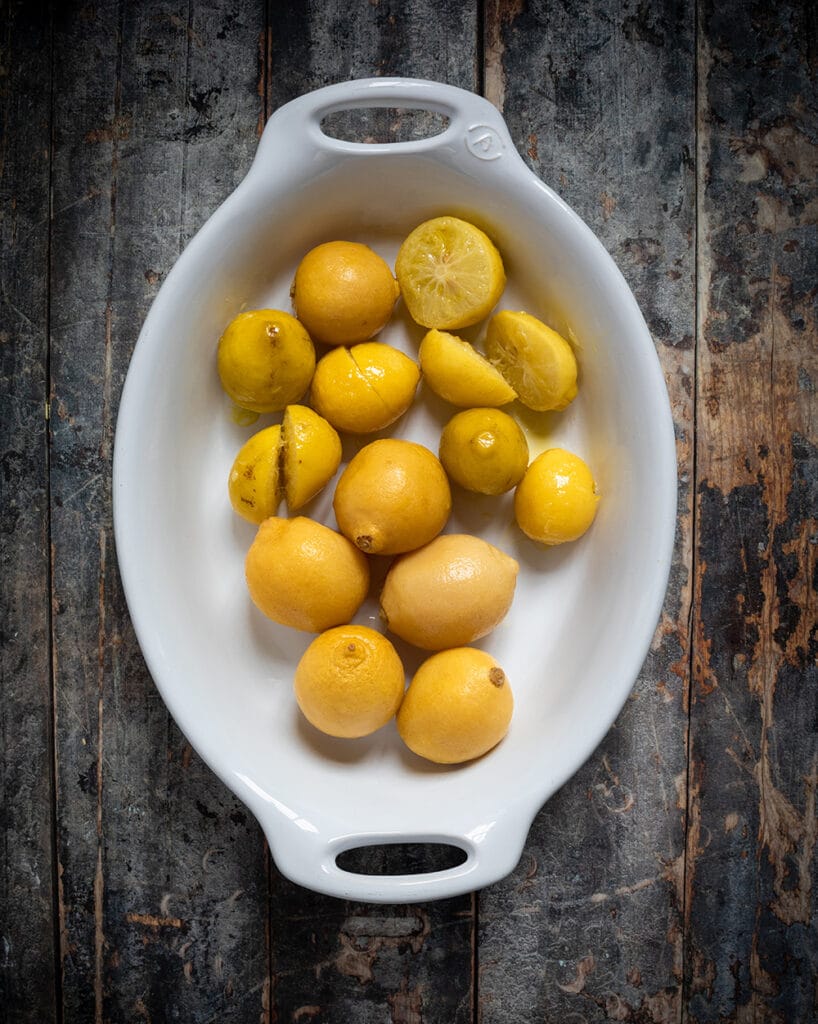
Many recipes for making preserved lemons will call for the fruits to be cut into wedges or slices, or for slits to be made and those openings to be packed with salt. For me, when the flesh has been exposed, the end product is too salty, too soapy, and some of the supposed ‘lemony flavour’ is obscured. I wonder if this particular method was developed in response to the specific fruits used, European lemons being particularly large with a thick layer of pith. I think the more interesting and indeed more palatable preserved lemons are still whole, made from fairly small and thin-skinned fruit. The Moroccan variety stocked by Fitz Fine Foods is a good example, and Arabica’s baby Egyptian lemons are even cuter (as the name suggests).
Anyway, back to how to use them. It hardly needs to be said that preserved lemons are a vital flavouring in many north African and Middle Eastern-inspired tagines, stews and tray bakes. Perhaps the main thing worth noting in this context is that the lemons can be used in different ways to different effect – try, for example, seasoning a dish by just popping a lemon in whole (as you might a stick of cinnamon or bay leaf), rather than slicing or dicing. If you’ve also got a rogue bunch of coriander to hand, consider harnessing the two bold flavours, along with garlic and chilli, to create a marinade known as chermoula. It’s particularly good with fish. Again, though, perhaps this north African relish was the reason you bought that underused jar to begin with.
For more spontaneous moments, you can use preserved lemons in many of the situations that you might consider adding a little fresh zest and juice. Scrape out the flesh and chop up the pith before stirring the lemons into lentils, couscous, barley, spelt or wheatberries; add dices or slices to mixes of minced lamb or spinach and feta and stuff into a filo-shrouded parcel or pie; use as the aromatic base for a herby sauce or salsa to embellish chicken, beef, white fish or fresh cheeses like burrata, soft goat’s cheese and baked ricotta.
Preserved lemon immediately transports familiar accompaniments to an exotic place. That said, I actually think that the best results come when the preserved lemons supplement rather than replace fresh lemons – the flavour profile that you get by using both is most alluring. One final thing: consider making Vietnamese chanh muôiI. Add a wedge of salted lemon to a glass, muddle with a spoon and top with soda water and ice. Ladies and gentlemen, when life gives you preserved lemons, make preserved lemon lemonade.
Edible Histories: the tomato
In an extract from his Fortnum & Mason Food & Drink Awards shortlisted book, Borough Market: Edible Histories, Mark Riddaway explores why the British spent hundreds of years ignoring the tomato
“AN ENGLISH DICTIONARY PUBLISHED IN 1677 DESCRIBED THE TOMATO AS ‘A SPANISH ROOT OF A COLOUR NEAR VIOLET’”
In his book Borough Market: Edible Histories, Mark Riddaway tells the epic tales of some of the everyday ingredients found on Borough Market’s stalls. This extract from the chapter on the tomato offers a taste of the surprising stories found within.
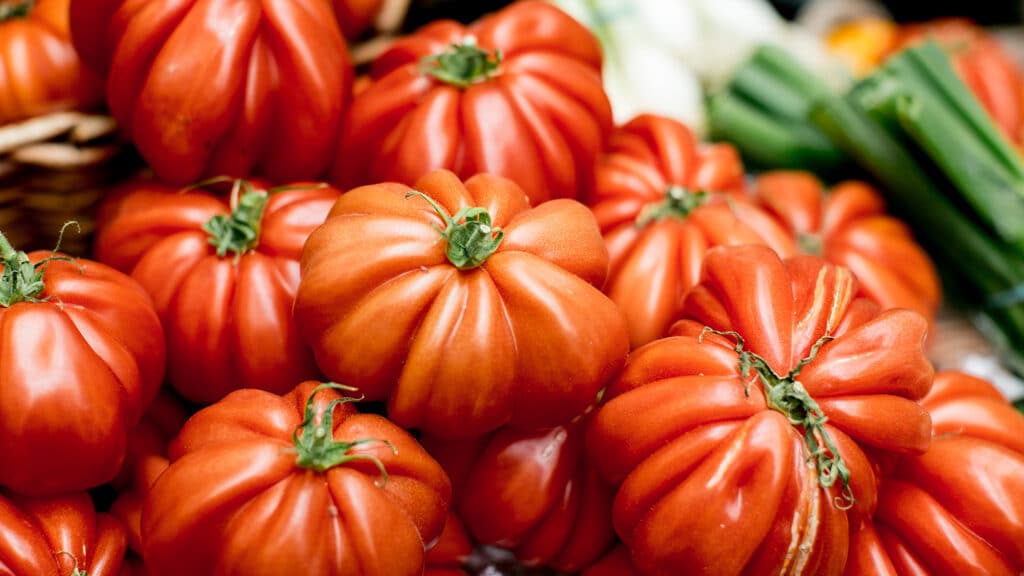
Much of what we know about the tomato’s early cultivation in Europe after it was brought across the Atlantic from its Mexican homeland can be found in the writings of the continent’s burgeoning community of herbalists, and their responses to this oddest of fruits were almost uniformly wary.
The earliest substantial reference to the tomato’s presence in Europe was penned by the Italian herbalist Pietro Andrea Mattioli in his Discorsi (1544). Mattioli suggested that this exotic new fruit, which he deemed it unnecessary to name, was a new species of aubergine – itself a fairly recent arrival, having migrated from Asia following the Arab invasions of Spain and Sicily. He wrote: “Another species has been brought to Italy in our time, flattened like the ‘mele rose’ [a variety of apple] and segmented, green at first and when ripe of a golden colour.” It was “eaten in the same manner” as the aubergine: fried in oil and seasoned with salt and pepper.
Ten years later, in a revision to his book, Mattioli alighted upon a name: ‘pomo d’oro’, meaning ‘golden apple’, later established in Italian as ‘pomodoro’. That same year, 1554, the Flemish physician Rembert Dodoens published both a woodcut picture of a tomato and a stark warning to anyone thinking that Mattioli’s fried, seasoned tomato slices sounded nice: “This is a strange plant and not found in this country except in the gardens of some herbalists, where it is sown … the complexion, nature and working of this plant is not yet known, but by that I can gather of the taste, it should be cold of nature, especially in the leaves, somewhat like unto the mandrake, and therefore also it is dangerous to be used.”
According to the enduring Galenic theory of ‘humours’ – a classical philosophy named after Galen, a 2nd century Greco-Roman physician – all plants offered a blend of four inherent ‘qualities’: hot, cold, moist and dry. Eating them could be either beneficial or dangerous, depending upon the current state of your body’s four humours (blood, yellow bile, black bile and phlegm), an imbalance of which would lead inevitably to illness. Tomatoes were deemed to be moist and extremely cold – according to Gerard, “perhaps in the highest degree of coldness” – which could be highly problematic. The consumption of a cold, moist food would, it was believed, be likely to result in a dangerous excess of phlegm, particularly in cold, damp countries like this one, where people were considered naturally phlegmatic and hot-bloodedness was rare.
As a result, most writers deemed the tomato to be corruptive. In England, a book from 1600 warned that “the fruit being eaten provoketh loathing and vomiting”, a result more commonly associated today with the late-night doner kebab. The Venetian botanist Pietro Antonio Michiel insisted that a tomato’s smell alone could cause eye diseases and headaches, while the physician Giovanni Domenico Sala, writing in 1628, called them “strange and horrible things” that only “a few unwise people” were willing to eat.
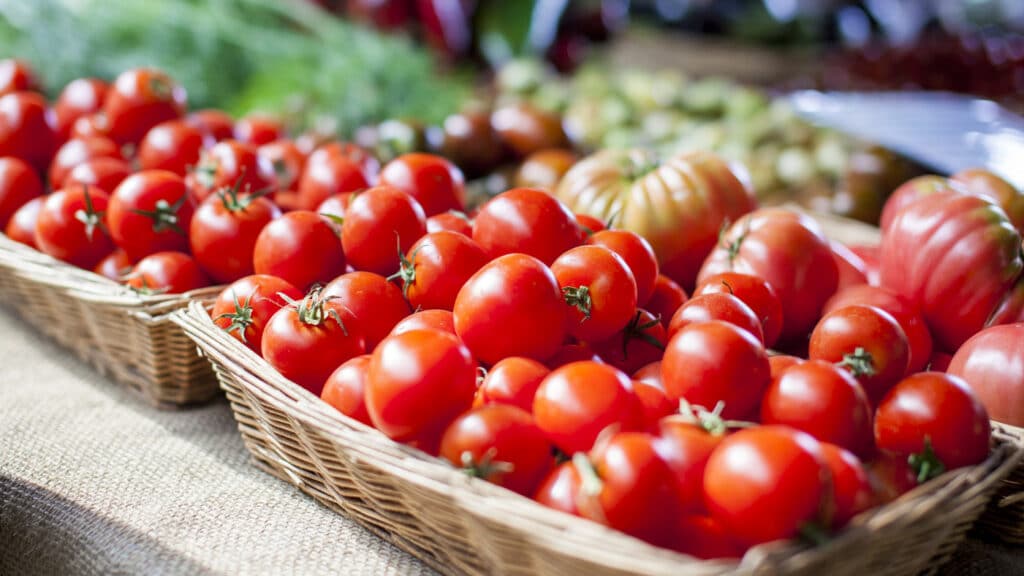
Humours aside, this reticence is easy to understand. Tomatoes were both foreign – although contemporary writers were highly confused as to their origins: Peru? India? Spain? – and odd. They didn’t look or taste like anything a European had seen before, and they probably didn’t taste anything like as good as they do now, after centuries of selective breeding. Their association with the aubergine didn’t help – known as the ‘mala insana’ (‘mad apple’), the aubergine was, wrote Michiel, “harmful to the head”, so being categorised alongside it was far from a compliment. Plus, the leaves and stems have an unusually strong smell and are indeed mildly toxic. Applied externally, the juice of the tomato was thought to be effective for the treatment of scabies or burns, but when it came to using the fruit for food, the consensus was solid: steer clear.
Largely because it was known in some places as the love apple (‘pomme d’amour’ in French), it is often stated that the tomato was considered an aphrodisiac – and some herbals of the time do allude to this reputation – but there is little evidence of this having had any practical consequences (indeed, ‘cold’ foods were considered passion killers, not a source of ardour). No one was eating tomatoes in the hope of a night of passion. In fact, people weren’t even eating them in the hope of a nice salad. Across most of Europe, the tomato grew widely in botanical gardens, but rarely found its way into the kitchen.
Italy and Spain, though, were different – southern Italy, in particular, where people were traditionally less averse to the consumption of vegetables than, for example, the meat-obsessed English, who considered plants the lowest form of sustenance. The influence of Spain, which ruled the kingdoms of Naples, Sicily and Sardinia for a large part of the early modern period, was also marked, making the region fertile ground – in every sense – for the Spanish conquistadores’ New World discoveries. By the end of the 17th century, Antonio Latini, chef to a noble household in Naples, was happily using tomatoes in the palace kitchen without any concern for the resulting levels of phlegm production. Latini’s book, Lo Scalco alla Moderna, published in the 1690s, included a sauce of tomato, chilli, thyme, salt, oil and vinegar, a dish of sautéed aubergine, onion, squash and tomato, and ‘cassuola di pomadoro’, in which roasted tomatoes were added to a stew of pigeon, veal, chicken necks, herbs, eggs and lemon juice. Oh, and for real savoury depth, some testicles. Two of Latini’s recipes referred to the tomato as being of the ‘Spanish style’ – an indication that the use of this fruit still felt a little foreign, even in its new heartland.
It was in the works of another Neapolitan chef, writing around a century later, that southern Italian cuisine could be seen to be truly taking the tomato to its bosom. Vincenzo Corrado’s famous book Il Cuoco Galante (1773) began to define a type of cooking now inexorably linked with the Mediterranean – simple and balanced, packed with olive oil and vegetables. The tomato featured heavily, and in very recognisable ways: a tomato soup, topped with basil, thyme and parsley; a tomato sauce flavoured with chilli, garlic, pennyroyal and rue; a dish of whole baked tomatoes stuffed with anchovies, garlic and herbs and topped with golden breadcrumbs. This latter dish Corrado called ‘pomidori alla Napolitana’ (‘Neapolitan-style tomatoes’) – by then, no mention of Spain was required.
Spain had been the first port of call for the tomato plant on its long journey to European ubiquity, but at first its fruit made very little impression on the historical record beyond a few dull lines of household admin and some mundane still-life paintings. Slowly and with very little fanfare, though, the tomato would become an important part of the Iberian diet, particularly in the south. In 1784, the Spanish botanist José Quer y Martínez described how tomatoes were “cultivated in great abundance on the truck farms and irrigated fields in all the provinces and lands of our peninsula” and explained that in the south they could be enjoyed almost all year round, so early did their fruiting begin. Quer wrote of their use as a light breakfast for the field workers of La Mancha and Valencia and as a supper dish of the poor, “who get fat and strong in the tomato season”, but he also waxed lyrical about their use in “sumptuous and delicate dishes” enjoyed by the rich, “seasoning the most delightful foods and forming a delicious sauce”. He dismissed the health concerns expressed by “those in the north”, noting that “the experience in our peninsula” showed such worries to be baseless: “Certainly in Spain they are not harmful and are used by the rich and the poor, and neither the former who eat them because they like them nor the latter who eat them out of necessity have suffered the slightest detriment to their health.”
Gradually, the appeal of the tomato spread northwards, to northern Italy and southern France. “One also begins to find in Lombardy a fruit that is common in Rome, and which is slightly known in Paris,” wrote one late-18th century French visitor to Italy, while a French dictionary of agriculture from 1789 proclaimed: “In Italy, in Spain, in Provence, and in Languedoc, the fruit of the tomato is very much sought after.” Of any loathing or vomiting, not a mention was made.
For a while, the Brits remained stubbornly unimpressed. In 1673, the English naturalist John Ray, who travelled widely in Italy, included the “love apple” in a list of the “many fruits they [Italians] eat, which either we have not, or eat not in England” – these also included the aubergine and carob, which, according to Ray, the English considered “fitter meat for swine than men”. Demonstrating just how alien the tomato remained, an English dictionary of ‘difficult terms’, published in 1677, described the ‘love apple’ as “a Spanish root of a colour near violet”. Other than it not really being Spanish, or a root, or violet, this was extremely useful information.
Eliza Smith’s hugely popular The Compleat Housewife (1727) contained no mention of tomatoes, while Hannah Glasse, another pioneer of English cookery writing, included tomatoes in just one of her hundreds of recipes. Published in 1758 and entitled ‘to dress haddocks the Spanish way’, this involved cooking the fish with spices, garlic, vinegar and “some love apples, when in season”. And yet, just a few decades later, the 1797 edition of the Encyclopaedia Britannica stated: “The tomato is in daily use, being either boiled in soups or broths, or served up boiled as garnishes to flesh and meats.” As the fruit became more widely dispersed – and the dodgy foundations of classical medicine became increasingly undermined by the progress of science – the dam was finally breaking.
In 1837, a new edition of The Cook and Housewife’s Manual, written by the Scottish journalist and novelist Christian Isobel Johnstone under the pseudonym Margaret Dods, included a short addition to the chapter on vegetables and roots, which hadn’t been present in her original 1826 version. It stated of tomatoes: “These have gone down in France, but are just (like other fashions) coming into vogue among us. Tomatas are used both in sauces and soup, and pickled.” Eight years later, Eliza Acton’s masterpiece of Victorian food writing Modern Cookery (1845) came stacked full of tomato-based recipes, the quantity and breezy nature of which reflected a fruit whose use would by now be far from unsettling to readers.
Acton recorded two recipes for tomato sauce – one “common”, one “finer” – which she listed among the “appropriate tureen sauces” for beef steaks, broiled oxtail and “all roasts of pork, except a sucking pig”. She added tomatoes to curries, roasted them (an excellent garnish for leg of mutton, she suggested), stewed them, and turned them into a creamy puree to be served with meat. She provided two recipes for “forced tomatas” – stuffed tomatoes – one English, one French, the English one suitably plain and modest (a stuffing of tomato pulp, bread and butter and some optional mushrooms), the French one involving a far more elaborate merging of ingredients, including ham, breadcrumbs and egg yolk. Oh, and for that authentic Gallic edge, garlic, which, Acton warned, “if added at all, should be parboiled first, as its strong flavour, combined with that of the eschalots, would scarcely suit the general taste”. Tomatoes may have become an acceptable foodstuff, but some foreign flavours remained firmly beyond the pale.
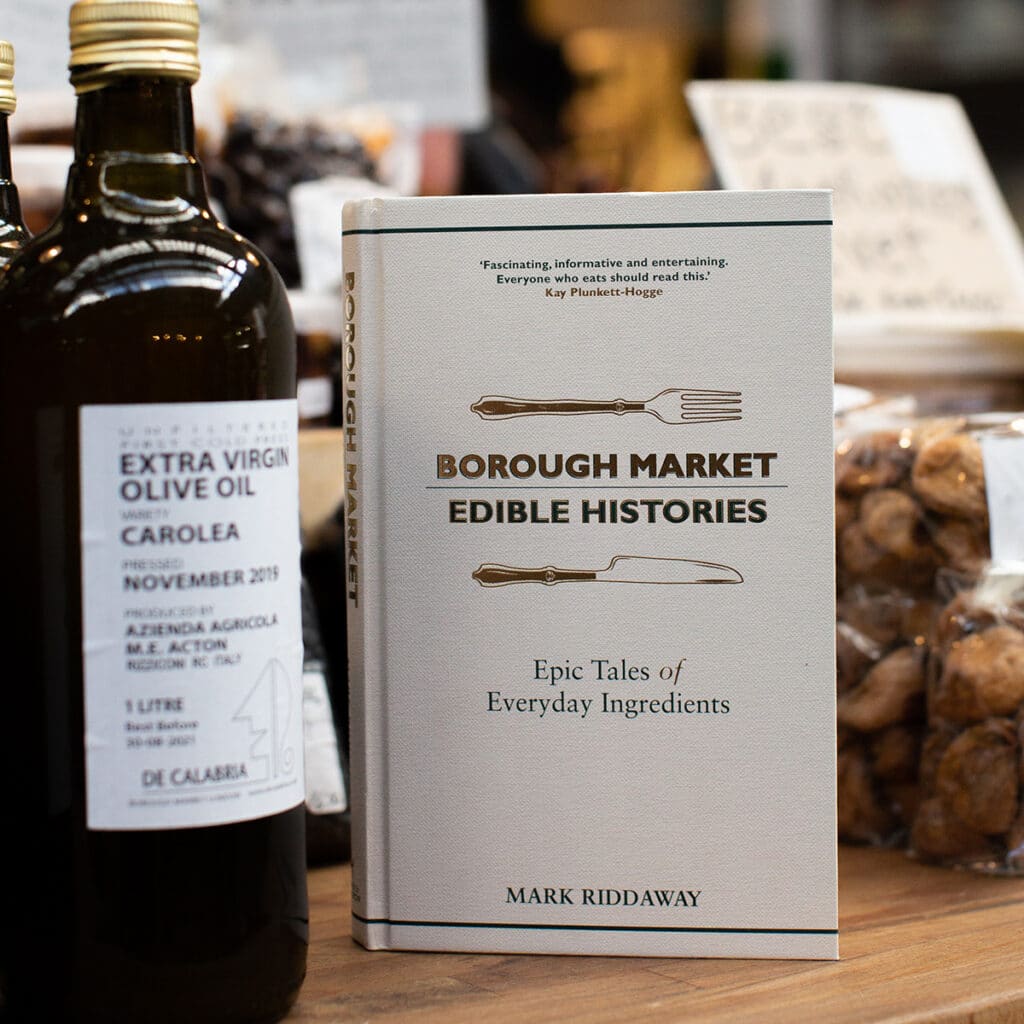
Borough Market: Edible Histories by Mark Riddaway (Hodder & Stoughton) is available now from The Borough Market Store, in bookshops and online.
Discover more

The Delia supremacy
As the Borough Market Cookbook Club comes together on 25th September to celebrate the 80th birthday of Delia Smith, Mark Riddaway pays tribute to her enduring influence on British cooking
“THERE ARE ONLY THREE STIGMAS PER FLOWER, AND THEY MUST BE CAREFULLY PICKED ON THE FIRST MORNING THAT FLOWER BLOOMS”
These are two flavours that immediately bring to mind the heady tastes and indeed colours of the Levant. One, saffron, has been with us in the UK since the Middle Ages (and is even grown here). The other, sumac, is relatively new to these shores, but is set to become an essential component of every spice drawer, if it isn’t already.
Sumac
Technically, there are multiple varieties of the sumac bush, some of them poisonous, but we should side-step that detail and keep this simple.
As far as we’re concerned, the red, flaky powder you see on the shelves has been ground from the sun-dried (and very edible) sumac berries. It’s a spice that has been used as a condiment in Middle Eastern cooking for centuries, and one that has gained traction in the UK since Claudia Roden and Yotam Ottolenghi began to make Levantine cuisine a dinner party staple.
The first thing you think of when dabbing sumac to your lips is lemon, though it’s arguably more like a sharp apple – there’s a mellow, rounded acidity that enlivens anything it is sprinkled on or run through. It’s a cracking addition to food aesthetically too, as the flakes leave a bold red-maroon colour trail wherever they’re scattered.
Not all ground sumac is created equal; once you’ve tasted a particularly potent version, you’ll know what I mean. Thankfully, the sumac sold at Spice Mountain and Arabica is of excellent quality.
Generally, sumac comes in flaky powder form, which, as with most of the ground spices in this series, lasts reasonably well for six to 12 months in an airtight container. It’s sometimes possible to pick up branches of whole sumac berries, which could be reconstituted, crushed lightly and the juice used in stews or sauces.
Some recipes will call for sumac to be used in a marinade. It has most impact, though, when sprinkled liberally as a condiment at the end of the cooking process. Sumac can also be mixed with olive oil or yoghurt to create a ruby coloured slick of flavour, again to lash your food with just before eating.
In countries like Lebanon, Israel, Turkey and Iran, sumac is as common on home tables as salt and pepper are on ours. I wouldn’t be surprised if, in 20 years’ time, there’ll be pinch pots of it at most meal times over here too.
Saffron
We know, of course, that saffron is one of the most expensive, if not the most expensive spice per gram. Have you given thought to why that is?
Those orangey-red threads are the stigma of the crocus sativus. There are only three stigmas per flower, and they must be carefully picked on the first morning that flower blooms, before the flower wilts, or rains or frost ruin the crop. Moreover, before the stigmas are picked, each flower needs to be bred and nurtured by human hand, and the drying and storing process appears to be just as labour intensive and time consuming. It’s perhaps no surprise to read in John O’Connell’s The Book of Spice, that it takes around 150 flowers to produce a gram of saffron.
Saffron was originally cultivated in Kashmir, and that remains a region famous for the spice. Iran now dominates with over 90 per cent of production. But other countries are in on the act as well, not least Spain and Greece. There’s even a boutique industry in Essex too – Saffron Walden (of course!) is historically famed for growing and harvesting the right type of iris.
Why all the fuss? Saffron would not be such a highly priced spice were it not for its prized flavour. The delicate threads emit complex notes of honey, dried meadow grass and bittersweet flowers. I have to say, I also get toilet cleaner on the nose and a metallic tinny taste when saffron dominates rather than supports (which is much of the time). But perhaps that’s just me.
This spice requires a liquid to make the most of its flavour – in contrast to sumac, saffron is not for sprinkling over dry food at the last minute. The Persians, probably the original users of the flavour, have it right when they temper a few threads for at least 15 minutes in a spoonful of boiling water, before adding it to their dish (often rice, but also stews).
There are a number of places to buy saffron in the Market. Spice Mountain stocks both Iranian and Kashmiri crocuses. Oliveology has a Greek variety, and Brindisa has saffron from La Mancha, Spain. I suspect most packs you have include a ‘best before’ date on them. Of course, these things are best used relatively quickly, though I’ve found old threads seem to come back to life using the boiling method. And this is one spice that I wouldn’t chuck out in a spring clean.
Culinary uses
Sumac brightens many savoury flavours. Expect, though, to see it sprinkled over lamb or chicken, hummus, yoghurt-based dips, fennel or onions, or added to anything where there’s already lemon or oranges involved, thereby added a more complex layer of acidity. It’s a wonderful addition to already well-oiled or buttered hot bread.
Sumac is a vital part of the za’atar spice mix, which also features sesame seeds, dried thyme and sometimes oregano and salt. Again, this is generally used as a condiment, sprinkled with abandon over meats, vegetables and fish, or mixed into olive oil to use as a dip for bread.
We associate sumac with Middle Eastern cooking and indeed most of the classic uses stem from this. One of my favourite dishes involving sumac comes from Turkish grills, where onions are burnt but still retain a little crispness, and are then dressed with pomegranate molasses, loads of sumac and parsley. It’s savoury, sweet and sour all at the same time. Sumac also adds a great deal to fattoush, that Levantine bread and parsley salad which should be tart enough to make your lips pucker. And I wonder whether it might also be used on sweet dishes too?
There are some key ingredient and flavour pairings for saffron that are worth remembering – if you’ve spent your pocket money on a little pack, you should use the threads wisely. In The Flavour Thesaurus, Niki Segnit mentions that saffron goes well with almonds, anise (think fennel), cauliflower, chicken, white fish, orange, potatoes, rosewater and shellfish. I agree with all of that.
Classic dishes using saffron all stem from the spice route, and quite probably all derived from Persian cuisine. So a tah-dig, that crisp-bottomed Persian rice, and other pilafs may have prompted Italian traders to create the Milanese risotto, which is served underneath yielding veal shin. Other rice-based dishes such as Spanish paella and Indian biryanis take their signature colour and aroma from just a few threads of saffron, and could well have taken their lead from the tah-dig.
Spanish seafood stews often have a hint of saffron in them. As does a proper bouillabaisse from Marseille, France. And we see saffron employed in many classic baked and sweet recipes too – loaves enriched with milk and saffron, saffron and almond cakes, and numerous ice creams and dairy based puddings and drinks.
We should also mention Cornish saffron cake / bread, a historic product, which shows that this spice has been used in the UK for centuries.
Market spice heroes
It’s hard to look past Arabica when it comes to sumac. James Walters has been trading at Borough for over 15 years, with sumac to the fore, and it continues to be sprinkled as a condiment over many of the restaurant’s dishes.
As mentioned above, you can buy a variety of different types of saffron at the Market. But look also for products that use the crocuses to great effect – like Brindisa’s saffron mayonnaise, which is excellent when dolloped next to lobster, or perhaps onto garlicky toasts sitting atop of a fish and clam stew.
Specific recipes to look out for
Any well-used Spanish or Middle Eastern cookbook will be stained with saffron. Great recipes from my collection include:
— The picada and the fishermen’s stew it flavours in Monika Linton’s encyclopedic Brindisa: The True Food of Spain.
— I love Sabrina Ghayour’s saffron chick, fennel and barbary stew in Persiana
— Sumaya Usmani utilises saffron in many of her recipes in Summers Under the Tamarind Tree. From the savoury (nutty saffron rice), to the sweet (saffron bread pudding and saffron halva).
— Yoghurt, a little water and icing sugar makes a bright yellow yet mellowing drink.
— And back to Spain: In The Food of Spain, saffron gives both name and flavour to Claudia Roden’s Malagan pescado en amarillo.
Although you’ll find that it’s mostly just suggested as a condiment or seasoning, sumac crops up in some lovely recipes too:
— Along with Claudia Roden, we probably have Yotam Ottolenghi to thank for the prevalence of sumac on our shelves, now. His version of Palestinan m’sakhan in Ottolenghi: The Cookbook is probably the place to start for a classic roast chicken with sumac, za’atar and lemon.
— Also note the sour cream and sumac sauce that goes with the same food writer’s turkey and courgette burgers in Jerusalem.
— Check out the use of sumac-macerated onions in a mackerel baguette in Rick Stein’s From Venice to Istanbul.
See Ed’s recipe for my sumac & hazelnut meringues.